
Many Australian business owners believe AI automation will instantly slash costs and boost efficiency. Yet 70% of agentic AI projects fail with delays and overruns. The gap between expectation and reality stems from misunderstanding how AI-driven automation works and what it demands from your organisation. This article cuts through the hype to reveal practical strategies for harnessing AI automation effectively, tailored to your efficiency goals and cost reduction targets, so you can avoid costly mistakes and achieve measurable operational gains.
Table of Contents
- Key takeaways
- What is AI-driven automation and why does it matter for your business?
- Common pitfalls and risks in AI automation projects
- How to tailor AI-driven automation to your business goals for better ROI
- Measuring success and staying agile with AI automation
- Explore tailored AI automation solutions for your industry
- FAQ
Key Takeaways
| Point | Details |
|---|---|
| AI automation limits | Recognise AI driven automation has limits and requires ongoing monitoring to deliver measurable gains. |
| Tailor to goals | Tailor automation to your efficiency and cost reduction targets to avoid wasted investment. |
| Human augmentation wins | In many business scenarios human augmentation outperforms full automation in terms of reliability and adaptability. |
| Monitor AI risks | Ongoing monitoring helps catch errors and drift as business conditions change. |
| ROI benchmarks | Use realistic ROI targets to set achievable expectations and guide phased implementations. |
What is AI-driven automation and why does it matter for your business?
AI-driven automation differs fundamentally from traditional rule-based systems. Where conventional automation follows fixed scripts, AI-driven automation leverages machine learning models to handle complex, variable tasks that previously required human judgement. These systems learn from patterns in data rather than executing predetermined instructions, enabling them to process unstructured information like customer emails, invoices, or inventory forecasts.
For Australian businesses, this capability opens doors to operational improvements that traditional automation cannot touch. Machine learning models can classify documents, predict customer behaviour, optimise scheduling, and respond to queries with natural language understanding. The technology encompasses various approaches including supervised learning for classification tasks, natural language processing for text analysis, and computer vision for image recognition.
Common applications transforming Australian operations include:
- Automated data entry from invoices and receipts, eliminating manual keying
- Customer service chatbots handling routine enquiries 24/7
- Predictive maintenance scheduling based on equipment sensor data
- Demand forecasting that adjusts inventory levels dynamically
- Document classification and routing for compliance workflows
The business case centres on cost reduction and efficiency gains. AI automation in professional services can process documents 10 times faster than manual methods while reducing error rates. Yet AI automation introduces unique challenges absent from traditional systems. Machine learning models exhibit unpredictability, occasionally producing incorrect outputs called hallucinations. They require ongoing monitoring to maintain accuracy as business conditions change. Understanding these trade-offs separates successful implementations from expensive failures.
Pro Tip: Start by documenting your current processes thoroughly before introducing AI automation. Automating chaos simply creates faster chaos.
Common pitfalls and risks in AI automation projects
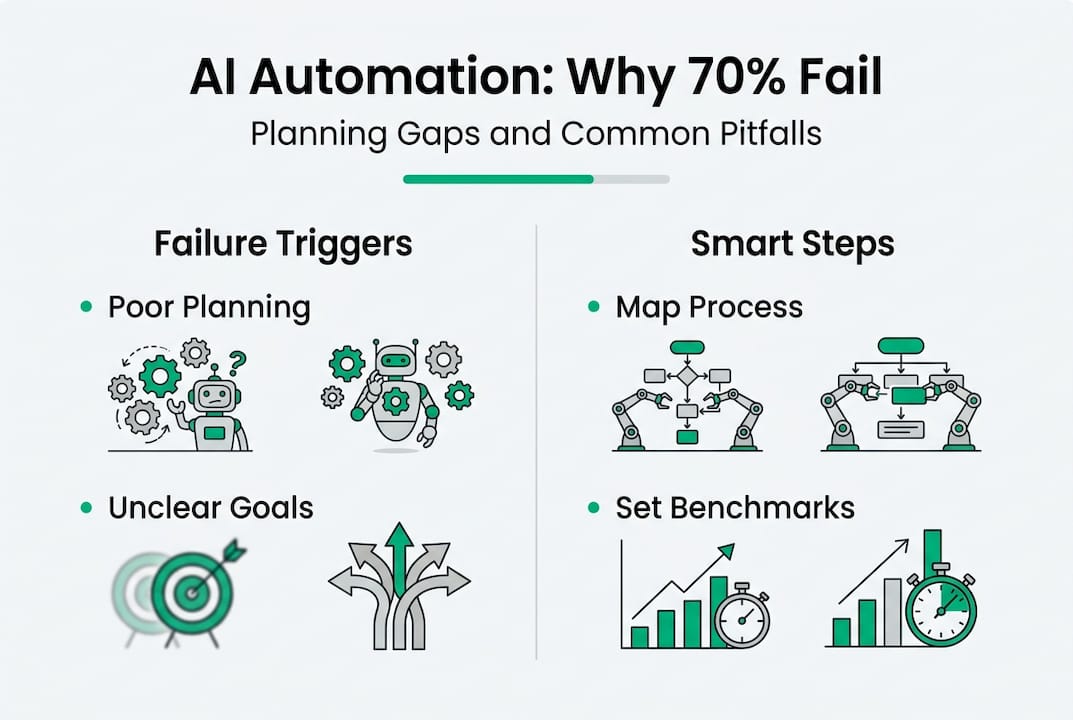
The harsh reality is that most AI automation initiatives stumble badly. 70% of agentic AI projects fail due to delays, cost overruns, or inability to deliver promised value. These failures share common patterns that Australian businesses can learn to recognise and avoid.
The primary culprit is automating processes that lack clear documentation or consistent execution. When your team follows different approaches for the same task, AI models cannot learn reliable patterns. The system amplifies existing inconsistencies rather than resolving them. Many organisations rush to automate before establishing process stability, guaranteeing disappointment.
Technical challenges compound implementation difficulties:
- Hallucinations: AI models confidently generate incorrect information, particularly dangerous in customer-facing applications or financial processes
- Model drift: Performance degrades over time as business conditions change and training data becomes stale
- Data inconsistencies: Poor quality input data produces unreliable outputs, following the garbage in, garbage out principle
- Distribution shifts: Models trained on historical data fail when encountering new patterns or edge cases
The edge case problem deserves special attention. Rare scenarios cause safety-critical failures that oversight and detection techniques must mitigate. A model performing well 95% of the time still creates significant problems when the remaining 5% involves high-value customers or regulatory compliance issues. These tail risks often emerge months after deployment, catching organisations unprepared.
"The most dangerous assumption in AI automation is believing the system will perform consistently without active human oversight. Models require continuous monitoring and correction to maintain effectiveness." — Industry research on AI implementation
Human oversight remains essential, yet many projects underestimate this requirement. Teams assume AI will eliminate manual work entirely, only to discover they need specialists monitoring outputs, retraining models, and handling exceptions. AI risks in health and beauty sectors illustrate how automation without adequate safeguards can damage customer relationships and brand reputation. The solution lies not in abandoning AI automation but in implementing it thoughtfully with realistic expectations and robust monitoring frameworks.

How to tailor AI-driven automation to your business goals for better ROI
Successful AI automation starts with crystal-clear objectives tied to measurable efficiency gains or cost reductions. Vague goals like "improve customer service" or "modernise operations" doom projects from the start. Instead, specify targets such as reducing invoice processing time by 60% or cutting customer query response time to under 2 minutes.
The human augmentation approach delivers superior results compared to full replacement strategies. Benchmarking shows 75% task automation and 10-month ROI are realistic when augmenting humans first. This approach captures tacit knowledge that employees hold but cannot easily articulate. Your team works alongside AI systems, correcting errors and teaching the model through their interventions. The AI handles routine aspects while humans manage exceptions and complex judgements.
Implement automation in deliberate phases:
- Document and stabilise current processes, establishing consistent workflows and clear decision criteria
- Identify high-impact, low-risk tasks where automation delivers immediate value with minimal downside
- Deploy pilot systems with extensive human oversight, collecting performance data and user feedback
- Expand gradually to additional tasks as confidence and capability grow
- Optimise continuously based on measured outcomes and changing business needs
This staged approach contrasts sharply with big-bang implementations that attempt to automate entire departments overnight. The table below compares realistic timelines and expectations:
| Approach | Task Coverage | Timeline to ROI | Risk Level | Best For |
|---|---|---|---|---|
| Human Augmentation | 60-75% | 8-12 months | Low | Most businesses starting AI journey |
| Hybrid Automation | 75-85% | 12-18 months | Medium | Established processes with good data |
| Full Automation | 85-95% | 18-24 months | High | Highly standardised, high-volume tasks |
AI automation strategies for retail demonstrate how phased implementations in inventory management and customer service deliver measurable gains within quarters, not years. Similarly, AI for trades and construction shows practical applications in scheduling and materials management that produce immediate efficiency improvements.
Pro Tip: Measure automation coverage as the percentage of tasks handled end-to-end by AI without human intervention. Track this metric monthly alongside error rates and processing times to gauge true progress.
Set realistic benchmarks from the start. Expecting 95% automation in the first year sets your team up for perceived failure even when achieving strong results. Celebrate hitting 70% coverage with 10% error rates as a significant win, then optimise from that foundation. This mindset shift from perfection to continuous improvement sustains momentum and secures ongoing investment.
Measuring success and staying agile with AI automation
AI automation demands ongoing vigilance, not set-and-forget deployment. Systems that perform brilliantly today can degrade rapidly as business conditions evolve, customer behaviour shifts, or data distributions change. Establishing robust measurement frameworks and feedback loops separates sustainable automation from expensive disappointments.
Continuous performance monitoring tracks multiple dimensions simultaneously. Accuracy metrics reveal how often the system produces correct outputs. Processing speed measures efficiency gains. Error rates highlight where human intervention remains necessary. Customer satisfaction scores indicate whether automation enhances or damages user experience. These metrics require daily or weekly review, not quarterly check-ins.
Implement active learning techniques to maintain effectiveness:
- Human-in-the-loop systems where staff review and correct AI outputs, with corrections feeding back into model training
- Confidence scoring that flags low-certainty predictions for human review before execution
- A/B testing comparing AI performance against human baselines or alternative models
- Drift detection algorithms that alert when input data patterns diverge from training distributions
Active learning and out-of-distribution detection are key to maintaining effectiveness over time. These techniques identify when models encounter situations outside their training experience, preventing silent failures that accumulate into major problems.
Retrieval-augmented generation (RAG) offers powerful capabilities for knowledge-intensive tasks. Rather than relying solely on model training, RAG systems retrieve relevant information from your business documents and databases to inform responses. This approach reduces hallucinations and keeps outputs aligned with current policies and procedures. As your documentation updates, the system automatically incorporates new information without complete retraining.
Transparency and accountability frameworks prevent AI systems from becoming black boxes that nobody understands or trusts. Document decision logic, maintain audit trails showing why the system produced specific outputs, and establish clear ownership for monitoring and improvement. AI automation monitoring in manufacturing illustrates how systematic oversight catches quality issues before they reach customers.
Pro Tip: Establish a governance framework that defines who reviews AI performance, how often, what triggers immediate intervention, and how improvements get prioritised and implemented. Without clear ownership, monitoring becomes everyone's responsibility and therefore nobody's priority.
Agility requires treating AI automation as a living system requiring care and feeding. Schedule monthly reviews examining performance trends, error patterns, and user feedback. Quarterly assessments should evaluate whether the system still aligns with business goals or requires strategic adjustments. This rhythm of continuous improvement ensures your AI automation investment delivers sustained value rather than becoming another abandoned technology project.
Explore tailored AI automation solutions for your industry
Australian businesses need partners who understand local market conditions, regulatory requirements, and industry-specific challenges. Generic AI solutions rarely deliver the targeted efficiency gains and cost reductions your organisation demands. ORVX AI integration consultants specialise in crafting bespoke automation strategies that align with your operational reality, not templated packages that ignore your unique workflows.
Our approach starts with comprehensive on-site audits that map your current processes, identify automation opportunities with genuine ROI potential, and develop realistic implementation roadmaps. We embed directly within your teams to capture tacit knowledge and ensure solutions fit how your people actually work.
Whether you operate in retail businesses managing inventory and customer interactions, or trades and construction coordinating projects and materials, our industry-specific expertise delivers practical automation that enhances efficiency without disrupting operations. We provide vendor-agnostic advice, ongoing support, and performance management to ensure your AI automation investment achieves the measurable results you expect.
FAQ
What is the difference between AI-driven automation and traditional automation?
AI-driven automation uses machine learning models to perform tasks requiring judgement and adaptability, while traditional automation follows fixed rules and scripts. AI systems learn from patterns in data and can handle unstructured inputs like natural language or images, whereas rule-based automation requires precisely defined conditions and actions. This flexibility enables AI to tackle complex tasks that traditional automation cannot address.
Why do so many AI automation projects fail or underperform?
Failures typically stem from automating undocumented or inconsistent processes without establishing clear goals and success metrics. Technical issues like data quality problems, model drift, and inadequate handling of edge cases compound these foundational weaknesses. Many organisations also underestimate the ongoing human oversight required to maintain AI system effectiveness, leading to degraded performance over time.
How can my business ensure a good return on investment with AI automation?
Focus on augmenting human workers rather than attempting full replacement, which captures tacit knowledge and reduces implementation risk. Set specific targets for task automation coverage and monitor progress through regular performance reviews. Start with high-impact, low-risk processes and expand gradually as you build capability and confidence. AI automation ROI strategies emphasise realistic benchmarks like 75% task coverage and 10-month payback periods as practical starting points.
What ongoing maintenance does AI automation require?
AI systems need continuous monitoring for accuracy, processing speed, and error rates to detect performance degradation. Regular retraining with fresh data prevents model drift as business conditions change. Human review of edge cases and low-confidence predictions maintains output quality. Quarterly strategic assessments ensure the automation still aligns with evolving business goals and processes.
Which business processes benefit most from AI-driven automation?
High-volume, repetitive tasks with clear patterns and measurable outcomes deliver the strongest ROI from AI automation. Document processing, customer query routing, data entry, inventory forecasting, and scheduling optimisation represent ideal starting points. Processes requiring complex judgement or handling sensitive exceptions benefit more from human augmentation approaches where AI assists rather than replaces workers.