
Australian small and medium businesses face a puzzling paradox. While AI adoption rates range from 19% to 46% across sectors, most adopters barely scratch the surface of what's possible. Retail leads at 46%, agriculture trails at 19%, yet even high adopters often operate at basic maturity levels. This gap between potential and practice leaves significant profitability on the table. Understanding which AI applications deliver real returns in your industry, and how to implement them effectively, can transform operational efficiency and competitive positioning for SMBs ready to move beyond experimentation.
Table of Contents
- Key takeaways
- The current landscape of AI adoption among Australian SMBs
- How AI maturity drives profitability and efficiency gains
- Key industry-specific AI applications driving results
- Practical steps to implement AI tailored to your industry
- Partner with expert AI consultants for your industry
- Frequently asked questions
Key Takeaways
| Point | Details |
|---|---|
| Industry and size variance | AI adoption in Australian SMBs varies by industry and firm size, with 19 percent in agriculture and 46 percent in retail, and many adopters remaining at basic maturity. |
| Top AI use cases | The top value applications include document processing, customer service chatbots, fraud detection, inventory optimisation, and personalised marketing. |
| Profitability linked to maturity | Moving from basic to intermediate maturity can deliver sizeable profitability gains and notable labour time savings on repetitive tasks. |
| Phased pilots over standalone tools | Overcoming data quality issues, skills gaps and legacy system barriers requires phased pilots that integrate into end to end processes rather than relying on standalone tools. |
The current landscape of AI adoption among Australian SMBs
Australian SMBs navigate an uneven AI landscape where adoption correlates strongly with both industry sector and company size. Recent data shows adoption rates vary from 19% in agriculture to 46% in retail, with health, manufacturing, and professional services clustering in the mid-30% range. Larger businesses adopt at higher rates, yet even among adopters, a striking maturity gap persists.
Current top AI applications across Australian SMBs:
- Document processing and automation (reducing manual data entry)
- Customer service chatbots (handling routine enquiries)
- Fraud detection and security monitoring
- Inventory and supply chain optimisation
- Personalised marketing and customer segmentation
Despite widespread experimentation, only 5% of SMBs reach full AI enablement even though 64-84% report using some AI capabilities. This maturity gap reveals a critical insight: most businesses implement isolated tools without strategic integration or process redesign. The result? Modest gains instead of transformative impact.
| Industry sector | Adoption rate | Common applications |
|---|---|---|
| Retail | 46% | Inventory optimisation, personalised marketing |
| Health | 38% | Patient scheduling, diagnostic support |
| Manufacturing | 35% | Predictive maintenance, quality control |
| Professional services | 32% | Document automation, client analytics |
| Agriculture | 19% | Yield prediction, equipment monitoring |
Three persistent challenges constrain deeper adoption. Data quality issues plague businesses lacking clean, structured information for AI training. Skills gaps leave teams unable to configure, monitor, or optimise AI systems effectively. Legacy system integration creates technical barriers when modern AI tools must connect with decades-old platforms. These obstacles explain why retail AI solutions and manufacturing AI applications often start with standalone pilots rather than enterprise-wide rollouts.
"The difference between experimenting with AI and achieving measurable business impact lies in moving from ad-hoc tool adoption to strategic process transformation."
For detailed adoption statistics, review the Australian government's AI adoption report tracking sector-by-sector progress.
How AI maturity drives profitability and efficiency gains
The financial case for advancing AI maturity becomes compelling when examining profitability data. Research demonstrates that progressing AI maturity increases SMB profitability up to 111% when businesses move from basic to intermediate implementation levels. This dramatic improvement stems from compounding effects: initial automation savings fund further investments, which unlock strategic capabilities that transform competitive positioning.
Labour time savings represent the most immediate and measurable benefit. Data shows 41% of AI users save over 25% labour time, translating directly into cost reduction or capacity expansion without additional hiring. These savings concentrate in repetitive administrative tasks where AI excels: invoice processing, customer enquiry responses, report generation, and data entry.
Profitability progression by AI maturity level:
- Basic adoption (single tools, no integration): 15-20% efficiency gains in targeted tasks
- Intermediate maturity (multiple tools, partial integration): 45% profitability increase through labour savings and process optimisation
- Advanced enablement (strategic integration, continuous optimisation): 111% profitability boost from competitive advantages and operational excellence
Operational efficiencies extend beyond simple time savings. Businesses report 40-60% reductions in task completion time for document processing, customer service responses, and routine analysis. These improvements free skilled staff for higher-value work: strategic planning, complex problem-solving, and relationship building that AI cannot replicate.
Pro Tip: Track AI ROI by measuring time saved per process before expanding implementation. Calculate the hourly cost of staff performing tasks manually, multiply by hours saved monthly, and compare against AI tool costs. This creates a clear business case for scaling successful pilots.
The incremental maturity approach proves most sustainable for SMBs with limited technical resources. Rather than attempting wholesale transformation, successful adopters identify high-impact processes, pilot AI solutions, measure results rigorously, and expand gradually. This methodology reduces risk, builds internal capabilities progressively, and maintains operational stability during transition.
"Sustainable AI transformation requires matching ambition with capability. Start where ROI is clearest, prove value, then scale systematically."
For professional services firms, this often means beginning with document automation before advancing to predictive analytics. Proper measurement frameworks ensure ongoing investments deliver returns. Review Deloitte's profitability research and labour savings data for detailed benchmarks.
Key industry-specific AI applications driving results
Different industries extract value from AI through applications tailored to their operational challenges and customer needs. Understanding which use cases deliver proven results in your sector accelerates implementation and reduces experimentation costs.
Retail sector applications:
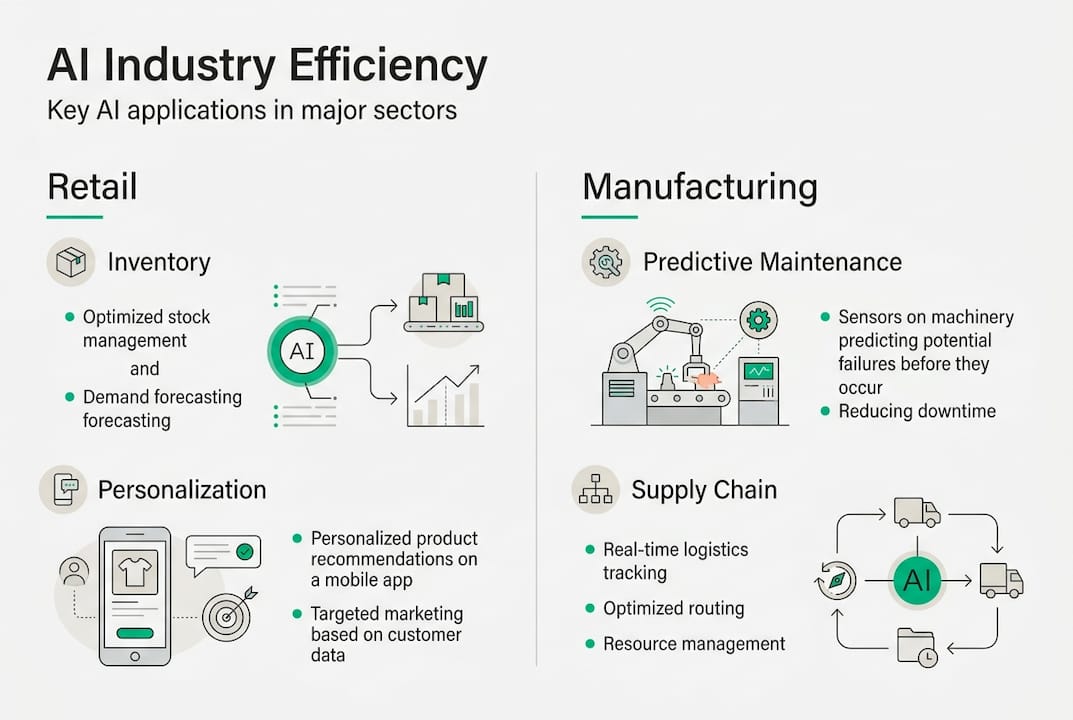
Retail businesses leverage AI for inventory optimisation, demand forecasting, and personalised marketing with measurable revenue impact. Inventory optimisation and personalised marketing drive up to 25% revenue increases by reducing stockouts, minimising overstock costs, and improving conversion rates through targeted recommendations. Customer behaviour analytics enable dynamic pricing and promotion strategies that respond to real-time demand signals.

Retail AI solutions also enhance customer experience through chatbots handling routine enquiries, freeing staff for complex customer interactions. Visual search and recommendation engines increase average transaction values by surfacing relevant products customers might otherwise miss.
Manufacturing sector applications:
Manufacturing operations benefit from predictive maintenance that monitors equipment sensors to forecast failures before they occur. This prevents costly unplanned downtime and extends asset lifecycles. Quality control systems using computer vision detect defects faster and more consistently than manual inspection, reducing waste and rework costs.
Supply chain optimisation algorithms balance inventory levels across production stages, minimising working capital requirements while maintaining production flow. Manufacturing AI implementations often start with predictive maintenance pilots on critical equipment before expanding to quality control and supply chain applications.
Professional services applications:
Law firms, accounting practices, and consultancies gain efficiency through document automation that extracts data from contracts, invoices, and reports. This eliminates manual data entry and enables rapid analysis of large document sets. Client service chatbots handle appointment scheduling, basic enquiries, and information requests, improving responsiveness without adding staff.
Professional services firms also deploy AI for research assistance, precedent analysis, and preliminary report generation. These applications reduce junior staff time on routine tasks while maintaining quality through senior review.
| Industry | Primary application | Secondary application | Typical efficiency gain |
|---|---|---|---|
| Retail | Inventory optimisation | Personalised marketing | 25% revenue increase |
| Manufacturing | Predictive maintenance | Quality control | 30% downtime reduction |
| Professional services | Document automation | Client chatbots | 40-60% time savings |
| Healthcare | Appointment scheduling | Diagnostic support | 35% admin reduction |
Pro Tip: Prioritise AI applications where your current process creates customer friction or consumes disproportionate staff time. These high-pain areas deliver the clearest ROI and strongest internal support for change.
Administrative tasks across all sectors see consistent 40-60% time reductions through AI automation. Invoice processing, expense management, report generation, and data reconciliation represent universal opportunities regardless of industry. Starting with these high-impact, low-risk applications builds confidence and capabilities before tackling more complex, industry-specific implementations. Review industry-specific AI gains for detailed case studies.
Practical steps to implement AI tailored to your industry
Successful AI implementation follows a structured methodology that balances ambition with pragmatism. Rather than pursuing comprehensive transformation immediately, effective adopters identify high-return opportunities, validate benefits through pilots, and scale systematically.
Implementation methodology:
- Identify high-impact use cases: Map current processes to quantify time spent, error rates, and customer impact. Prioritise applications where AI addresses clear pain points with measurable benefits.
- Start with pilot projects: Phased rollout beginning with document processing or chatbot pilots enables manageable integration and learning. Choose contained processes with clear success metrics.
- Integrate with existing platforms: Leverage AI capabilities within current software rather than adding standalone tools. MYOB AI features for accounting, Salesforce Einstein for CRM, and Shopify AI for eCommerce reduce integration complexity.
- Measure and iterate: Track time savings, error reduction, and cost impact weekly during pilots. Use data to refine configuration and identify expansion opportunities.
- Scale proven solutions: Once pilots demonstrate ROI, expand to similar processes across departments or locations. Maintain measurement discipline to ensure scaled implementations deliver expected returns.
Pro Tip: Document current process performance before implementing AI. Baseline metrics provide objective evidence of improvement and justify further investment to stakeholders.
Risk mitigation requires attention to data privacy, accuracy, and bias concerns. Address AI risks like data leakage and bias through clear governance policies that specify:
- What data AI systems can access and process
- How to validate AI outputs before acting on recommendations
- When human review is mandatory (high-stakes decisions, customer-facing content)
- Regular audits of AI performance and bias indicators
Data privacy protection starts with understanding where customer and business data flows. Ensure AI vendors comply with Australian Privacy Principles and store data within Australia when handling sensitive information. Implement access controls limiting which staff can configure AI systems or access AI-processed data.
Government support programs reduce financial barriers to AI adoption. The Australian Government's Digital Solutions program and various state-level grants provide funding for technology investments, including AI tools and consulting services. These programs often cover 50-75% of eligible costs, making professional guidance accessible for budget-conscious SMBs.
Key risk mitigation practices:
- Establish clear data governance policies before AI deployment
- Require human review of AI outputs for customer-facing or high-stakes decisions
- Monitor AI performance metrics weekly to detect accuracy degradation
- Train staff on AI limitations and appropriate use cases
- Maintain audit trails of AI decisions for compliance and improvement
Partner with AI integration consultants who understand your industry's specific requirements and regulatory environment. Expert guidance accelerates implementation, reduces trial-and-error costs, and ensures solutions align with business strategy rather than following technology trends. Review practical AI rollout approaches and risk management frameworks for detailed implementation guidance.
Partner with expert AI consultants for your industry
Navigating AI adoption becomes significantly easier with experienced guidance tailored to your industry's specific challenges and opportunities. ORVX AI specialises in helping Australian SMBs implement practical AI solutions that deliver measurable returns without the complexity of enterprise-scale deployments.
Our consultants work directly within your operations to map workflows, identify high-impact opportunities, and design phased implementation roadmaps that match your technical capabilities and budget constraints. Whether you operate in retail, manufacturing, professional services, or other sectors, we bring industry-specific expertise that accelerates results.
We provide vendor-agnostic advice, recommending solutions based on your needs rather than partnerships or commissions. Our hands-on approach includes on-site audits, pilot project management, staff training, and ongoing optimisation support. This ensures AI implementations deliver promised benefits and continue improving over time. Visit ORVX AI to explore how tailored AI strategies can transform your operations and competitive positioning.
Frequently asked questions
What industries benefit most from AI adoption in Australia?
Retail, manufacturing, professional services, and healthcare sectors demonstrate the strongest AI adoption rates and measurable gains. Retail benefits from inventory optimisation and personalised marketing, while manufacturing excels with predictive maintenance. Professional services gain efficiency through document automation, and healthcare improves scheduling and diagnostic support. However, smaller sectors can achieve significant benefits by focusing on high-impact use cases like customer service chatbots or administrative automation, even with lower overall adoption rates.
How can small businesses start adopting AI effectively?
Begin with high-impact, low-risk pilots targeting specific pain points like document processing or customer enquiry handling. Leverage AI capabilities already built into existing software platforms such as accounting, CRM, or eCommerce systems to minimise integration complexity. Measure time savings and cost reductions rigorously during pilots, then scale proven solutions gradually. This approach builds internal capabilities while demonstrating clear ROI that justifies further investment.
What common challenges should businesses prepare for with AI implementation?
Data privacy and security concerns require clear governance policies specifying what information AI systems can access. Bias and accuracy issues demand human review of AI outputs, especially for customer-facing or high-stakes decisions. Skills shortages necessitate training programs to help staff configure and monitor AI systems effectively. Legacy system integration creates technical barriers that may require middleware or phased replacement. Establishing oversight processes and maintaining audit trails mitigates these risks while ensuring compliance.
What return on investment can SMBs expect from AI adoption?
Businesses reaching intermediate AI maturity typically see 45% profitability increases through labour savings and process optimisation. Fully enabled AI users may achieve gains exceeding 111% as strategic capabilities compound competitive advantages. Labour time savings frequently exceed 25%, translating into direct cost reductions or expanded capacity without additional hiring. Specific ROI depends on implementation quality, process selection, and organisational maturity, making measurement and iteration critical for maximising returns.