
Artificial intelligence adoption is accelerating across Australian small and medium enterprises, with 80% now using AI tools to drive efficiency and growth. Yet selecting the right AI approach remains challenging for business leaders navigating diverse implementation options, privacy concerns, and resource constraints. This article provides a systematic evaluation framework to help you choose AI strategies that align with your business goals, maximise tangible benefits, and overcome common adoption barriers. You'll discover proven criteria for assessing AI readiness, practical insights into labour-saving benefits, risk management strategies, and a comparative analysis of implementation approaches tailored for Australian SMEs.
Table of Contents
- Key takeaways
- Criteria for evaluating AI implementation benefits
- Labour and efficiency benefits of AI
- Managing risks and overcoming adoption barriers
- Comparing AI implementation approaches for SMEs
- Accelerate your business transformation with expert AI integration
- Frequently asked questions
Key Takeaways
| Point | Details |
|---|---|
| Phased governance roadmaps | Adopt a phased roadmap that starts with readiness and data, then governance, piloting, automation and integration, and finally embedding and scaling AI. |
| Data readiness focus | Before deployment, assess data quality and organisational readiness to set realistic timelines and resource needs. |
| Pilot low risk use cases | Test small tasks such as email categorisation or basic customer enquiries to build quick wins and provide concrete data on savings. |
| Document AI journey | Document every stage of your AI implementation from pilots to scale to capture lessons and support ROI communications. |
Criteria for evaluating AI implementation benefits
Choosing the right AI implementation starts with understanding your business readiness and defining clear evaluation criteria. Successful AI adoption follows phased roadmaps including assess readiness and data, govern and policy, pilot low-risk use cases, automate and integrate, then embed and scale. This structured approach ensures you build on solid foundations rather than rushing into complex deployments that create more problems than they solve.
Your first priority is assessing data quality and organisational readiness. AI systems require clean, structured data to generate reliable insights. Evaluate your current data infrastructure, identify gaps in collection or storage, and determine whether your team has the skills to manage AI tools effectively. This groundwork prevents costly false starts and helps you set realistic expectations for implementation timelines and resource requirements.
Governance and policy frameworks form the second critical criterion. Before deploying AI across your operations, establish clear guidelines for data privacy, ethical use, and decision-making authority. These policies protect your business from compliance risks and build customer trust. They also define accountability when AI systems make recommendations or automate processes, ensuring human oversight remains central to critical business decisions.
Piloting low-risk use cases allows you to test AI capabilities without exposing your business to significant operational disruption. Start with discrete tasks like email categorisation, basic customer enquiry responses, or invoice processing. These pilots generate quick wins that build internal confidence and provide concrete data on time savings and accuracy rates. Success in controlled environments creates momentum for broader adoption across departments.
Automation and integration represent the scaling phase where AI delivers substantial efficiency benefits. Once pilots prove successful, integrate AI tools with existing systems like your CRM, accounting software, or inventory management platforms. This integration multiplies benefits by creating seamless workflows that reduce manual data entry and eliminate information silos. Working with AI integration consultants ensures technical compatibility and minimises disruption during this critical transition phase.
Pro Tip: Document every stage of your AI implementation journey, including failed experiments and unexpected challenges. This knowledge base becomes invaluable when training new staff, scaling successful pilots, or troubleshooting issues. It also helps you articulate ROI to stakeholders and refine your approach for future AI initiatives.
Labour and efficiency benefits of AI
The most compelling benefit of AI adoption for Australian SMEs is measurable labour time savings. Recent data shows 41% of businesses save more than 25% labour time, with 17.5% achieving savings exceeding 50%. These aren't marginal improvements but transformational shifts that fundamentally change how small businesses allocate human resources and compete in their markets.

AI applications delivering these labour savings span a wide range of business functions. Customer service chatbots handle routine enquiries 24/7, freeing your team to focus on complex customer needs requiring human judgement. Document processing tools extract data from invoices, receipts, and contracts in seconds rather than hours. Scheduling algorithms optimise workforce allocation based on demand patterns, reducing overtime costs whilst maintaining service levels. Predictive maintenance systems alert you to equipment issues before breakdowns occur, preventing costly downtime and emergency repairs.
Practical examples from Australian sectors illustrate these efficiency gains. Trades and construction businesses use AI-powered project management tools to automate quote generation, track materials usage, and predict job completion times with greater accuracy. This automation reduces administrative burden by 30-40%, allowing tradies to take on more projects without hiring additional office staff. Professional services firms deploy AI research assistants that summarise case law, analyse contracts, and generate first-draft reports, cutting billable hour requirements whilst maintaining quality standards.
The efficiency gains extend beyond simple time savings to capacity for strategic innovation. When your team spends less time on repetitive tasks, they have mental bandwidth to develop new service offerings, improve customer experience, and identify growth opportunities. Professional services firms report that AI-enabled efficiency allows them to offer fixed-fee pricing models that were previously too risky, creating competitive advantages in price-sensitive markets.
"AI doesn't replace our people, it amplifies what they can achieve. We've redirected 15 hours per week per employee from data entry to client relationship building, and our retention rates have jumped 23% as a result."
Pro Tip: Calculate your baseline labour costs for specific tasks before implementing AI, then measure actual time savings monthly for six months. This data proves ROI to sceptical stakeholders and helps you identify which AI tools deliver genuine value versus those that sound impressive but underperform in practice.
Managing risks and overcoming adoption barriers
Whilst AI benefits are substantial, Australian SMEs face real obstacles that slow adoption and limit success. Understanding these barriers and implementing targeted mitigation strategies separates businesses that extract full value from AI from those that abandon implementations after disappointing results. Privacy concerns affect 42% of firms, time constraints 23%, and accuracy worries 35%, creating a complex risk landscape that requires deliberate management.
Privacy concerns stem from legitimate questions about data security, customer consent, and regulatory compliance. Australian Privacy Principles impose strict obligations on how businesses collect, store, and use personal information. AI systems that process customer data must comply with these requirements, necessitating clear data governance policies and technical safeguards. Address privacy risks by conducting privacy impact assessments before deployment, implementing data minimisation principles that limit collection to essential information only, and establishing transparent customer communication about AI use in service delivery.
Accuracy challenges arise because AI systems learn from historical data and can perpetuate biases or make errors when encountering novel situations. A chatbot trained on past customer interactions might provide incorrect information if product specifications change. Predictive models might miss emerging market trends not reflected in training data. Mitigate accuracy risks through ongoing validation processes that compare AI outputs against known correct answers, implement human review workflows for high-stakes decisions, and establish feedback loops that continuously improve model performance based on real-world results.
Time constraints represent perhaps the most underestimated barrier to AI adoption. Implementing AI requires upfront investment in data preparation, system integration, staff training, and process redesign. Many SME leaders underestimate this time commitment and become frustrated when quick wins don't materialise. Overcome time barriers by starting with narrowly defined pilot projects that deliver results within 90 days, securing executive sponsorship that protects implementation time from competing priorities, and leveraging external expertise to accelerate deployment without overburdening internal teams.
Strategies for accelerating enterprise-wide adoption:
- Establish cross-functional AI steering committees that include operations, IT, and frontline staff to ensure diverse perspectives inform implementation decisions
- Create internal AI champions who receive advanced training and advocate for adoption within their departments
- Develop standardised evaluation criteria for assessing new AI tools, streamlining decision-making and reducing analysis paralysis
- Implement change management programmes that address employee concerns about job security and skill obsolescence
Leadership commitment proves essential for overcoming slow adoption rates. When executives actively use AI tools, discuss AI initiatives in company communications, and allocate budget for experimentation, employees recognise AI as a strategic priority rather than a passing trend. This top-down support creates psychological safety for staff to experiment with new tools, share failures openly, and collaborate on continuous improvement.
"We initially struggled with AI adoption because our team saw it as a threat to their roles. Once we reframed AI as a tool that eliminates the boring parts of their jobs so they can focus on creative problem-solving, resistance melted away and adoption accelerated dramatically."
Comparing AI implementation approaches for SMEs
Selecting the optimal AI implementation approach requires understanding how different methodologies balance speed, complexity, risk, and value delivery. The phased roadmap approach balances these factors by breaking implementation into discrete stages, each building on previous successes whilst managing risk exposure. This contrasts with big-bang deployments that attempt comprehensive AI transformation simultaneously, often overwhelming organisations and leading to abandoned initiatives.
Different AI tools and deployment models suit varying SME maturity levels and strategic objectives. Off-the-shelf SaaS AI tools offer rapid deployment with minimal technical complexity but provide limited customisation. Custom-built AI solutions deliver precisely tailored functionality but require significant development time and ongoing maintenance. Hybrid approaches that combine configurable platforms with custom integrations often provide the best balance for growing SMEs, offering flexibility without excessive complexity.
| Approach | Deployment Speed | Complexity | Scalability | Typical Benefits | Primary Risks |
|---|---|---|---|---|---|
| Phased roadmap | 3-6 months to first value | Moderate, increases gradually | High, builds on proven foundations | Controlled risk, measurable ROI, team confidence | Slower initial results, requires sustained commitment |
| Big-bang transformation | 6-12 months before benefits | Very high, all at once | Variable, depends on initial success | Comprehensive change if successful | High failure risk, resource intensive, staff overwhelm |
| Tool-by-tool adoption | 2-4 weeks per tool | Low per tool, integration challenges | Limited without coordination | Quick wins, low individual risk | Fragmented systems, duplicate data, inefficiency |
| Outsourced managed services | 4-8 weeks to deployment | Low for client, managed externally | High, provider handles scaling | Expert implementation, predictable costs | Vendor dependency, less internal capability building |
The phased roadmap approach typically delivers the best outcomes for Australian SMEs because it matches implementation pace to organisational change capacity. You start with assessment and governance, establishing the foundation for responsible AI use. Pilot projects generate early wins that build momentum and provide concrete data on benefits. Automation and integration phases scale proven use cases across operations. Finally, embedding AI into standard workflows and culture ensures long-term sustainability.
Timing considerations influence which approach suits your circumstances. If you face imminent competitive threats or regulatory changes, accelerated deployment through managed services might justify higher costs and vendor dependency. Conversely, if you're exploring AI for the first time with limited internal expertise, a cautious tool-by-tool approach allows learning without excessive risk exposure. Most established SMEs benefit from phased roadmaps that balance speed and sustainability.
Industry-specific factors also shape implementation approach selection. Retail businesses often benefit from rapid deployment of customer-facing AI like recommendation engines and chatbots, where competitive pressure demands quick action. Professional services firms typically require more deliberate implementations that address complex compliance requirements and integrate with specialised industry software. Working with AI integration consultants who understand your sector's unique requirements ensures your chosen approach aligns with industry best practices and regulatory expectations.
Pro Tip: Create a simple decision matrix that scores potential AI implementations against criteria like strategic alignment, technical feasibility, resource requirements, and expected ROI. This objective framework prevents enthusiasm for trendy AI applications from diverting resources away from initiatives that deliver genuine business value aligned with your strategic priorities.
Accelerate your business transformation with expert AI integration
Navigating AI implementation successfully requires more than understanding benefits and risks. You need practical guidance tailored to your industry, technical environment, and strategic objectives. ORVX AI specialises in helping Australian SMEs develop customised AI strategies that deliver measurable results without the complexity and false starts that plague DIY implementations. Our vendor-agnostic approach ensures recommendations serve your interests, not software sales quotas.
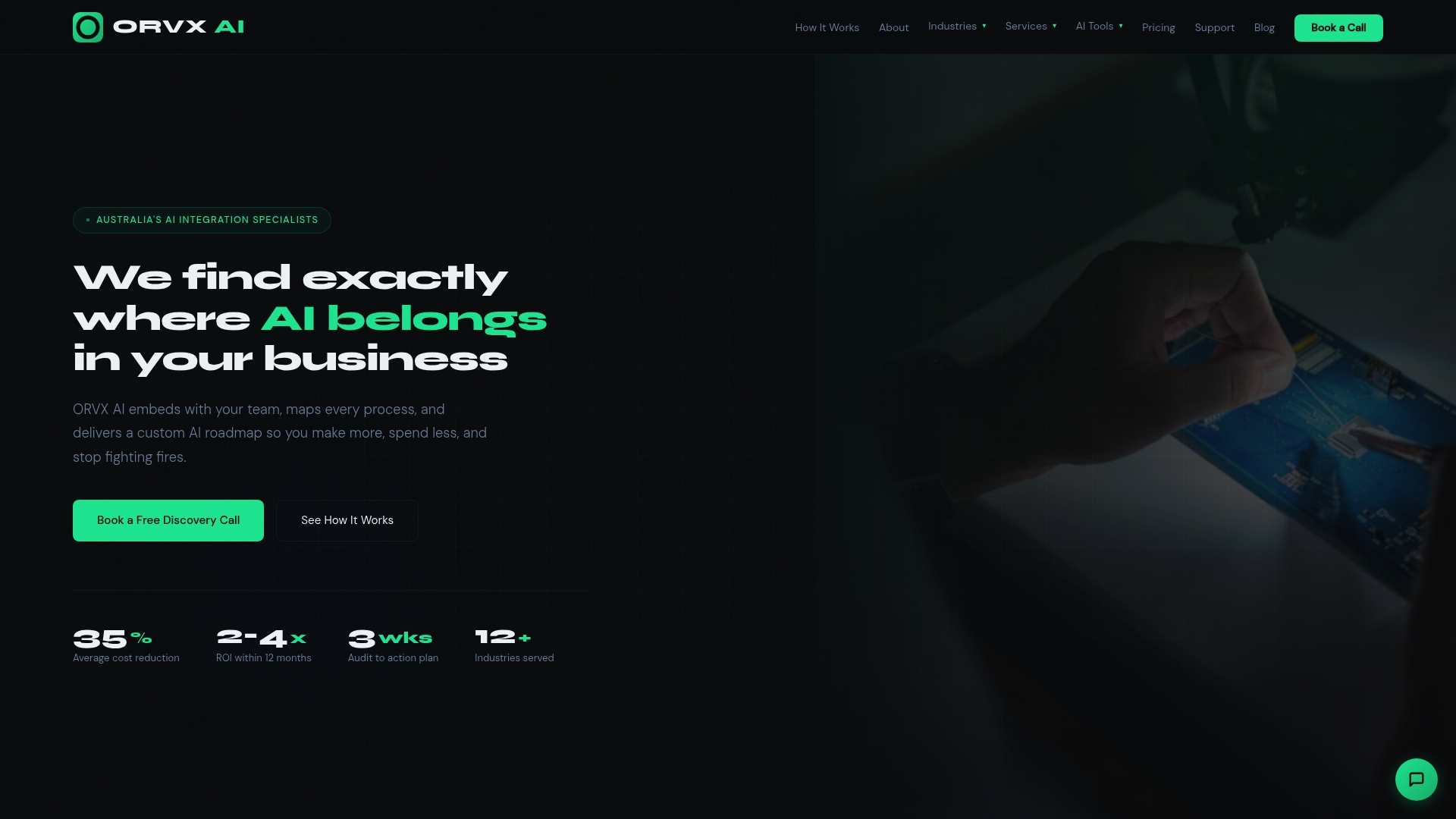
Our hands-on methodology starts with comprehensive on-site audits that map your current workflows, identify high-value automation opportunities, and assess data readiness. We then develop phased implementation roadmaps that prioritise quick wins whilst building towards transformational capabilities. Whether you operate in trades and construction, retail, or professional services, our sector-specific expertise ensures AI solutions align with your operational realities and customer expectations. We embed directly within your team during implementation, providing training and support that builds internal capability for long-term success.
Frequently asked questions
What are the top benefits of implementing AI for Australian SMEs?
The primary benefits include labour time savings exceeding 25% for most adopters, efficiency gains that reduce operational costs by 15-30%, and competitive advantages through faster service delivery and data-driven insights. AI also frees staff from repetitive tasks, allowing them to focus on strategic work that drives growth and innovation.
How long does it take to see ROI from AI implementation?
Most SMEs see measurable benefits within 90 days from pilot projects focused on specific use cases like customer service automation or invoice processing. Comprehensive ROI typically materialises within 6-12 months as implementations scale across operations. The phased roadmap approach delivers incremental value throughout the journey rather than requiring you to wait for complete deployment.
How can I address privacy and accuracy concerns with AI?
Implement clear data governance policies that define collection, storage, and usage rules compliant with Australian Privacy Principles. Establish human review workflows for high-stakes AI decisions and create feedback loops that continuously validate AI outputs against known correct answers. Regular audits and staff training ensure ongoing compliance and accuracy as your AI capabilities evolve.
Should I build custom AI solutions or use off-the-shelf tools?
Most SMEs benefit from starting with configurable off-the-shelf tools that address common business functions, then gradually adding custom integrations as specific needs emerge. This hybrid approach balances rapid deployment with flexibility, avoiding the high costs and long timelines of fully custom development whilst preventing the limitations of rigid SaaS platforms.
What skills does my team need to manage AI implementations successfully?
Your team needs basic data literacy to understand AI inputs and outputs, change management skills to guide staff through adoption, and critical thinking to evaluate AI recommendations rather than accepting them blindly. Technical AI expertise can be outsourced initially, but building internal capability through training and hands-on experience ensures long-term sustainability and reduces vendor dependency.