
Australian businesses are facing a critical challenge: while 70% recognise AI's transformative potential, 70% of AI projects fail due to poor strategic alignment and rushed execution. The gap between ambition and successful deployment has never been wider. This guide walks you through a proven, phased roadmap designed specifically for Australian SMBs and enterprises. You'll discover how to align AI initiatives with business goals, prepare your data infrastructure, execute deployment systematically, and avoid the costly pitfalls that derail most projects.
Table of Contents
- Key takeaways
- Understanding the AI implementation landscape in Australia
- Preparing your business for AI: aligning strategy and data readiness
- Executing the AI implementation step by step
- Common pitfalls and how to avoid them during AI projects
- Anticipated benefits and local success stories of AI implementation
- Partner with ORVX AI for your AI journey
- FAQ
Key Takeaways
| Point | Details |
|---|---|
| Strategic alignment essential | AI success hinges on aligning initiatives with clear business goals and measurable outcomes. |
| Phased roadmap reduces risk | A phased roadmap reduces risk and enables controlled, scalable deployment across the organisation. |
| Pilot projects for SMBs | For SMBs, start with focused three to six months pilots on high value low risk tasks to prove value without breaking the budget. |
| Data governance matters | Robust data governance and AI readiness are foundational before building models, including data ownership and privacy compliance. |
| Local case studies shine | Australian businesses are realising substantial efficiency gains when AI is applied to practical and high impact use cases. |
Understanding the AI implementation landscape in Australia
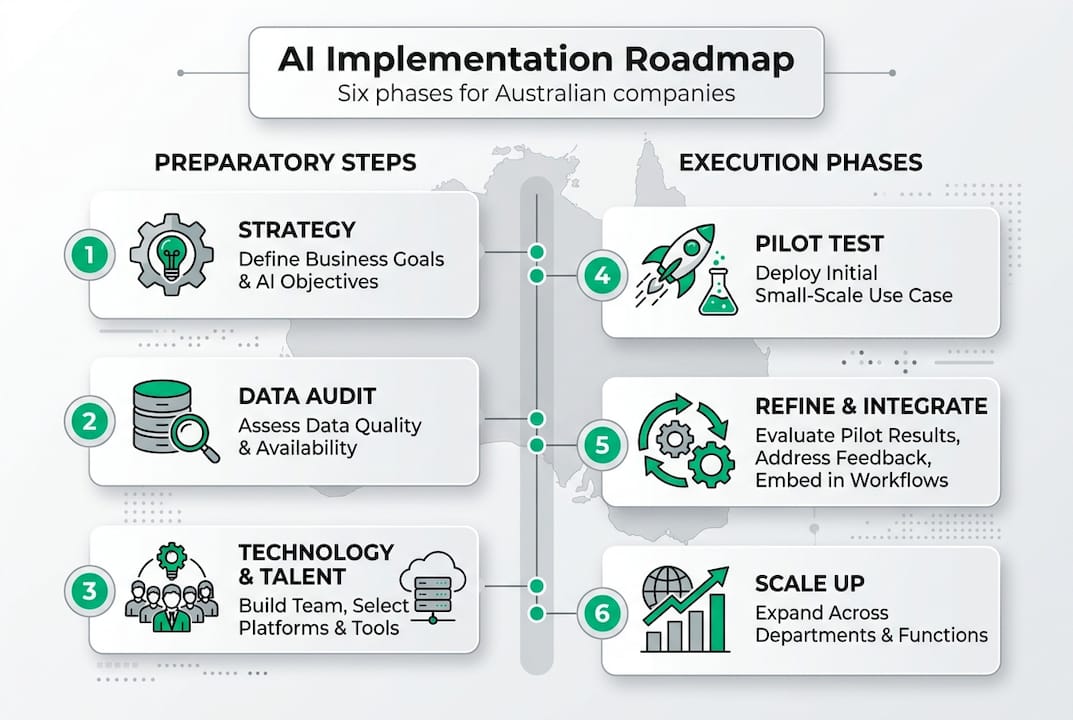
Successful AI adoption follows a structured 6-phase roadmap that enterprises typically complete over 18 to 24 months. Each phase builds on the previous one, creating a foundation that supports sustainable scaling. The six phases are strategic alignment, infrastructure planning, data strategy development, model development and training, deployment and integration, and ongoing governance and optimisation.
For SMBs, this timeline compresses significantly. Most start with focused pilots lasting three to six months, concentrating on high-value, low-risk applications like chatbots for customer service or automation of repetitive administrative tasks. These pilot projects typically cost between $20,000 and $50,000, making them accessible entry points that deliver measurable returns without overwhelming budgets.
The high failure rate of 70% stems primarily from inadequate strategic alignment. Businesses rush into technology selection before clarifying which problems AI should solve or how solutions will integrate with existing workflows. This misalignment creates expensive dead ends where deployed systems sit unused or deliver minimal value.
AI implementation roadmap phases:
| Phase | Duration | Primary focus |
|---|---|---|
| Strategic alignment | 2-3 months | Define business objectives and AI use cases |
| Infrastructure planning | 3-4 months | Assess technical requirements and cloud resources |
| Data strategy | 4-6 months | Audit data quality, establish governance frameworks |
| Model development | 6-8 months | Build, train, and validate AI models |
| Deployment | 3-4 months | Integrate systems, conduct staged rollouts |
| Governance | Ongoing | Monitor performance, manage model drift, ensure compliance |
Common implementation challenges:
- Poor data quality preventing model training
- Lack of executive sponsorship causing resource constraints
- Insufficient technical expertise within existing teams
- Resistance to change from staff concerned about job security
- Underestimating ongoing maintenance and monitoring requirements
Partnering with experienced AI integration consultants helps navigate these challenges by providing vendor-agnostic guidance tailored to your industry context and organisational maturity.
Preparing your business for AI: aligning strategy and data readiness
Before writing a single line of code or selecting any platform, you must establish strategic clarity. AI initiatives succeed when they directly support measurable business objectives like reducing operational costs, improving customer satisfaction scores, or accelerating decision-making cycles. Start by identifying specific pain points where automation or intelligent analysis would create tangible value.
Conduct workshops with stakeholders across departments to surface use cases and prioritise them based on feasibility and impact. This cross-functional engagement builds organisational buy-in early, reducing resistance during later implementation phases. Document how each proposed AI application maps to strategic goals, creating accountability for outcomes rather than just technology deployment.
Data readiness determines whether your AI ambitions can become reality. 60% of Australian businesses discover their data is not AI-ready only after initiating projects. Run a thorough data audit examining completeness, accuracy, consistency, and accessibility across systems. Identify gaps where critical information is missing, siloed in legacy platforms, or stored in formats unsuitable for machine learning.

Establish robust data governance frameworks before model development begins. These frameworks define data ownership, quality standards, access controls, and ethical guidelines for AI usage. Governance structures must address privacy compliance with Australian regulations, bias detection and mitigation, and transparency in how models make decisions.
Essential data governance elements:
- Clear data ownership and stewardship roles
- Quality metrics and monitoring processes
- Access controls and security protocols
- Ethical guidelines for AI decision-making
- Compliance documentation for regulatory requirements
- Audit trails tracking data lineage and model decisions
Pro Tip: Engage cross-functional stakeholders including IT, operations, legal, and end users from the earliest planning stages. Their diverse perspectives identify blind spots and ensure AI solutions address real workflow needs rather than theoretical possibilities.
Industries like professional services and health and beauty face unique data governance challenges around client confidentiality and sensitive personal information. Tailoring your governance approach to industry-specific requirements prevents compliance issues that could derail projects late in development.
Executing the AI implementation step by step
With strategy and data foundations in place, you're ready to execute the technical implementation. Follow this sequential approach to maintain control and reduce risk at each stage.
-
Establish infrastructure requirements. Assess whether cloud platforms, on-premises servers, or hybrid architectures best suit your scale and security needs. Cloud solutions offer flexibility and rapid scaling but require careful cost management. Select tools and platforms that integrate with existing systems to avoid creating new data silos.
-
Develop and train models iteratively. Start with minimum viable models using representative data samples. Test hypotheses quickly rather than pursuing perfect accuracy from the outset. Iterate based on validation results, gradually expanding training data and refining algorithms as performance improves.
-
Implement staged deployment strategies. SMBs should begin with low-risk pilots costing $20,000 to $50,000 over three to six months, focusing on chatbots and process automation. These pilots prove value before committing to enterprise-wide rollouts. Use canary deployments where new models run alongside existing systems, processing small traffic percentages while you monitor for errors.
-
Integrate human oversight mechanisms. Human-in-the-loop approaches and monitoring for model drift catch problems before they compound. Build review workflows where staff validate AI decisions on sample transactions, especially during early deployment phases. This oversight maintains quality while building user confidence in system reliability.
-
Monitor performance continuously. Establish dashboards tracking key metrics like prediction accuracy, processing speed, error rates, and user satisfaction. Set thresholds triggering alerts when performance degrades, indicating potential model drift or data quality issues requiring intervention.
-
Optimise and scale gradually. Once pilots demonstrate clear ROI, expand to additional use cases or departments. Maintain incremental investment pacing that aligns with budget cycles and organisational change capacity.
AI deployment approach comparison:
| Approach | Best for | Advantages | Disadvantages |
|---|---|---|---|
| Pilot project | SMBs, first AI initiative | Low risk, fast validation, contained costs | Limited immediate impact, requires scaling plan |
| Phased scaling | Mid-size enterprises | Balanced risk and reward, iterative learning | Longer timeline to full value realisation |
| Full rollout | Large enterprises with mature AI capability | Maximum impact, economies of scale | High upfront investment, greater failure risk |
Pro Tip: Use staged rollouts with human-in-the-loop validation to catch edge cases and model errors before they affect large user populations. This approach builds trust while protecting your brand from AI-generated mistakes.
Industries like trades and construction and retail benefit from starting with narrow applications such as scheduling optimisation or inventory forecasting before expanding to more complex customer-facing implementations.
Common pitfalls and how to avoid them during AI projects
Understanding where others fail helps you proactively mitigate risks. These pitfalls account for the majority of unsuccessful AI initiatives across Australian businesses.
Frequent implementation mistakes:
- Ignoring data quality issues until model training reveals fundamental gaps
- Weak governance structures leading to compliance violations or ethical concerns
- Skipping pilot phases and moving directly to enterprise-wide deployment
- Rushing scaling without validating model performance across diverse scenarios
- Underestimating change management needs and staff training requirements
- Failing to establish clear success metrics before project initiation
Data quality problems are pervasive. 72% of business data is not AI-ready, containing inconsistencies, missing values, or biases that corrupt model training. The Commonwealth Bank's experience illustrates the consequences of rushed deployment: they were forced to reverse redundancies after their AI systems failed to perform as expected, creating operational chaos and reputational damage.
"Rushed scaling causes failures such as reversed redundancies at CBA, where inadequate testing and governance led to systems that couldn't handle real-world complexity. The bank had to rehire staff and publicly acknowledge the premature deployment."
Avoid these outcomes through disciplined risk mitigation strategies. Always run pilot projects that validate concepts in controlled environments before broader rollout. Establish comprehensive data governance covering quality standards, ethical guidelines, and compliance requirements. Maintain human oversight during early deployment phases, gradually reducing intervention as systems prove reliability.
Ethical AI considerations are particularly important for sectors like healthcare where algorithmic bias could lead to discriminatory treatment recommendations. Build diverse testing datasets that represent your full customer base, and conduct regular bias audits examining whether models perform equitably across demographic groups.
Invest in change management alongside technical implementation. Staff resistance derails even technically sound AI systems when users don't understand benefits or fear job displacement. Communicate clearly about how AI augments rather than replaces human capabilities, and provide training that builds confidence in working alongside intelligent systems.
Anticipated benefits and local success stories of AI implementation
When executed properly, AI delivers substantial, measurable returns across Australian businesses. Understanding realistic benchmarks helps set appropriate expectations and justify investment to stakeholders.
41% of businesses save over 25% in labour time through AI automation of repetitive tasks. These savings compound over time as systems handle increasing workloads without proportional staff increases. Document processing, data entry, and routine customer inquiries are prime candidates for automation that frees skilled staff for higher-value activities.
NRMA's QBot implementation demonstrates dramatic efficiency gains achievable in Australian contexts. The system reduces incident report generation from one week to 10 minutes, transforming a labour-intensive administrative burden into an automated process. This acceleration improves response times and data accuracy while eliminating bottlenecks that previously delayed decision-making.
Successful Australian AI implementations:
- Manufacturing sector achieving 25% uptime improvement through predictive maintenance systems that forecast equipment failures before they occur
- Retail chains optimising inventory levels, reducing stockouts by 30% while cutting holding costs
- Financial services automating loan application processing, reducing approval times from days to hours
- Healthcare providers using diagnostic support tools that improve early detection rates for critical conditions
- Logistics companies optimising route planning, cutting fuel costs by 15% and improving delivery reliability
Industry-specific AI benefits:
| Industry | Primary benefit | Typical improvement |
|---|---|---|
| Manufacturing | Predictive maintenance | 25% uptime increase |
| Retail | Inventory optimisation | 30% reduction in stockouts |
| Financial services | Process automation | 60% faster approvals |
| Healthcare | Diagnostic support | 20% improvement in early detection |
| Logistics | Route optimisation | 15% fuel cost reduction |
These outcomes aren't theoretical. They represent real results from Australian organisations that followed structured implementation roadmaps, prioritised data readiness, and maintained disciplined governance throughout deployment.
Businesses in manufacturing and real estate find particularly strong returns from AI applications in predictive analytics and customer relationship management, where pattern recognition and personalisation create competitive advantages.
Partner with ORVX AI for your AI journey
Navigating AI implementation successfully requires both strategic vision and technical expertise. ORVX AI brings deep experience helping Australian businesses across industries translate AI potential into operational reality. Our approach starts with on-site audits that map your current workflows, identify high-value opportunities, and develop customised roadmaps aligned with your specific business objectives.
We specialise in vendor-agnostic guidance, ensuring technology recommendations serve your needs rather than platform preferences. Our hands-on methodology embeds consultants directly within your teams, facilitating knowledge transfer and building internal AI capability as we implement solutions. This partnership approach means you're not dependent on external resources indefinitely.
For retail businesses, we've delivered chatbot implementations that handle customer enquiries 24/7 while improving satisfaction scores. In manufacturing, our predictive maintenance systems have extended equipment lifecycles and reduced unplanned downtime.
Pro Tip: Early consultation with experienced AI integration specialists helps identify the right pilot projects and governance models for your industry context, significantly reducing implementation risk and accelerating time to value.
Whether you're exploring AI for the first time or scaling existing initiatives, ORVX AI provides end-to-end support from initial strategy through ongoing performance management. Explore how tailored AI solutions can transform your operations.
FAQ
What is the typical timeline for AI implementation in Australian enterprises?
Enterprise AI implementations typically span 18 to 24 months when following the complete six-phase roadmap from strategic alignment through deployment and governance establishment. SMBs often achieve faster results by starting with focused pilots lasting three to six months that target specific high-value use cases like chatbot deployment or process automation. Timeline variations depend on organisational readiness, data quality, and technical complexity of chosen applications.
How can small businesses minimise the risks of AI adoption?
Start with low-cost pilot projects between $20,000 and $50,000 that focus on specific, measurable use cases with clear success criteria. Prioritise data readiness by auditing quality and establishing basic governance before model development. Partner with experienced consultants who provide vendor-agnostic guidance tailored to your industry context. This staged approach validates concepts and builds internal capability before committing to larger investments.
What are the most common causes of AI project failures?
Poor strategic alignment causes 70% of failures when AI initiatives aren't clearly connected to business objectives or integrated with existing workflows. Inadequate data quality prevents effective model training, while weak governance structures lead to compliance issues and ethical concerns. Rushing deployment without pilot testing or human oversight compounds errors before they're detected. Insufficient change management and staff training create resistance that undermines even technically sound implementations.
What operational benefits can businesses expect from successful AI deployment?
Australian businesses commonly achieve labour time savings exceeding 25% through automation of repetitive tasks and document processing. Manufacturing operations see uptime improvements around 25% from predictive maintenance systems. Retail organisations reduce stockouts by 30% while cutting inventory holding costs through optimisation algorithms. Financial services accelerate approval processes by 60%, and logistics companies reduce fuel costs by 15% through intelligent route planning. These benefits compound over time as systems handle increasing workloads without proportional resource increases.