
Generative AI adoption in Australian professional services has nearly doubled to 40%, with 80% of users integrating it weekly for operational efficiency. Despite this rapid growth, many business leaders remain uncertain about why AI matters for their firms and how to harness it effectively without introducing new risks. This guide cuts through the confusion, explaining the real-world benefits AI delivers to professional services, the challenges you need to navigate, and the practical steps to adopt AI responsibly and profitably in your business.
Table of Contents
- Key takeaways
- The rise of AI in Australian professional services
- Operational efficiency and productivity gains with AI
- Challenges and risks in adopting AI for professional services
- Practical steps to harness AI effectively in your business
- Drive your AI transformation with expert support
- Frequently asked questions about AI for professional services
Key Takeaways
| Point | Details |
|---|---|
| Rapid AI uptake | AI can deliver up to 61 per cent operational efficiency gains and significant labour savings. |
| ROI and risk management | Successful AI adoption requires measuring ROI and implementing strong governance to manage risk. |
| Start with low risk automation | Initial AI efforts should automate high volume, low risk processes under clear governance. |
| Document processing gains | Document processing can see up to 75 per cent reduction in processing time. |
The rise of AI in Australian professional services
The professional services landscape in Australia has transformed dramatically over the past two years. Adoption jumped from 22% to 40% as firms discovered practical applications that deliver measurable value. Most users now engage AI weekly in their workflows, integrating it into document processing, client services, human resources, and research tasks that previously consumed significant staff time.
The data reveals compelling evidence of AI's practical impact. AI delivers labour savings of over 25% for 41% of firms, with operational efficiency gains ranging from 35% to 61% depending on the task. Document processing sees particularly dramatic improvements, with some firms achieving up to 75% reduction in processing time. These aren't marginal gains or theoretical benefits. They represent fundamental shifts in how professional services operate.
Common use cases demonstrate AI's versatility across the sector:
- Automated document review and contract analysis
- Research synthesis and literature scanning
- Client query handling and initial consultations
- Compliance checking and regulatory updates
- Invoice processing and financial reconciliation
- Meeting transcription and action item extraction
This data-driven growth highlights AI as a critical operational tool rather than an experimental technology. Firms that master AI integration gain competitive advantages through faster turnaround times, lower operating costs, and improved service quality. The question is no longer whether to adopt AI, but how to do so effectively whilst managing the inherent risks. AI for professional services has moved from novelty to necessity in maintaining market competitiveness.
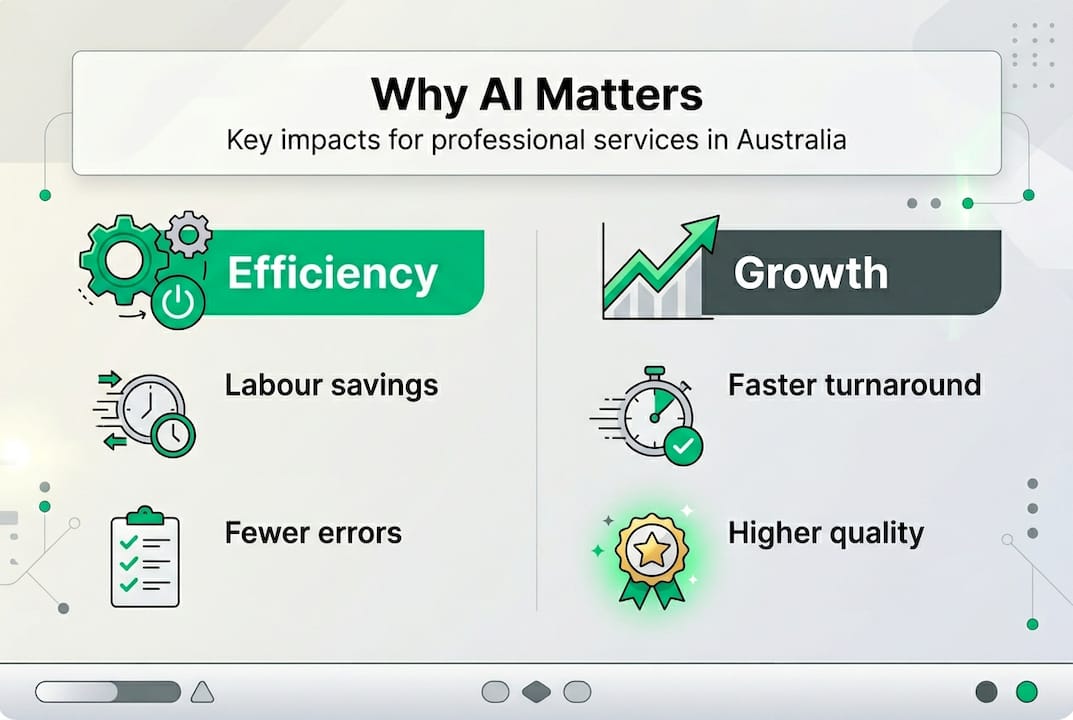
40% adoption rate: Australian professional services firms have doubled their AI use in two years, with 80% integrating it into weekly workflows.
Operational efficiency and productivity gains with AI
AI streamlines critical processes that traditionally consumed substantial professional time and introduced human error. Document processing, approval workflows, audit procedures, and client communications all benefit from intelligent automation. The efficiency gains range from 35% to 61% depending on task complexity and data structure, with document-heavy and data-intensive processes showing the strongest improvements.

Labour savings combine with faster turnaround times and lower error rates to create compounding value. When 41% of businesses save more than 25% in labour costs, those savings free up professional staff for higher-value advisory work that clients value most. A legal firm that automates contract review can redeploy lawyers to strategic client counselling. An accounting practice that automates reconciliation can focus on tax planning and business advisory services.
Efficiency gains vary significantly by process type and implementation approach:
| Process type | Typical efficiency gain | Labour time saved | Best AI approach |
|---|---|---|---|
| Document processing | 60-75% | 40-50% | Template recognition, extraction |
| Data entry and reconciliation | 50-65% | 35-45% | Automated classification, matching |
| Research and synthesis | 40-55% | 30-40% | Natural language processing, summarisation |
| Client communications | 35-50% | 25-35% | Chatbots, response templates |
| Compliance checking | 45-60% | 30-40% | Rule-based validation, flagging |
Pro Tip: Focus on automating high-volume, low-risk processes first to maximise ROI and minimise disruption. Start with tasks that have clear inputs, structured outputs, and low consequences for errors, such as invoice processing or meeting transcription, before moving to higher-stakes applications like client advice or regulatory submissions.
The productivity benefits extend beyond time savings to quality improvements. AI systems maintain consistency across large volumes, catching errors that humans might miss during repetitive tasks. They work continuously without fatigue, processing overnight batches that would require overtime staffing. This combination of speed, accuracy, and availability transforms operational capacity, allowing firms to handle greater workloads without proportional staffing increases. Professional services AI efficiency creates scalability that traditional labour models cannot match.
Challenges and risks in adopting AI for professional services
AI hallucinations pose serious credibility risks when systems generate plausible but false information. The Deloitte report incident demonstrated how AI hallucinations led to fabricated citations in expert analysis, damaging professional reputation and raising questions about quality control. When your business reputation depends on accuracy and expertise, even occasional AI errors can undermine client trust and expose you to liability.
Regulatory scrutiny intensifies for professional services using AI, particularly in legal opinions, financial advice, and expert reports. Regulators expect firms to validate AI outputs and maintain human accountability for all client-facing work. Data leakage presents another major risk, as confidential client information fed into commercial AI platforms may be used for model training or inadvertently exposed. Strict governance and comprehensive staff training become essential safeguards rather than optional enhancements.
Key risks requiring active management include:
- AI generating false citations, case law, or precedents
- Confidential client data leaking through third-party AI platforms
- Bias in AI recommendations affecting client outcomes
- Regulatory non-compliance due to inadequate human oversight | Unauthorised use of AI by staff without proper training
- Over-reliance on AI reducing critical thinking and professional judgement
Only 18% of firms track AI ROI accurately, whilst Australians lag the global investment pace despite strong adoption rates.
Measuring ROI remains neglected despite its critical importance in justifying AI investment. Only 18% of firms track AI ROI reliably, creating a blind spot that prevents optimisation and makes it difficult to demonstrate value to partners or boards. Without clear metrics linking AI use to revenue growth, cost reduction, or client satisfaction, firms struggle to prioritise AI initiatives or scale successful pilots.
The challenge extends beyond technical implementation to organisational change management. Staff may resist AI adoption due to job security concerns or scepticism about its value. Partners accustomed to traditional workflows may underinvest in training and governance. Clients may question whether AI-assisted work justifies professional fees. Addressing these human factors requires transparent communication, demonstrated value, and clear policies that define appropriate AI use whilst preserving professional standards. AI integration consulting helps navigate these complex organisational and technical challenges with tailored frameworks for your sector.
Practical steps to harness AI effectively in your business
Successful AI adoption follows a structured approach that balances opportunity with risk management. Start with high-volume, low-risk processes using agentic AI frameworks that maintain human oversight whilst automating routine tasks. This approach delivers quick wins that build organisational confidence and provide learning opportunities before tackling higher-stakes applications.
-
Identify high-volume, low-risk processes for initial AI application. Map your workflows to find repetitive tasks with clear inputs and outputs, such as document classification, data extraction, or initial client inquiry responses. These processes offer measurable efficiency gains whilst minimising the impact of potential errors.
-
Implement AI governance frameworks to manage risk and compliance. Establish clear policies defining acceptable AI use, data handling requirements, output validation procedures, and escalation protocols. Document these frameworks to demonstrate regulatory compliance and create accountability for AI-assisted work.
-
Use retrieval-augmented generation (RAG) and human-in-the-loop review to reduce hallucinations. RAG systems ground AI responses in your verified knowledge base rather than relying solely on pre-trained models. Human review catches errors before they reach clients, maintaining quality standards whilst leveraging AI efficiency.
-
Establish internal metrics to measure ROI and efficiency gains continuously. Track time saved, error rates, client satisfaction, and cost per transaction for AI-assisted processes. Compare these metrics against baseline performance to quantify value and identify optimisation opportunities.
-
Scale AI adoption gradually, ensuring knowledge security and comprehensive user training. Expand from pilot processes to adjacent workflows once you've validated benefits and refined governance. Train all users on appropriate AI use, output validation, and data security to prevent unauthorised or risky applications.
Pro Tip: Ownership of AI internal schemas helps prevent knowledge heist and builds client trust. When you control the knowledge base and fine-tuning data, you protect proprietary expertise and client confidentiality whilst ensuring AI outputs align with your firm's standards and methodology.
The scaling phase requires particular attention to change management and continuous improvement. Monitor AI performance across different use cases, gathering feedback from users about accuracy, usefulness, and workflow integration. Adjust governance policies as you learn what works and where risks emerge. Celebrate wins to build momentum whilst addressing concerns transparently. This iterative approach allows you to capture AI's benefits whilst maintaining the professional standards that differentiate your services. AI adoption steps for services provides detailed guidance tailored to your sector's specific requirements and regulatory environment.
Drive your AI transformation with expert support
Navigating AI adoption successfully requires expertise in both technology and your specific sector. Expert consultants guide you through AI roadmap development and implementation, translating technical possibilities into practical business outcomes. Tailored strategies for professional services maximise efficiency and compliance whilst respecting the unique requirements of legal, accounting, consulting, and advisory firms.
Support includes governance frameworks that protect your business and clients, ROI measurement systems that demonstrate value to stakeholders, user training that builds confidence and capability, and ongoing optimisation that captures emerging opportunities. This end-to-end approach ensures AI delivers sustained benefits rather than creating new problems or abandoned pilots. AI integration consultants bring vendor-agnostic advice and hands-on implementation experience to accelerate your AI journey whilst managing risk.
The benefits extend beyond professional services to transform operations across industries. Whether you're optimising AI solutions for professional services or exploring applications in retail, logistics, healthcare, or manufacturing, expert guidance helps you avoid costly mistakes and capture value faster. AI solutions for retail business demonstrate how tailored approaches address sector-specific challenges and opportunities, delivering measurable results that justify investment and build competitive advantage.
Frequently asked questions about AI for professional services
What are the easiest processes to automate with AI in professional services?
Document processing, data entry, meeting transcription, and initial client inquiry responses offer the easiest automation opportunities. These high-volume, structured tasks deliver measurable efficiency gains with minimal risk, making them ideal starting points for AI adoption. Focus on processes where errors have low consequences and outputs are easily validated.
How can I measure the ROI of AI implementations effectively?
Track time saved, cost per transaction, error rates, and client satisfaction for AI-assisted processes compared to baseline performance. Establish metrics before implementation to enable accurate comparison. Include both direct labour savings and indirect benefits like faster turnaround times and improved capacity to handle peak workloads without additional staffing.
What risks should I be most aware of when using AI to support legal or expert reports?
AI hallucinations creating false citations or precedents pose the greatest risk to professional credibility and client outcomes. Implement mandatory human review of all AI-generated content, use retrieval-augmented generation grounded in verified sources, and maintain clear documentation of AI's role in work product. Regulatory scrutiny requires demonstrable human accountability for all client-facing advice.
How do I ensure data security when deploying AI solutions?
Implement strict governance controlling what data enters AI systems, favouring on-premise or private cloud deployments for confidential information. Train staff on data handling requirements and monitor AI platform terms of service regarding data use for model training. Consider contractual protections with AI vendors and regular security audits to identify vulnerabilities before they're exploited.
Can AI reduce labour costs without sacrificing service quality?
Yes, when implemented thoughtfully with appropriate governance and human oversight. AI handles routine tasks faster and more consistently than humans, freeing professional staff for higher-value work that clients value most. The key is maintaining quality through validation processes whilst capturing efficiency gains, then reinvesting saved time into advisory services that differentiate your firm. Professional services AI FAQs provides additional guidance on balancing efficiency with quality standards.
How long does it typically take to see ROI from AI implementations?
Most firms see measurable efficiency gains within three to six months for well-scoped pilot projects focused on high-volume processes. Full ROI including implementation costs typically materialises within 12 to 18 months as you scale successful pilots and optimise workflows. Quick wins from document automation or data processing build momentum for longer-term strategic applications that deliver compounding value over time.