
Many Australian businesses assume that off-the-shelf AI tools will quickly transform their operations and deliver immediate returns. Yet 85% of AI projects fail without tailoring to specific enterprise needs, leaving decision-makers frustrated and budgets wasted. Generic AI platforms often plateau after initial deployment, struggling with unique workflows, compliance demands, and domain-specific challenges that define Australian industries. This article explores why custom AI solutions consistently outperform generic alternatives, delivering measurably higher ROI, stronger productivity gains, and long-term strategic value for businesses willing to invest in bespoke technology that truly fits their operations.
Table of Contents
- Key takeaways
- Why off-the-shelf AI often falls short for Australian businesses
- How custom AI solutions are developed to fit your business
- The measurable benefits of custom AI for Australian businesses
- Navigating edge cases, compliance, and ongoing optimisation in custom AI
- Discover tailored AI solutions for your industry
- Frequently asked questions
Key Takeaways
| Point | Details |
|---|---|
| Custom AI ROI gains | Bespoke AI solutions deliver higher long term ROI and productivity gains for Australian businesses. |
| Regulatory aligned design | Generic tools often miss Australian Privacy Principles and sector regulations, creating risk and manual workarounds. |
| Edge case reliability | Custom AI better handles domain specific edge cases, improving reliability in Australian operations. |
| Iterative development approach | Development is iterative, focusing on precision, compliance and ongoing model tuning. |
Why off-the-shelf AI often falls short for Australian businesses
Generic AI solutions promise quick deployment and immediate value, but they fundamentally lack the deep integration required to address unique enterprise data structures and workflows. These platforms are built for broad market appeal, not the specific operational realities of Australian manufacturing plants, healthcare providers, or financial institutions. When businesses attempt to force-fit generic tools into complex existing systems, they encounter persistent friction that undermines adoption and erodes potential returns.
Compliance represents another critical weakness. Australian Privacy Principles impose strict requirements on how businesses collect, store, and process personal information. Generic AI products rarely account for these jurisdiction-specific regulations, leaving businesses exposed to legal risks and forcing manual workarounds that negate efficiency gains. Industries like healthcare and finance face even more stringent regulatory frameworks that demand custom approaches to data handling and decision transparency.
The value plateau effect becomes evident within months of deployment. Standard chatbots handle basic customer queries effectively at first, but quickly reveal their limitations when customers ask nuanced questions or require personalised assistance. Predictive maintenance tools trained on generic datasets fail to recognise the specific failure patterns of equipment used in Australian mining operations or manufacturing facilities. These limitations stem from the fundamental mismatch between generic training data and the unique operational context of individual businesses.
Australian enterprises increasingly recognise these shortcomings. A New South Wales manufacturing company implementing AI for manufacturing discovered that generic predictive maintenance tools missed critical equipment failure patterns specific to their production line, resulting in costly unplanned downtime. Similarly, Australian banks developing fraud detection systems found that off-the-shelf solutions struggled with local transaction patterns and regulatory reporting requirements, necessitating extensive customisation that negated the supposed simplicity of generic products.
Key limitations of generic AI include:
- Inability to capture proprietary business logic and competitive advantages
- Poor performance on edge cases specific to your industry or region
- Limited scalability as business needs evolve beyond standard features
- Lack of intellectual property ownership, creating vendor dependency
- Insufficient transparency for high-stakes decisions requiring explainability
"The real challenge isn't implementing AI technology. It's ensuring that technology actually understands and serves the specific needs of your business, your customers, and your regulatory environment. Generic solutions simply can't deliver that level of precision."
Businesses pursuing AI for professional services face similar challenges. Legal firms require AI that understands Australian case law and jurisdiction-specific terminology. Accounting practices need tools that handle Australian tax regulations and reporting standards. Generic international products rarely provide this level of localisation, forcing professionals to maintain parallel manual processes that defeat the purpose of automation.
How custom AI solutions are developed to fit your business
Developing custom AI begins with precisely framing the business problem you're solving. This crucial first step involves working closely with stakeholders across departments to identify specific pain points, quantify current performance metrics, and define clear success criteria. Unlike generic implementations that start with available features, custom development starts with your actual needs and builds technology to match them exactly.
The development process follows a structured yet flexible approach:
-
Problem framing and requirements gathering: Document current workflows, identify bottlenecks, establish measurable objectives, and define constraints including budget, timeline, and compliance requirements.
-
Domain-specific data preparation: Collect and clean data relevant to your specific use case, ensuring compliance with Australian Privacy Principles. This includes structuring proprietary datasets, labelling examples, and establishing data governance protocols.
-
Model selection and fine-tuning: Choose appropriate base models and customise them using techniques like Low-Rank Adaptation (LoRA), which modifies just 1% of parameters while achieving substantial performance improvements for your specific domain.
-
Rigorous evaluation and testing: Test models against unseen data, edge cases, and adversarial inputs to ensure reliability across the full range of scenarios your business encounters, not just common cases.
-
Deployment and ongoing monitoring: Implement MLOps tools to track model performance, detect drift, identify emerging biases, and trigger retraining when accuracy degrades or business conditions change.
Human oversight remains essential throughout this process. High-stakes decisions in AI for healthcare applications require medical professionals to review AI recommendations before implementation. Financial institutions using custom fraud detection maintain human analysts who investigate flagged transactions and provide feedback that continuously improves model accuracy. This human-in-the-loop approach ensures AI augments rather than replaces professional judgement in critical situations.
The iterative nature of custom development allows businesses to start with focused applications and expand gradually. A logistics company might begin with route optimisation for a single depot, validate results, then roll out across the network. This phased approach reduces risk, builds organisational confidence, and allows continuous refinement based on real-world performance data.
Manufacturers implementing AI for manufacturing benefit from models trained on their specific equipment, production schedules, and quality standards. Rather than generic predictive maintenance that alerts on standard failure patterns, custom systems learn the unique signatures of your machinery, environmental conditions, and operational practices. This precision dramatically reduces false positives while catching genuine issues earlier.
Pro Tip: Schedule quarterly model reviews to assess performance against evolving business conditions, regulatory changes, and new data patterns. Regular updates maintain accuracy and ensure your AI continues delivering value as your business grows and market conditions shift.
The measurable benefits of custom AI for Australian businesses
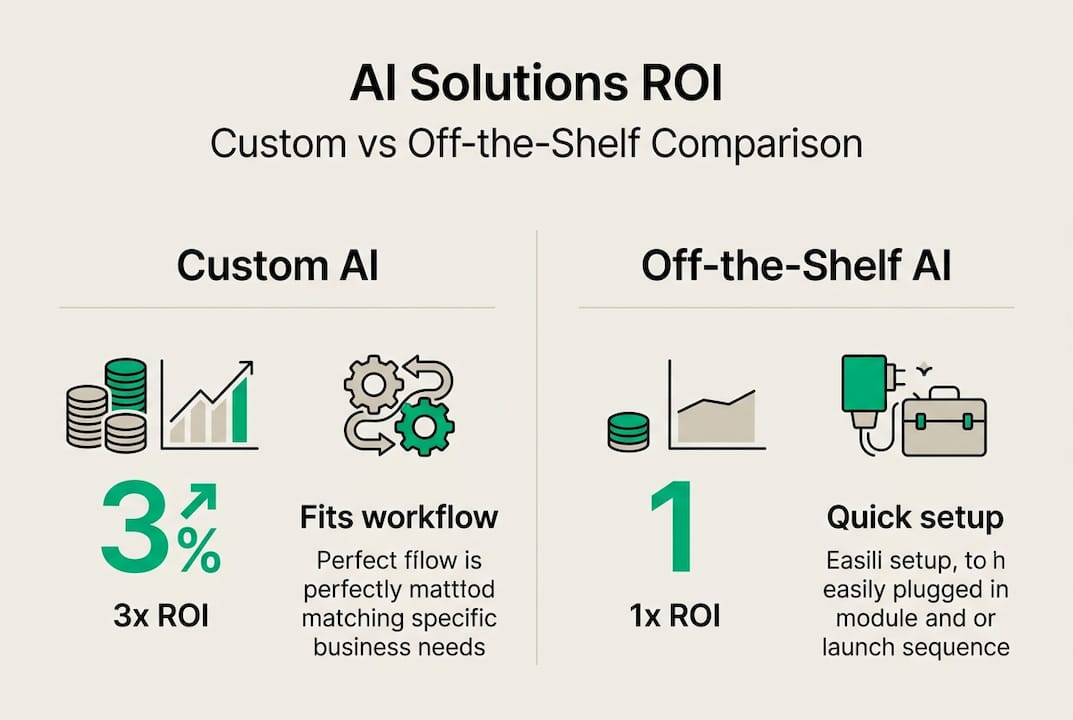
While custom AI requires higher initial investment than off-the-shelf alternatives, the long-term financial returns justify this upfront cost for businesses serious about competitive advantage. Custom AI delivers three times higher ROI compared to generic solutions, according to enterprise deployment data. This superior performance stems from precise alignment between AI capabilities and actual business needs, eliminating the waste inherent in one-size-fits-all approaches.
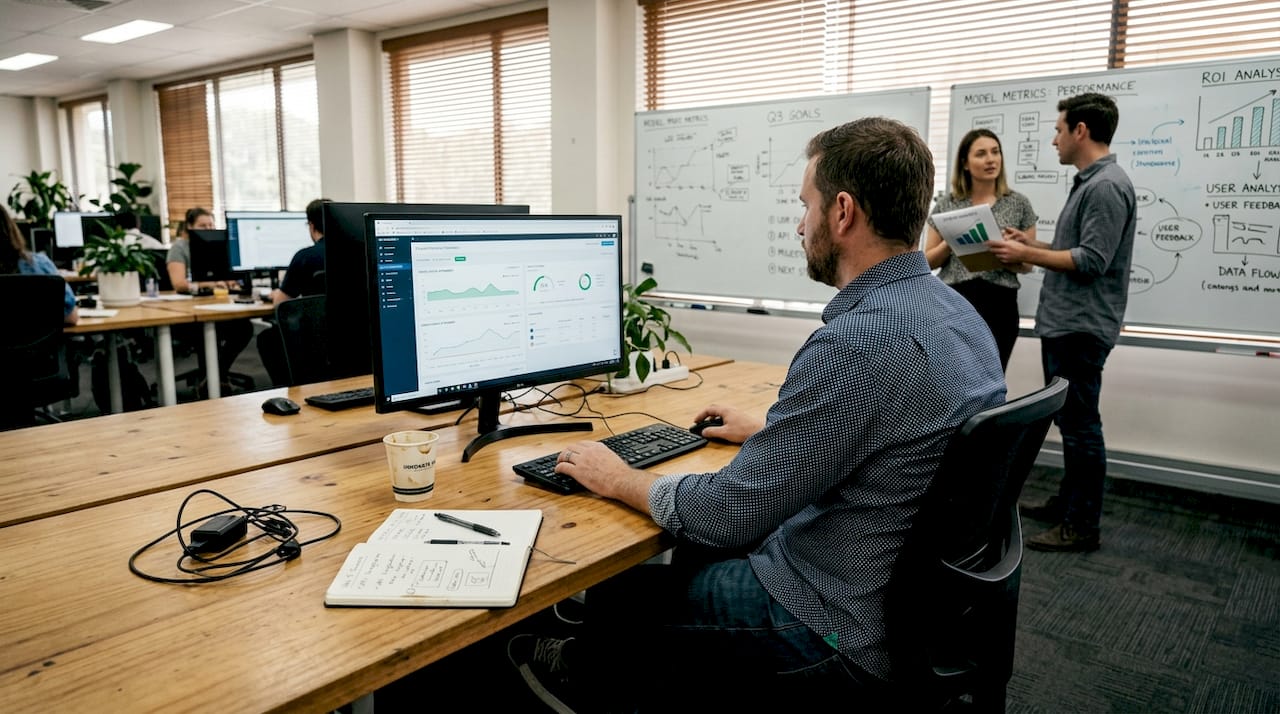
Real-world Australian implementations demonstrate these benefits concretely. Carer Solutions, an aged care provider, achieved 64% to 121% ROI in the first year of custom AI deployment, with operational cost reductions becoming more pronounced in year two as the system optimised staffing patterns and resource allocation. These results far exceed typical returns from generic workforce management tools that lack the nuanced understanding of aged care regulations and client needs.
Productivity improvements represent another substantial benefit. Businesses implementing custom AI report efficiency gains between 30% and 60%, freeing staff to focus on higher-value activities that require human creativity and judgement. A Sydney-based AI for retail implementation automated inventory forecasting with 30% greater accuracy than previous generic tools, reducing stockouts and overstock situations that previously cost the business significant revenue and storage expenses.
Forecast accuracy improvements of 30% translate directly to better decision-making across operations. Procurement teams order the right quantities at optimal times. Marketing allocates budgets to channels that actually drive conversions. Production schedules match demand without excess capacity or shortages. These incremental improvements compound over time, creating substantial competitive advantages that generic AI simply cannot deliver.
| Metric | Custom AI | Off-the-Shelf AI |
|---|---|---|
| ROI multiplier | 3x baseline | 1x baseline |
| Productivity gain | 30-60% improvement | 10-20% improvement |
| Forecast accuracy | +30% vs previous methods | +10-15% vs previous methods |
| Year 1 ROI range | 64-121% | 20-40% |
| Payback period | 12-18 months | 18-24 months |
| Long-term cost trend | Decreasing after year 2 | Stable or increasing |
Construction and trades businesses implementing AI for trades and construction see particularly strong returns from custom solutions that understand project-specific variables like Australian building codes, local supplier networks, and seasonal weather patterns. Generic project management AI lacks this contextual intelligence, providing recommendations that sound reasonable in theory but fail in practice because they ignore crucial local factors.
Pro Tip: When evaluating custom AI investment, calculate total cost of ownership over three to five years rather than focusing solely on initial development costs. Include the value of competitive differentiation, intellectual property ownership, and avoided costs from regulatory compliance failures that generic solutions might cause.
Navigating edge cases, compliance, and ongoing optimisation in custom AI
Edge cases expose the fundamental difference between custom and generic AI. A generic customer service chatbot trained on broad datasets handles common queries adequately but fails when customers ask industry-specific questions, use regional terminology, or describe unusual but legitimate scenarios. Custom AI trained on your actual customer interactions and product knowledge recognises these situations and responds appropriately, maintaining service quality across the full spectrum of real-world interactions.
Adversarial inputs represent another critical challenge. Malicious actors deliberately craft inputs designed to confuse AI systems, potentially causing incorrect decisions or exposing sensitive information. Custom AI achieves over 90% accuracy by incorporating adversarial testing during development, compared to 70-80% accuracy typical of generic solutions that haven't been hardened against domain-specific attack vectors. This reliability matters enormously in high-stakes applications like fraud detection, medical diagnosis, or safety-critical manufacturing processes.
Australian regulatory compliance demands careful attention to how AI systems collect, process, and store personal information. The Privacy Act 1988 and Australian Privacy Principles establish strict requirements that vary by industry and use case. Custom AI development builds these constraints directly into system architecture, data pipelines, and decision processes. Generic international products rarely provide this level of compliance integration, forcing businesses to implement costly workarounds or accept regulatory risks.
Key compliance considerations for Australian businesses include:
- Transparent data collection practices with explicit consent mechanisms
- Secure storage meeting Australian data sovereignty requirements
- Explainable AI decisions for applications affecting individuals
- Regular audits of algorithmic bias and fairness across demographic groups
- Incident response procedures for data breaches or system failures
- Documentation proving compliance with industry-specific regulations
Human-in-the-loop processes provide essential safeguards for high-stakes decisions. AI for health and beauty applications might flag potential drug interactions or contraindications, but qualified healthcare professionals review these alerts before making final treatment decisions. This combination of AI efficiency and human expertise delivers better outcomes than either approach alone while maintaining appropriate accountability.
| Factor | Custom AI | Off-the-Shelf AI |
|---|---|---|
| Edge case accuracy | >90% on domain-specific scenarios | 70-80% on uncommon situations |
| Compliance integration | Built into architecture from start | Requires manual workarounds |
| Bias detection | Continuous monitoring for your data | Generic fairness metrics |
| Adaptability | Regular updates based on your needs | Vendor-controlled update schedule |
| Explainability | Transparent for your use cases | Black box or generic explanations |
Model drift occurs when AI performance degrades over time as real-world conditions diverge from training data. Custom AI implementations include monitoring systems that detect drift early and trigger retraining with updated data. This ongoing optimisation maintains accuracy as customer behaviour evolves, market conditions shift, or your business introduces new products and services. Generic solutions typically lack this adaptive capability, requiring businesses to accept declining performance or purchase expensive upgrades.
Professional services firms using AI for professional services particularly benefit from ongoing optimisation. Legal precedents change, tax regulations update, and industry best practices evolve. Custom AI systems incorporate these changes continuously, ensuring advice remains current and compliant. Generic tools often lag months or years behind regulatory changes, creating liability risks for firms relying on outdated recommendations.
Discover tailored AI solutions for your industry
Implementing custom AI that delivers measurable ROI requires expertise in both artificial intelligence technology and your specific industry context. ORVX AI specialises in developing bespoke AI solutions for Australian businesses across diverse sectors, from manufacturing and healthcare to professional services and retail. Our consultants work directly within your team to understand workflows, identify high-value opportunities, and build AI systems that integrate seamlessly with existing operations while ensuring full regulatory compliance.
Whether you're exploring AI for manufacturing to optimise production schedules, implementing AI for healthcare to improve patient outcomes, or developing custom solutions for your unique business challenges, our vendor-agnostic approach ensures you receive technology recommendations based solely on your needs rather than product partnerships. We guide you from initial audit through full deployment and ongoing optimisation, maximising returns while minimising risk. Contact ORVX AI today to begin your custom AI journey.
Frequently asked questions
What makes custom AI solutions better than off-the-shelf options?
Custom AI integrates precisely with your unique workflows, data structures, and regulatory requirements rather than forcing your business to adapt to generic software limitations. It handles industry-specific edge cases, maintains higher accuracy on domain-specific tasks, and provides intellectual property ownership that creates lasting competitive advantages. While initial investment is higher, custom solutions deliver three times the ROI of generic alternatives by solving your actual problems rather than providing broad features you may never use.
How long does it take to see ROI from a custom AI solution?
Most Australian businesses achieve positive ROI between 64% and 121% within the first year of custom AI deployment, with returns accelerating in subsequent years as systems optimise and operational costs decrease. The exact timeline depends on implementation scope and business complexity, but phased rollouts allow you to validate returns from initial modules before expanding investment. Cost reductions typically become more pronounced by year two as the system matures and staff fully adopt new workflows.
Can custom AI solutions ensure compliance with Australian privacy laws?
Custom AI development incorporates Australian Privacy Principles and industry-specific regulations directly into system architecture from the start. Custom solutions handle Australian PII requirements effectively by building legal constraints into data collection, storage, processing, and decision-making processes. Ongoing monitoring flags potential compliance risks early, while human oversight ensures high-stakes decisions meet regulatory standards. Generic international products rarely provide this level of localised compliance integration.
What industries benefit most from custom AI in Australia?
Every industry gains advantages from custom AI, but sectors with complex regulatory requirements, unique operational processes, or high-stakes decisions see particularly strong returns. Manufacturing benefits from equipment-specific predictive maintenance. Healthcare gains from patient-specific treatment recommendations. Professional services leverage domain-specific knowledge systems. Retail optimises inventory for local demand patterns. The key is matching AI capabilities to your specific business challenges rather than accepting generic features designed for broad markets.
How do you prevent custom AI from becoming outdated?
Custom AI implementations include ongoing monitoring and optimisation as core components rather than one-time deployments. MLOps tools track model performance, detect drift, and trigger retraining when accuracy degrades or business conditions change. Quarterly reviews assess performance against evolving requirements, regulatory updates, and new data patterns. This continuous improvement approach ensures your AI maintains relevance and accuracy as your business grows, markets shift, and technology advances, delivering sustained value over years rather than months.