
TL;DR:
- Nearly half of Australian hospitality SMBs use AI, reporting operational and financial improvements.
- AI technologies like predictive analytics, generative AI, and reinforcement learning are transforming bookings, fraud prevention, staffing, and waste reduction.
- Start small with targeted AI applications, gradually scaling to enhance efficiency, guest experience, and data insights.
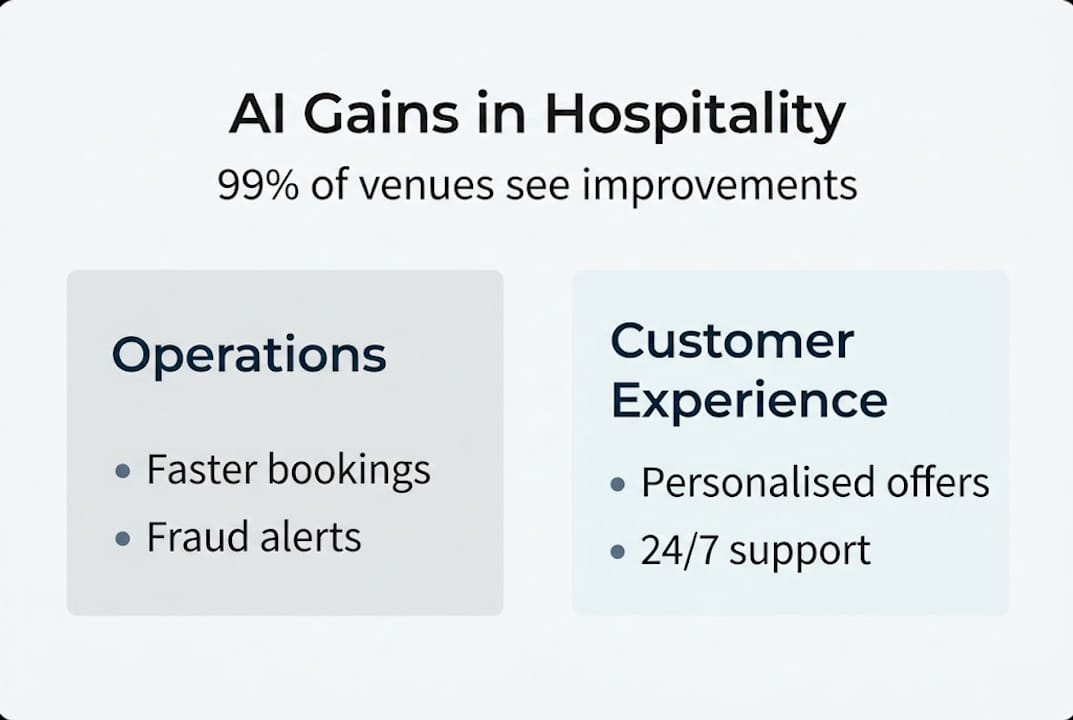
Nearly half of all small and medium hospitality businesses in Australia are already running AI in some form, and 99% report gains from doing so. Yet plenty of venue owners and managers still think AI is either too complex, too expensive, or simply not relevant to their operation. That gap between perception and reality is costing businesses real money. This article cuts through the noise and explains exactly how AI is reshaping hospitality across Australia, which technologies actually matter, what measurable outcomes venues are achieving, and how to approach adoption without unnecessary risk.
Table of Contents
- How AI is changing the hospitality landscape in Australia
- The main AI technologies in hospitality explained
- Why leading venues rely on AI: Operational, customer, and analytics benefits
- Navigating the challenges: What to know before adopting AI
- A practical perspective: What most hospitality leaders overlook
- Ready to bring AI to your venue?
- Frequently asked questions
Key Takeaways
| Point | Details |
|---|---|
| Rapid Australian uptake | AI is used by 42% of Australian hospitality SMBs and delivers proven gains. |
| Multiple AI technologies | Predictive analytics, generative AI, and RL tackle different pain-points from bookings to maintenance. |
| ROI is real and fast | Most venues see operational improvements and cost savings soon after adopting targeted AI tools. |
| Start with high-impact areas | Pilot projects in bookings or rostering can deliver results before scaling AI across the venue. |
How AI is changing the hospitality landscape in Australia
The numbers tell a clear story. 42% of Aussie hospitality SMBs use AI today, and almost every single one of them reports operational or financial improvements as a direct result. This is not a fringe technology being tested by a handful of forward-thinking venues. It is rapidly becoming standard practice across hotels, restaurants, accommodation providers, and event spaces nationwide.
The shift is being driven by a few converging pressures. Labour shortages have made manual rostering and scheduling unsustainable for many operations. Rising input costs are pushing managers to find savings wherever possible. And guests increasingly expect seamless, personalised experiences that are very difficult to deliver without some level of automation behind the scenes.
Here is a snapshot of where AI is making the biggest difference right now:
- Bookings and reservations: 28% of travellers now use AI tools to research and plan travel, meaning your booking experience needs to match that expectation
- Fraud prevention: Fraud incidents in hospitality have risen by 39%, and AI-powered detection systems are the primary line of defence for payments and transactions
- Rostering and scheduling: AI tools analyse historical demand and predict staffing needs, cutting unnecessary labour spend significantly
- Waste reduction: Predictive inventory systems flag over-ordering and reduce food waste, which directly improves margins
| Area | AI application | Reported benefit |
|---|---|---|
| Bookings | Automated reservation management | Faster conversion, fewer no-shows |
| Fraud | Real-time transaction monitoring | Fewer financial losses |
| Rostering | Demand-based scheduling | Reduced labour costs |
| Inventory | Predictive stock management | Less waste, better margins |
For venues looking to understand hospitality AI efficiency in practical terms, the data is compelling. Those who adopt even one or two targeted tools typically see results within a few months. And for those still weighing up the decision, reviewing adoption strategies for AI tailored to Australian SMBs can help clarify where to start without overcomplicating the process.
The main AI technologies in hospitality explained
AI is not one single thing. It is a collection of different technologies, each suited to different problems. Understanding the three main methodologies used in hospitality helps you make smarter decisions about where to invest.
1. Predictive analytics This is machine learning applied to historical data to forecast future demand. In hospitality, it powers dynamic pricing, occupancy forecasting, and inventory planning. A hotel using predictive analytics can automatically adjust room rates based on projected demand, local events, and seasonal trends, without a revenue manager manually updating spreadsheets every day.
2. Generative AI This is the technology behind AI chatbots and personalised communication tools. It generates human-like responses and content, which is why it works so well for AI-powered guest experience applications. A generative AI chatbot can handle booking enquiries, answer FAQs, upsell add-ons, and respond to complaints around the clock without adding to your headcount.
3. Reinforcement learning This is a more advanced technique where an AI system learns by trial and error, optimising its behaviour over time based on outcomes. In hospitality, it is applied to maintenance scheduling, energy management, and operations optimisation. The system gets better the longer it runs, which means the ROI compounds over time.
Recent research confirms that these three methodologies sit at the core of modern hospitality AI, each addressing a distinct layer of the business from guest-facing service through to back-of-house operations.
| Technology | Best use case | Complexity to implement |
|---|---|---|
| Predictive analytics | Pricing, demand forecasting | Low to medium |
| Generative AI | Chatbots, personalised messaging | Low |
| Reinforcement learning | Maintenance, energy, operations | Medium to high |
Pro Tip: Start with generative AI for guest communications. It is the fastest to deploy, requires the least integration work, and delivers visible improvements to guest satisfaction almost immediately.
These technologies are not mutually exclusive. Many venues layer them over time, beginning with one application and expanding as confidence and capability grow.
Why leading venues rely on AI: Operational, customer, and analytics benefits
The business case for AI in hospitality is strongest when you look at outcomes across three dimensions: operational efficiency, guest experience, and data-driven decision-making. Leading venues in Australia are already realising benefits in all three.

From an operational standpoint, AI minimises the manual workload that consumes management time and increases the risk of human error. Predictive systems monitor quality control indicators and flag issues before they escalate. Automated rostering tools cut labour costs and adapt in real time to variable demand patterns, which is particularly valuable in an industry where staffing needs can shift dramatically within a single day.
On the guest experience side, the impact is just as significant:
- Personalised pre-arrival communication builds anticipation and reduces check-in friction
- AI chatbots handle routine enquiries instantly, freeing staff for higher-value interactions
- Dynamic recommendation engines suggest upgrades, dining options, and experiences based on individual guest profiles
- Automated feedback collection identifies service gaps before they become reputation issues
"The venues pulling ahead are not necessarily spending more. They are spending smarter, using AI to do the repetitive work so their people can focus on genuine hospitality."
The analytics dimension is where AI creates the most durable competitive advantage. Real-time dashboards give managers a live view of revenue, occupancy, and guest sentiment. Waste reduction tools pinpoint where food costs are blowing out. Forecasting models identify which promotional strategies are actually working and which are not.
Pro Tip: Connect your AI analytics tool to your existing PMS or POS system first. The richest insights come from combining operational data with financial data in one view.
For venue managers exploring industry AI for hospitality, the entry point does not need to be a complete overhaul. Even targeted deployment in one area, such as rostering or guest communications, delivers measurable returns that justify the next investment.
Navigating the challenges: What to know before adopting AI
AI adoption in hospitality is not without its hurdles. Understanding them upfront saves time, money, and frustration down the track.
The three most common barriers are fraud risk management, investment hesitation, and legacy system integration. Here is how to approach each:
1. Fraud risk management Fraud incidents in Australian hospitality rose by 39% recently, and manual detection simply cannot keep pace. AI fraud detection tools analyse transaction patterns in real time, flagging anomalies before they result in financial loss. Implementing this early protects revenue and builds trust with payment providers.
2. Investment hesitation Many managers underestimate the ROI potential and overestimate the upfront cost. The most effective approach is incremental adoption. Pick one high-impact use case, measure the result over 60 to 90 days, then reinvest the savings into the next initiative. This model is lower risk and builds internal confidence in AI as a business tool.
3. Legacy system integration Older property management systems, point-of-sale platforms, and booking engines can make AI integration feel daunting. Working with an experienced consultancy ensures the right tools are chosen for your existing tech stack, reducing the friction of getting systems to talk to each other.
"47% of hospitality venues expect AI to dramatically reshape the bookings landscape in the years ahead. The venues preparing now will be better positioned when that shift accelerates."
Key questions to ask before starting:
- Which single operational problem costs us the most time or money right now?
- Do we have clean, accessible data to feed an AI system?
- Who internally will own the AI adoption process?
Following a structured AI implementation guide built for Australian businesses takes much of the guesswork out of the process and reduces the risk of costly missteps.
A practical perspective: What most hospitality leaders overlook
Here is something we see consistently when working with venues across Australia. The biggest barrier to AI adoption is not cost or technology. It is the belief that the whole operation needs to be transformed at once before any benefit is realised. That thinking keeps decision-makers stuck.
The venues moving fastest are those that identify one specific pain point, automate it, measure the outcome, and iterate. That might be automating the weekly roster. It might be deploying a chatbot for after-hours booking enquiries. The scope does not matter nearly as much as the discipline to start and measure.
Australia's regulatory environment and the availability of local AI adoption strategies and support ecosystems make this less risky than many assume. You are not doing this alone. The competitive gap is real, and it widens every quarter. The venues building experience with AI now are accumulating advantages in efficiency, guest satisfaction, and data literacy that will be very hard to replicate in two or three years.
Ready to bring AI to your venue?
If you have seen enough to know that AI belongs in your operation, the next step is finding the right partner to make it work without the usual headaches. ORVX AI works directly with hospitality businesses across Australia, from independent restaurants to multi-property hotel groups, helping them identify the right tools, integrate them cleanly, and measure results from day one.
Our team specialises in specialist AI for hospitality, covering everything from bookings automation and fraud reduction to waste management and guest analytics. We do not sell templated packages. We embed with your team, map your workflows, and build a solution that fits your operation. Visit ORVX AI to book a no-obligation consultation and find out exactly where AI can deliver the fastest return for your venue.
Frequently asked questions
What is the most common use of AI in hospitality venues?
AI is most commonly used for operational efficiency and guest service automation, including rostering, bookings, and fraud prevention. 99% of businesses using AI in Australian hospitality report measurable gains from these applications.
How does AI help combat fraud in hospitality?
AI systems detect suspicious transaction patterns in real time, flagging potential fraud far faster than any manual review process. This is increasingly critical given that fraud has risen 39% across the sector.
Is AI adoption expensive for small venues?
Many AI tools are now affordable and deliver ROI quickly, particularly when focused on targeted pain-points like rostering or booking management. The rostering and waste tools highlighted by industry research show strong cost savings even for smaller operations.
What is the first step to introducing AI into my hospitality business?
Start with a practical pilot in one high-impact area such as bookings or rostering, then measure the results and scale from there. A structured step-by-step implementation guide built for Australian businesses makes this process significantly more straightforward.