TL;DR:
- Australian hospitality venues are already using AI to improve efficiency and guest satisfaction.
- AI focuses on automating routine decisions like dynamic pricing, messaging, and housekeeping coordination.
- Human expertise remains essential for complex issues, while AI enhances staff roles and operational insights.
Many Australian hospitality managers assume AI belongs to large hotel chains with deep pockets or some distant tech future. That assumption is costing venues real money right now. Independent motels, boutique resorts, and mid-size restaurants across Australia are already using AI to cut costs, lift guest satisfaction scores, and free up staff for the work that actually matters. This guide walks you through what AI genuinely does in a hospitality setting, which tools are available locally, where the real benefits sit, what the honest limitations are, and how to take your first practical steps without disrupting your team or blowing your budget.
Table of Contents
- What AI means for the Australian hospitality industry
- Key benefits: How AI drives efficiency and guest satisfaction
- Challenges and limitations: Where human expertise is still essential
- Implementing AI in your venue: Steps and best practices
- Most guides overlook the real key: Human-AI partnership, not replacement
- How OMNX can help your venue thrive with AI
- Frequently asked questions
Key Takeaways
| Point | Details |
|---|---|
| AI delivers practical value | Australian hospitality venues are using AI to cut admin, personalise guest service, and save money. |
| Human roles stay essential | AI can't handle emotional guest care, complex issues, or heritage site challenges—staff still play a vital role. |
| Best practice is step-by-step | Start with a single, visible use case and track results clearly before expanding AI adoption. |
| ROI comes from balance | Combining AI and staff strengths brings the biggest improvements in guest satisfaction and operational efficiency. |
What AI means for the Australian hospitality industry
AI in hospitality is not a robot concierge or a fully automated front desk. In practical terms, it means software that learns from data and automates repetitive decisions, so your team spends less time on admin and more time with guests. Think dynamic room pricing that adjusts automatically based on demand, messaging tools that respond to guest enquiries at 2am, or housekeeping schedules that adapt in real time to occupancy changes.
Several platforms are already embedded in Australian venues. SiteMinder, RMS Cloud, and Optii are widely used for revenue management, guest communications, and housekeeping optimisation respectively. These are not experimental tools. They are production-ready systems that integrate with existing property management software.
Here is what AI is actually doing for Australian venues right now:
- Dynamic pricing: Adjusting room rates automatically based on local events, competitor availability, and booking pace
- Guest messaging: Sending pre-arrival information, upsell offers, and post-stay surveys without manual effort
- Housekeeping coordination: Prioritising room cleans based on check-out times and staff location
- Predictive maintenance: Flagging equipment issues before they become guest complaints
- Review monitoring: Aggregating and summarising online feedback across platforms
What AI is not doing is replacing your experienced staff or solving every operational problem overnight. Heritage-listed properties, venues with complex physical layouts, and businesses with fragmented data will face real constraints.
"The most effective AI adoption in hospitality is incremental. Venues that try to automate everything at once typically see poor uptake and frustrated teams."
The AI for Australian hospitality landscape is maturing fast. Independent operators are no longer priced out. Many tools now offer subscription pricing that suits smaller venues, and the compliance landscape around data privacy is becoming clearer for Australian businesses.
Key benefits: How AI drives efficiency and guest satisfaction
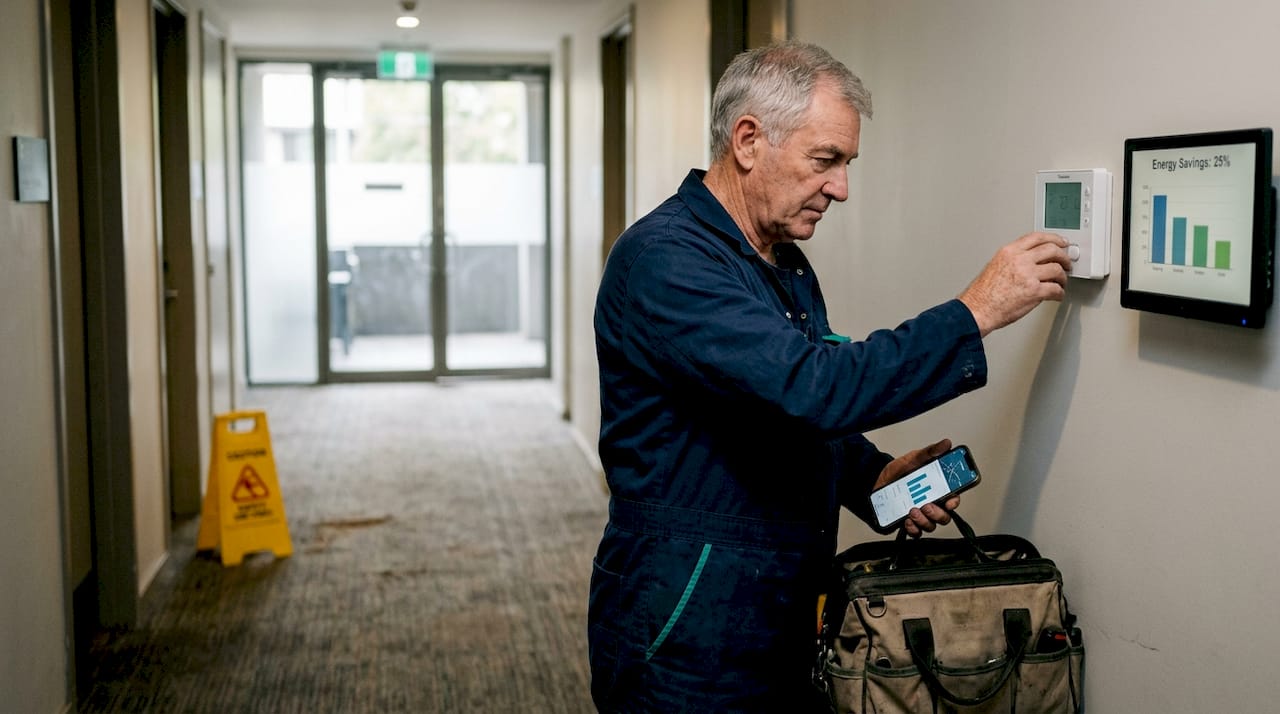
The business case for AI in hospitality comes down to three areas: revenue uplift, cost reduction, and guest experience improvement. Each one compounds the others when implemented well.
AI implementation can raise RevPAR by 15% and yield energy savings of 25% through smart building management. Those are not marginal gains. For a 60-room property running at average Australian room rates, a 15% RevPAR improvement can mean hundreds of thousands of dollars annually.
| Benefit area | Example outcome | Typical AI tool |
|---|---|---|
| Revenue management | 10 to 15% RevPAR uplift | SiteMinder, RateGain |
| Energy management | 20 to 25% reduction in costs | Smart building platforms |
| Guest messaging | 30% faster response times | RMS Cloud, Whistle |
| Housekeeping efficiency | 15% fewer labour hours | Optii, HotSOS |
| Review scores | 0.3 to 0.5 star improvement | Revinate, TrustYou |
Beyond the numbers, AI boosts hotel efficiency by removing friction from the guest journey. Automated check-in messages, personalised room preferences stored from previous stays, and instant responses to common questions all create a smoother experience without adding to your team's workload.
Pro Tip: Start with one guest-facing win, such as automated pre-arrival messaging. Guests notice it immediately, it costs relatively little to implement, and it builds internal confidence in AI before you tackle back-of-house automation.
For hospitality AI case studies from Australian venues, the pattern is consistent. Properties that focus on visible, guest-noticeable improvements first tend to get stronger staff buy-in and faster ROI than those that start with invisible back-end changes.
The administration benefits matter too. Fewer manual rate updates, automated reporting, and smarter scheduling mean your managers spend less time on spreadsheets and more time coaching their teams and building guest relationships.
Challenges and limitations: Where human expertise is still essential
AI is not a universal fix. Understanding where it falls short is just as important as knowing where it excels.
Physical barriers, nuanced guest care, skills gaps, and unclear ROI tracking remain major AI challenges in hospitality. A heritage property with no central HVAC system cannot deploy smart energy management. A boutique venue where guests expect deeply personal service cannot automate the warmth of a genuine human interaction.
| Task type | AI-suited | Human-essential |
|---|---|---|
| Rate adjustments | Yes | No |
| Routine guest messaging | Yes | No |
| Conflict resolution | No | Yes |
| Emergency response | No | Yes |
| Personalised recommendations | Partially | Yes |
| Complex complaints | No | Yes |
The skills gap issue is real. 62% of venues cite lack of internal AI expertise as a significant barrier to adoption. Another 51% report unclear strategies as the reason projects stall before they deliver results.
"The AI reliance score in hospitality sits at just 4.7 out of 10, reflecting that most venues are still in early stages and heavily dependent on human judgement for anything outside routine operations."
Here is a practical approach to mitigating these risks:
- Audit your team's digital confidence before selecting any tool. A system your staff won't use is money wasted.
- Map your guest journey and identify only the touchpoints where automation genuinely improves the experience.
- Choose tools with strong local support, so you are not relying on offshore helpdesks when something breaks mid-peak season.
- Pilot with one department before rolling out venue-wide. Housekeeping or reservations are good starting points.
- Build in a human review step for any AI-generated communication that goes to guests. Probabilistic errors in automated messages can damage trust quickly.
Review integration best practices before committing to any platform, and consult a proper AI implementation guide to avoid the most common rollout mistakes.
Implementing AI in your venue: Steps and best practices
A structured approach separates venues that see genuine returns from those that spend money on tools that gather dust.
Start by assessing readiness honestly. Look at your current infrastructure, your team's comfort with digital tools, and the quality of your existing data. AI systems are only as good as the data you feed them. If your booking records are fragmented or your CRM is incomplete, fix that first.
42% of venues don't track ROI on AI at all, which means they have no idea whether their investment is working. Set your KPIs before you go live, not after.
Follow these AI project steps to build a solid foundation:
- Identify your top three pain points. Where are staff spending time on tasks that don't require human judgement? Where are guests experiencing friction?
- Shortlist two or three tools that address those specific pain points. Avoid platforms that promise to do everything.
- Run a 60-day pilot with one tool in one department. Measure the outcome against your baseline KPIs.
- Train your team properly. Allocate real time for onboarding, not just a 30-minute walkthrough. Designate an internal champion.
- Review and adjust. After the pilot, decide whether to expand, switch tools, or pause.
- Scale gradually. Add one new use case every quarter rather than overhauling everything at once.
On compliance, Australian privacy law requires that guest data collected by AI systems is stored securely, used only for disclosed purposes, and accessible to guests on request. Choose vendors who are transparent about data handling and can demonstrate compliance with the Australian Privacy Act.
Pro Tip: Your KPIs should cover at least four dimensions: cost savings, revenue impact, guest satisfaction scores, and staff time recovered. Tracking all four gives you a complete picture of whether AI is actually delivering value.
Outside consultants can accelerate this process significantly, particularly for venues without in-house technical expertise. The right partner brings vendor-agnostic advice and implementation experience that reduces trial-and-error costs.
Most guides overlook the real key: Human-AI partnership, not replacement
Here is the uncomfortable truth most AI articles skip past. The venues seeing the best results are not the ones that have automated the most. They are the ones that have been deliberate about where they apply AI and why.
We have seen properties improve both staff morale and guest satisfaction scores simultaneously, not because they removed human roles, but because they removed the frustrating, repetitive parts of those roles. Staff who spend less time on manual data entry and more time on genuine guest interaction report higher job satisfaction. Guests notice the difference.
The AI Compass framework offers a useful filter: only apply AI where it saves meaningful energy, where the outcome is explainable, where guests will notice the improvement, and where the system can adapt to your specific context. If a proposed AI application fails any of those four tests, it is probably not worth the investment yet.
The balance between AI and human judgement is achieved through this kind of selective empowerment, not wholesale automation. Empathy, quick thinking in a crisis, and genuine warmth are not skills you can replicate with software. They are your competitive advantage. AI should protect and amplify those qualities, not compete with them.
How OMNX can help your venue thrive with AI
If you are ready to move from curiosity to action, having the right partner makes a significant difference. ORVX AI works directly with Australian hospitality businesses to assess readiness, identify the highest-impact use cases, and manage implementation from start to finish.
Our approach is hands-on and vendor-agnostic. We embed with your team, map your actual workflows, and recommend tools that fit your venue's size, budget, and guest experience goals. We also handle staff training and ongoing performance reviews, so your AI investment keeps delivering. Whether you manage a single boutique property or a multi-site operation, explore AI for hospitality solutions built for the Australian market, or visit ORVX AI to request a consultation with our team today.
Frequently asked questions
What is the simplest AI tool I can start with in my hotel?
Revenue management platforms like SiteMinder or guest messaging with RMS Cloud are straightforward starting points widely used across Australian venues with minimal setup complexity.
How much expertise do I need on staff to run AI solutions?
Most modern hospitality AI tools are designed for non-technical teams, but 62% of venues still cite skills gaps as a barrier, so designating an internal champion and investing in proper onboarding makes adoption significantly smoother.
Does AI replace all hotel staff functions?
No. AI handles routine and repetitive tasks well, but nuanced guest issues and emergencies still require experienced human staff who can exercise judgement and empathy.
How can I measure the return on investment of AI in my venue?
Track KPIs including RevPAR, staff hours saved, guest review scores, and energy costs before and after implementation. 15% RevPAR uplift and 25% energy savings are achievable benchmarks reported with well-implemented AI tools.