
Australian SMBs are sitting on a genuine competitive advantage, but most are leaving it on the table. AI is no longer the exclusive domain of large enterprises with deep pockets and dedicated data science teams. The real challenge facing SMB executives right now is not whether to adopt AI, but how to integrate it in a way that actually moves the needle. Generic, off-the-shelf approaches rarely deliver meaningful results. What separates businesses that see measurable ROI from those stuck in endless pilot loops is a clear, structured framework built around their specific operations, people, and goals.
Table of Contents
- Establish clear AI goals and alignment
- Assess and prepare your data foundations
- Choose the right AI tools and partners
- Drive adoption with change management and training
- Monitor, optimise, and scale your AI solutions
- Our take: Why most AI projects fail and how Australian SMBs can succeed
- Ready to transform your business with AI?
- Frequently asked questions
Key Takeaways
| Point | Details |
|---|---|
| Align AI with business goals | AI projects succeed when tied to clear, measurable business outcomes. |
| Prioritise data quality | Robust, clean data underpins every successful AI integration. |
| Consult industry experts | External AI consultants often accelerate ROI and reduce project risks. |
| Invest in staff adoption | Staff training and buy-in are essential for embedding AI into everyday operations. |
| Optimise continuously | Iterative improvement ensures long-term impact from AI investment. |
Establish clear AI goals and alignment
Before you look at a single vendor or platform, you need to know exactly what you want AI to do for your business. This sounds obvious, yet it is the step most SMBs skip or rush through. The result is technology deployed in search of a problem, rather than technology solving a defined one.
AI implemented with clear goals is 50% more likely to yield positive ROI. That statistic alone should make goal-setting your first and most deliberate action. Vague objectives like "use AI to improve efficiency" will not get you there. Specific ones will.
Here is what a well-defined AI objective looks like compared to a vague one:
- Vague: Improve customer service with AI
- Specific: Reduce average customer response time from 4 hours to under 30 minutes using an AI chatbot by Q3 2026
- Vague: Use AI to help with marketing
- Specific: Increase qualified lead volume by 20% within 6 months using AI-driven lead scoring integrated with our existing CRM
Once you have specific objectives, map each one to a measurable KPI. Think response times, conversion rates, cost per acquisition, or staff hours saved per week. These become your benchmarks for success and your early warning system if something is not working.
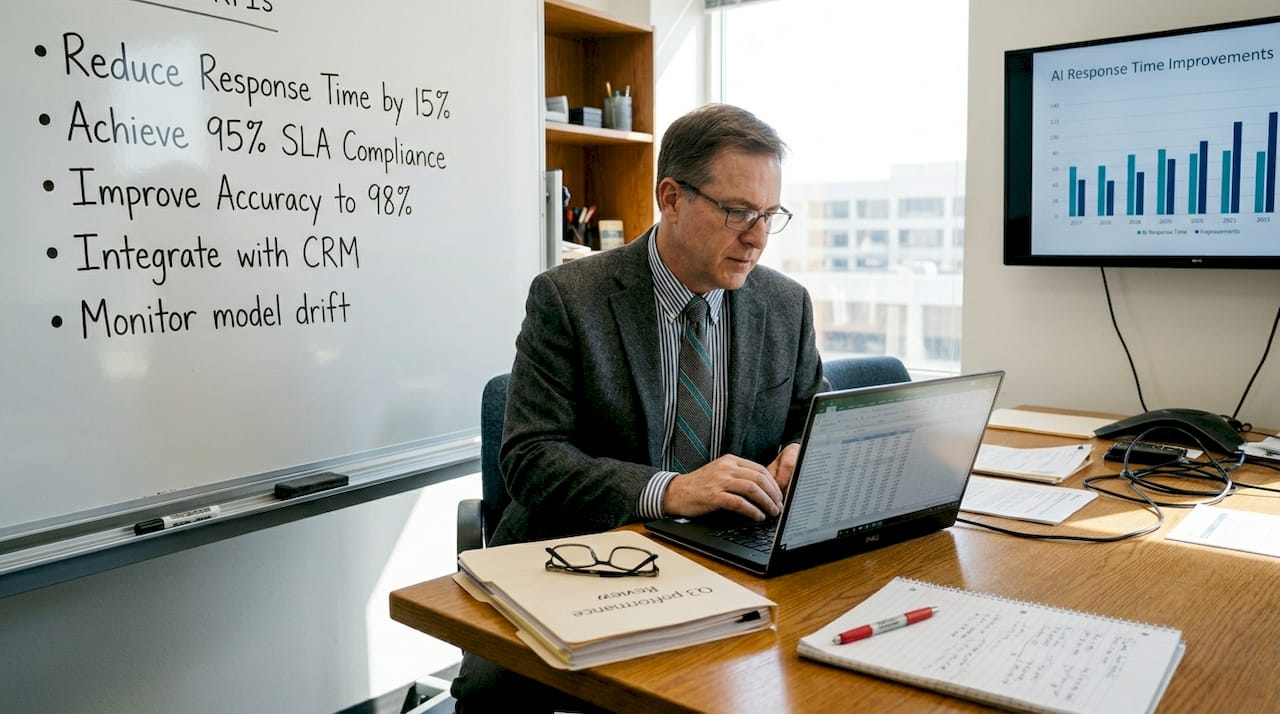
Exploring AI industry applications relevant to your sector will also sharpen your thinking. Seeing how businesses in logistics, retail, or professional services define and measure AI success gives you a practical reference point.
Pro Tip: Before finalising any AI objective, validate it with your frontline teams. They will tell you where the real friction is, and their buy-in at this stage makes adoption far smoother later.
"The organisations that get the most from AI are not the ones with the biggest budgets. They are the ones that start with ruthless clarity about what problem they are solving and why it matters to the business." This insight reflects what the most successful AI trends in Australia consistently show.
Assess and prepare your data foundations
Once your strategic direction is set, the next step is unglamorous but absolutely critical: getting your data in order. AI systems learn from data. Feed them poor quality inputs and you will get poor quality outputs, regardless of how sophisticated the technology is.
Poor data quality causes 27% of AI projects to underperform. For Australian SMBs, data typically lives across a patchwork of systems: ERP platforms, CRM tools, spreadsheets, email threads, and paper records. The challenge is not always a lack of data. It is inconsistency, duplication, and siloed storage that causes problems.
Here is a practical approach to assessing your data readiness:
- Catalogue your data sources. List every system where business data is stored, from your accounting software to your customer database.
- Assess data quality. Look for missing fields, inconsistent formats, duplicate records, and outdated entries.
- Identify high-value datasets. Pinpoint which data, if cleaned and structured, would deliver the most insight for your AI goals.
- Clean and standardise. Invest time in normalising formats, filling gaps where possible, and establishing data entry standards going forward.
- Establish governance. Set clear rules for how data is collected, stored, and maintained to protect quality over time.
Understanding the full scope of AI implementation benefits also means recognising that data maturity is directly linked to how far and fast you can scale your AI solutions. A business with clean, structured data can move from pilot to full deployment in months. One with chaotic data may spend that same time just trying to get the foundation right.
Pro Tip: Do not try to fix everything at once. Start with one high-potential dataset, pilot your AI solution on it, and use that success to build momentum and internal confidence before expanding.
Choose the right AI tools and partners
With a solid strategic foundation and clean data, the next challenge is navigating a crowded and often confusing technology landscape. Every vendor claims their solution is the best fit for your business. Your job is to cut through the noise with evidence-based criteria.
SMBs leveraging external AI consultants report higher satisfaction and ROI than those attempting full in-house builds. That does not mean consulting is always the answer, but it does mean the decision deserves careful thought.
| Approach | Cost | Customisation | Speed to value | Risk |
|---|---|---|---|---|
| In-house build | High | Very high | Slow | High |
| Off-the-shelf tools | Low | Limited | Fast | Medium |
| AI consulting partner | Medium | High | Medium | Low |
For most Australian SMBs, a consulting partner that offers vendor-agnostic advice and industry-specific experience will outperform both extremes. When evaluating AI for professional services or any sector-specific solution, ask these questions:
- Does the vendor have proven experience in your industry?
- Can they demonstrate integration with your existing systems?
- What does ongoing support and optimisation look like after go-live?
- Is the solution scalable as your business grows?
- What are the data ownership and privacy terms?
Vendor lock-in is a genuine risk. If a platform owns your data or makes it difficult to switch, your flexibility is compromised. Look for AI consultants for professional services who prioritise your long-term independence and build solutions that serve your goals, not theirs.
Drive adoption with change management and training
The technology is in place. Now comes the part that determines whether it actually gets used. Staff adoption is where more AI projects quietly fail than at any technical stage. Fear of job displacement, skill gaps, and unclear processes are the three most common barriers.
Organisations that proactively train staff on AI tools are 2x as likely to report positive outcomes. Training is not a nice-to-have. It is a core part of your integration strategy.
Here is a sample training plan framework for SMB teams:
| Phase | Focus | Duration | Delivery method |
|---|---|---|---|
| Awareness | Why AI, what changes | Week 1 | Team briefing, Q&A |
| Foundations | How to use the tool | Weeks 2 to 3 | Hands-on workshops |
| Practice | Real workflow integration | Weeks 4 to 6 | Supervised use |
| Optimisation | Feedback and refinement | Ongoing | Monthly reviews |
Beyond formal training, these change management tactics consistently deliver results:
- Identify pilot champions. Find enthusiastic early adopters in each team and empower them to support colleagues.
- Communicate transparently. Be honest about what AI will and will not change in people's roles.
- Incentivise engagement. Recognise and reward teams that embrace new tools and contribute improvement ideas.
- Create feedback channels. Give staff a clear way to raise concerns or suggest refinements.
Exploring the AI advantages for SMBs that come from well-managed adoption will reinforce why this investment in people pays off.
"Technology changes processes. Leadership changes culture. You need both to make AI stick."
Monitor, optimise, and scale your AI solutions
Go-live is not the finish line. It is the starting point for the real work. Many SMBs make the mistake of treating AI deployment as a project with an end date rather than an ongoing capability that needs active management.
The biggest ROI gains come from iterative optimisation, not one-off launches. Building a structured review process into your operations from day one ensures you capture those gains.
Here is a post-integration review framework to follow:
- Review KPIs weekly for the first month. Catch issues early before they compound.
- Gather user feedback at the 30-day mark. Frontline staff will surface practical problems that dashboards miss.
- Benchmark against pre-AI baselines. Compare current performance to your original metrics to quantify real impact.
- Identify optimisation opportunities. Look for workflow steps where AI outputs are being manually corrected or ignored.
- Plan your next pilot. Once one solution is stable, use the learnings to scope the next AI initiative.
Scaling AI across your business works best when you treat each successful pilot as a proof of concept for the next. The AI efficiency implementation lessons from one department often translate directly to another with minor adjustments.
Pro Tip: Involve end users in your monthly optimisation review meetings. They are closest to the workflow and will often identify improvement opportunities that leadership cannot see from a distance.
Our take: Why most AI projects fail and how Australian SMBs can succeed
Having worked through these best practices, it is worth being direct about something the industry rarely says plainly: most AI projects do not fail because of bad technology. They fail because of bad change leadership.
Australian SMBs face specific pressures that larger enterprises do not. Leaner teams, tighter budgets, and less tolerance for long implementation timelines mean the margin for error is smaller. That context makes the human side of AI adoption even more critical here than elsewhere.
Australian SMBs report 2x better outcomes when blending technology with strategic change management. Yet the default instinct is still to focus the majority of investment on the software itself. We see this pattern repeatedly: a business spends months selecting the perfect platform, then allocates two weeks to training and communication. The result is a technically sound solution that nobody uses properly.
The businesses that genuinely succeed with AI strategy trends are the ones that treat AI as a business transformation initiative, not an IT project. That shift in framing changes everything, from how goals are set to how success is measured and celebrated.
Ready to transform your business with AI?
If these best practices have clarified what good AI integration looks like, the next step is applying them to your specific business context. Every industry has its own nuances, and a framework that works for a logistics firm may need significant adjustment for a retail operation or a trades business.
At ORVX AI, we work as AI integration consultants embedded within your team, not just advisors handing over a report. Whether you are in retail managing inventory and customer experience, or in trades looking to automate scheduling and quoting, we build solutions around your real workflows. Reach out to explore how a tailored AI roadmap could accelerate your results.
Frequently asked questions
What is the first step for SMBs starting AI integration?
Define clear business objectives and align AI initiatives with strategic goals before investing in technology. AI with clear goals is 50% more likely to deliver positive ROI.
How can we ensure our data is ready for AI projects?
Audit, clean, and structure your data, then start with one manageable dataset to pilot your AI solution. Poor data quality causes 27% of AI projects to underperform.
Should we build AI in-house or partner with consultants?
Most Australian SMBs achieve better results working with experienced AI consultants who understand local and industry-specific challenges. External AI consultants consistently report higher satisfaction and ROI for SMBs.
What are common mistakes in AI integration?
The most common errors are unclear goals, poor data preparation, and neglecting staff training on new tools. Proactive staff training makes organisations 2x as likely to report positive outcomes.
How do we measure ongoing AI success?
Use business KPIs, continuous user feedback, and iterative optimisation to ensure value grows over time. Iterative optimisation consistently delivers the biggest long-term ROI gains.