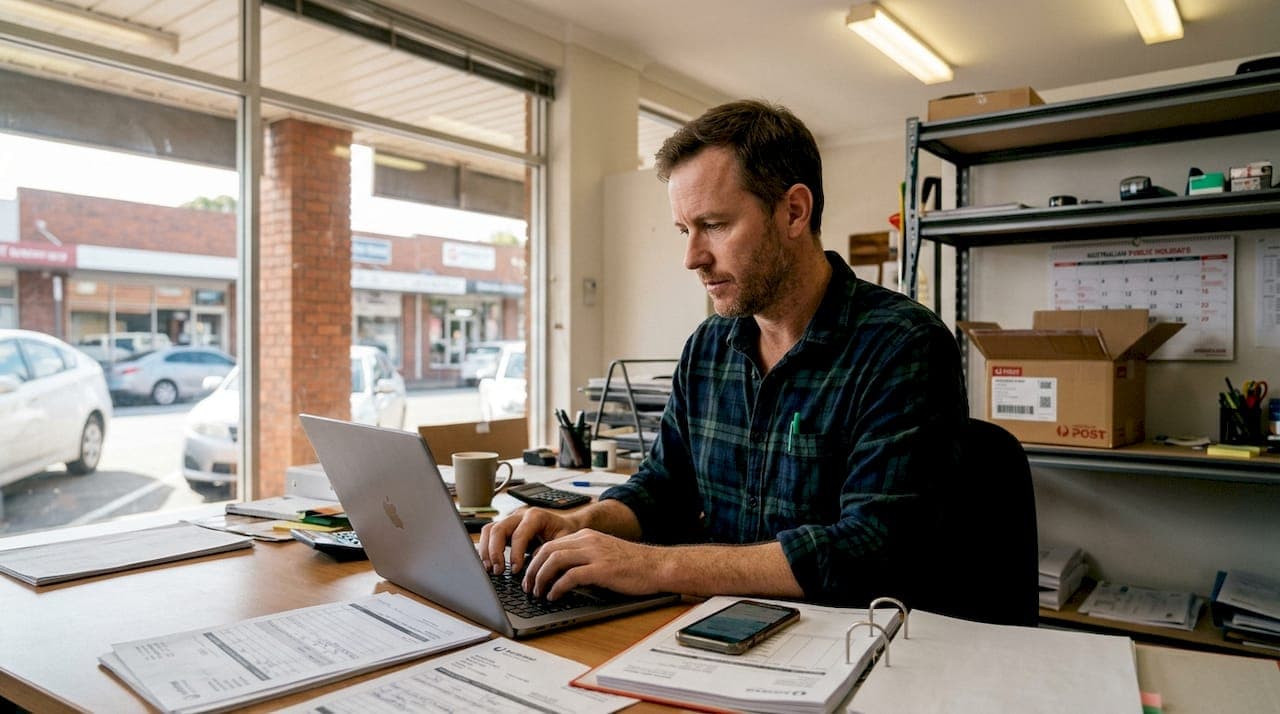
AI adoption among Australian small and medium businesses is accelerating fast, yet most owners still struggle to identify which tools will actually move the needle. The difference between a smart AI investment and a costly distraction often comes down to fit, not features. 41% of AI-using SMBs already save more than 25% of their labour time, which means the upside is real and measurable. This article walks you through the key criteria for evaluating AI, the strongest operational advantages on offer, and what Australian businesses are actually achieving right now.
Table of Contents
- Key criteria to evaluate AI solutions for SMBs
- Top operational efficiency advantages from AI
- AI's impact on marketing and customer engagement
- Upskilling your team with AI: value beyond hiring
- Australian case study: Real-world SMB savings with AI
- Summary comparison: How AI advantages stack up for Australian SMBs
- Get started with AI for your Australian SMB
- Frequently asked questions
Key Takeaways
| Point | Details |
|---|---|
| Labour time savings | AI tools can save Australian SMBs 6-8 hours each week through automation. |
| Marketing cost reduction | AI helps reduce reliance on external marketing services and create targeted campaigns for less. |
| Upskilling benefits | SMBs can use AI to upskill current staff, avoiding costly new hires and boosting productivity. |
| Operational efficiency | AI integrates with admin workflows to streamline tasks and enhance reporting accuracy. |
| Profitability potential | Perfected AI adoption offers up to 38% uplift in SMB profitability in Australia. |
Key criteria to evaluate AI solutions for SMBs
Before you commit to any AI tool, you need a clear picture of where your business actually loses time and money. Start by mapping your biggest operational pain points. Are you drowning in admin? Struggling to keep up with marketing? Spending too much on customer service? The answer shapes everything.
Here is what to look for when evaluating any AI solution:
- Operational fit: Does it solve a real, recurring problem in your workflow?
- Integration: Can it connect with the tools you already use, like your CRM, accounting software, or booking system?
- Implementation support: Does the vendor offer onboarding, training, and a clear roadmap?
- Proven SMB results: Has it delivered measurable outcomes for businesses your size?
- Cost vs. return: Is the monthly cost justified by time saved or revenue gained?
One honest challenge worth naming: AI ambition outpaces readiness for many smaller businesses, with readiness gaps and difficulty measuring results being common barriers. This is why choosing custom AI solutions built around your specific context tends to outperform off-the-shelf tools.
Pro Tip: Ask any AI vendor for case studies from Australian SMBs in your industry before signing up. Generic demos rarely reflect the complexity of real business operations.
Top operational efficiency advantages from AI
Operational efficiency is where AI delivers its most consistent and measurable wins for SMBs. The gains are not marginal. They are the kind that free up your week and reduce your wage bill in meaningful ways.
AI tools routinely automate tasks that used to eat hours every day:
- Invoicing and accounts: Auto-generate, send, and follow up on invoices without manual input
- Scheduling: AI booking tools handle appointments, reminders, and cancellations automatically
- Data entry and reporting: Pull data from multiple sources and generate clean reports in minutes
- Marketing content: Draft social posts, email campaigns, and product descriptions at scale
- Customer queries: AI chatbots handle FAQs and triage support tickets around the clock
The numbers back this up. 41% of SMBs save over 25% labour time, and 17.5% save over 50%. That is not a rounding error. That is the equivalent of gaining back one to two full working days every week.
"Early AI adopters save up to 6 hours per week and research suggests AI could lift SMB revenues by 6.7%." — Intuit research via AFR
For context on how these gains play out across different sectors, the range of industry AI efficiency outcomes is broad but consistently positive. Whether you run a trade business, a retail shop, or a professional services firm, the SME AI benefits follow a similar pattern: less manual work, faster turnaround, and fewer errors.

AI's impact on marketing and customer engagement
Marketing is one of the most expensive and time-consuming functions for any SMB. Hiring a marketing agency or a full-time coordinator is out of reach for many businesses. AI changes that equation significantly.
Here is what AI-powered marketing looks like in practice:
- Automated social media: Schedule and publish content across platforms without lifting a finger each day
- AI-generated copy: Tools like ChatGPT produce blog posts, ad copy, and email sequences in minutes
- Customer targeting: AI analytics identify your best-performing customer segments and optimise ad spend accordingly
- Personalised messaging: Send tailored offers and follow-ups based on customer behaviour, not guesswork
- Visual content: Canva AI generates on-brand graphics and video thumbnails quickly and cheaply
The financial impact is tangible. A MYOB survey found 26% of AI users reduced their need for external marketing services entirely. That is a direct cost saving that compounds month after month.
Pro Tip: Start with ChatGPT for written content and Canva AI for visuals. Together, they cover most SMB marketing needs at a fraction of the cost of outsourcing.
For businesses selling online, the advantages extend further. The role of AI for eCommerce SMEs includes personalised product recommendations, abandoned cart recovery, and dynamic pricing. Staying across AI trends in business helps you spot the next opportunity before your competitors do.
Upskilling your team with AI: value beyond hiring
Hiring is expensive. Recruiting, onboarding, and training a new employee can cost tens of thousands of dollars before they are fully productive. AI offers a smarter alternative: making your existing team more capable.
Here is how AI supports team upskilling:
- On-the-job learning: AI tools guide employees through new processes with prompts and automation, reducing the learning curve
- Task automation: Repetitive work gets handled by AI, freeing staff to focus on higher-value responsibilities
- Flexible workflows: AI supports remote and hybrid arrangements by centralising information and automating handoffs
- Skill development: Staff who learn to use AI tools become more versatile and valuable over time
The data is clear. 23% of surveyed businesses upskilled their existing staff using AI instead of hiring new employees. That is a significant shift in how SMBs think about workforce growth.
| Approach | Typical cost | Time to productivity | Long-term value |
|---|---|---|---|
| Hire new employee | $15,000 to $40,000+ | 3 to 6 months | High if retained |
| Upskill with AI tools | $50 to $500/month | 2 to 6 weeks | High and scalable |
| Outsource tasks | $1,000 to $5,000/month | Immediate | Limited internal growth |
For businesses in professional services, the upskilling advantage is especially strong. Understanding AI in professional services shows how firms are using AI to handle document review, client reporting, and compliance tasks that previously required senior staff hours.
Pro Tip: Combine AI tool access with short, hands-on workshops every quarter. Staff who understand the why behind a tool adopt it faster and use it more effectively.
Australian case study: Real-world SMB savings with AI
Theory is useful. Real numbers are better. Here is a breakdown of what one Australian SMB achieved by integrating AI into daily operations.
A Sydney café owner implemented three AI tools over a single month:
- ChatGPT for writing weekly social media captions, email newsletters, and menu descriptions
- Canva AI for designing promotional graphics, seasonal menus, and loyalty programme materials
- Zapier for automating order confirmations, supplier emails, and staff roster notifications
The outcome was striking. The owner saved 8 hours per week at a total cost of just AU$50 per month. That is roughly AU$600 per year to reclaim more than 400 hours of productive time.
"The ROI was obvious within the first two weeks. I stopped dreading Monday mornings." — Sydney café owner, 2026
This case study is not an outlier. It reflects what happens when AI tools are matched carefully to real workflow problems rather than adopted for novelty. For hospitality businesses specifically, the AI for hospitality applications extend well beyond marketing into reservations, inventory, and staff scheduling.
Summary comparison: How AI advantages stack up for Australian SMBs
With all the advantages laid out, it helps to see them side by side. Here is how the main AI benefits compare across key business dimensions.
| AI advantage | Typical impact | Best suited for |
|---|---|---|
| Time savings | 6 to 8 hours per week | All SMB types |
| Labour cost reduction | 25% to 50%+ reduction | Admin-heavy businesses |
| Marketing efficiency | 26% reduce external spend | Retail, hospitality, services |
| Team upskilling | 23% avoid new hires | Professional services, trades |
| Revenue potential | Up to 38% profitability boost | Scaling SMBs |
The profitability figure is worth pausing on. A 38% boost is not guaranteed, but it reflects what becomes possible when AI is implemented well across multiple business functions simultaneously. For AI for professional services firms, combining automation with analytics and client management tools is where that ceiling gets pushed.
Get started with AI for your Australian SMB
If the advantages above resonate with where your business is right now, the next step is finding the right partner to help you act on them. Knowing which tools to use is one thing. Knowing how to integrate them into your specific workflows, team structure, and industry context is another.
ORVX AI works directly with Australian SMBs to design and implement AI strategies that fit your actual operations, not a generic template. Whether you run a hospitality business looking to automate rostering and marketing, or a professional services firm wanting to streamline document processing and client reporting, the approach is always tailored to your goals. Book a consultation and find out exactly where AI can save you time and money this year.
Frequently asked questions
How much time can Australian SMBs realistically save with AI tools?
Most Australian SMBs report saving between 6 and 8 hours per week once AI tools are properly integrated, with over 41% reducing labour time by at least 25%. A Sydney café owner saved 8 hours weekly for just AU$50 per month.
What is the main barrier to AI adoption for small businesses in Australia?
The biggest barrier is readiness, not interest. Readiness gaps are common among Australian SMBs, including limited time, lack of technical expertise, and inconsistent data quality that makes AI tools harder to deploy effectively.
Can AI help reduce hiring costs for Australian SMBs?
Yes. 23% of surveyed businesses chose to upskill existing staff using AI rather than recruit new employees, resulting in meaningful cost savings and faster productivity gains.
What are the most common AI tools used by SMBs in Australia?
ChatGPT, Canva AI, and Zapier are among the most widely used, covering content creation, visual design, and workflow automation. A Sydney café owner used all three to save 8 hours per week at minimal cost.