
Australian SMEs that implement AI see inventory costs drop by up to 25%, yet many business owners still hold back, convinced that AI is either too complex or too expensive for their operation. That assumption is costing them real money. From personalised product recommendations to automated customer support, AI is reshaping how eCommerce businesses compete, and the tools are far more accessible than most people realise. This article breaks down exactly how AI works in eCommerce, which use cases deliver the strongest returns, and how you can start implementing it without a dedicated tech team or a massive budget.
Table of Contents
- How AI transforms eCommerce for Australian SMEs
- Core AI use cases: personalisation, automation, and smarter pricing
- AI implementation: practical roadmap for Australian SMEs
- Challenges, risks, and regulatory realities for AI in Australian eCommerce
- Maximising value: best practice tips when adopting AI
- Explore tailored AI solutions for your Australian eCommerce business
- Frequently asked questions
Key Takeaways
| Point | Details |
|---|---|
| AI is accessible for SMEs | Smart AI solutions cost less than A$1000/year and can unlock big performance gains for smaller businesses. |
| Personalisation drives ROI | Australian eCommerce leaders see boosted conversions using tailored product recommendations and inventory tools. |
| Compliance and trust matter | Staying compliant with Australian privacy laws and blending AI with human service builds lasting customer loyalty. |
| Start with quick wins | Piloting one high-impact use case, like inventory forecasting, helps measure ROI fast and reduces implementation risk. |
How AI transforms eCommerce for Australian SMEs
AI is not a single tool. It is a collection of technologies that work together to make your eCommerce operation faster, smarter, and more profitable. The most impactful applications right now include personalised product recommendations, dynamic pricing, inventory forecasting, AI-powered chatbots, and fraud detection. Each of these solves a specific business problem, and AI-driven eCommerce transformation is already delivering measurable results across industries.
The numbers are hard to ignore. Amazon generates roughly 35% of its revenue through AI-driven product recommendations alone. Closer to home, Australian SME AI examples show that Woolworths used AI to reduce food waste through smarter inventory management, while Culture Kings boosted conversions by deploying personalised recommendation engines. A meal delivery company achieved a 91% revenue increase and 1,200% year-on-year traffic growth using AI-powered SEO strategies.
These are not outliers. They reflect a broader shift in how industry AI efficiency is being realised across retail, logistics, and services. The key difference between businesses that benefit and those that don't is not budget. It is knowing where to start.
| AI application | Primary benefit | Typical SME impact |
|---|---|---|
| Product recommendations | Higher average order value | Conversion lift of 10 to 30% |
| Dynamic pricing | Margin optimisation | Revenue increase of 5 to 15% |
| Inventory forecasting | Reduced overstock and waste | Cost savings of up to 25% |
| AI chatbots | 24/7 customer support | Support cost reduction of 30%+ |
| Fraud detection | Reduced chargebacks | Loss prevention of up to 40% |
Understanding AI trends for business in 2026 means recognising that these tools are no longer reserved for enterprise players. Shopify, WooCommerce, and similar platforms now offer native AI integrations that any SME can activate within days.
Core AI use cases: personalisation, automation, and smarter pricing
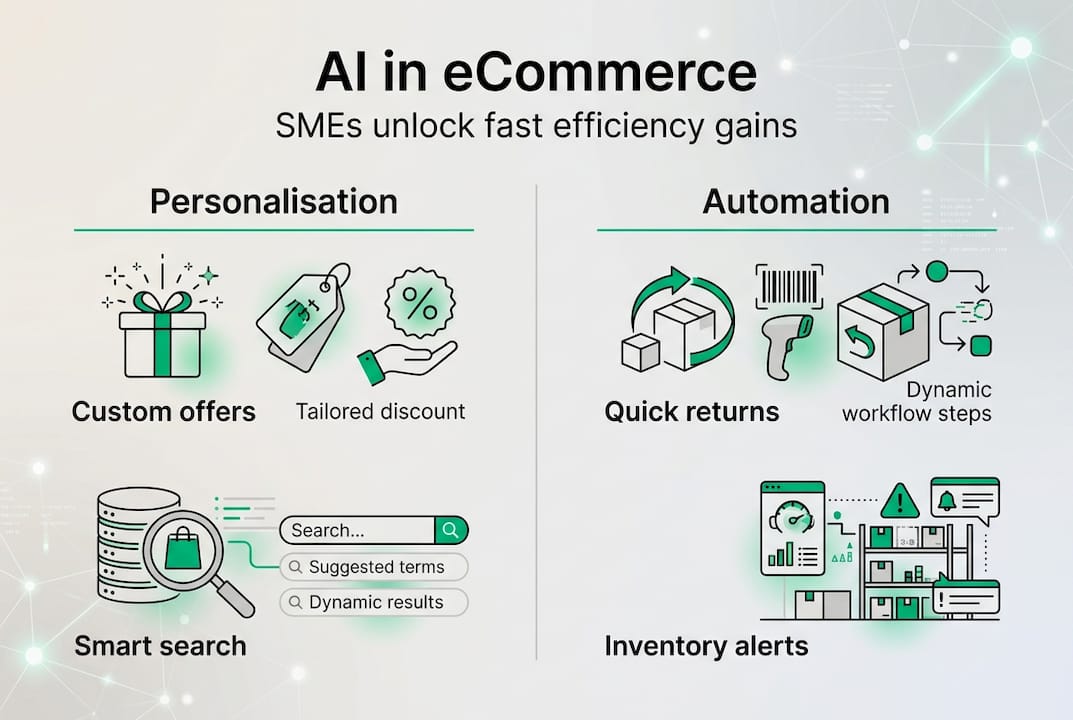
Personalisation is where most SMEs see the fastest return. When a customer visits your store and sees products tailored to their browsing history, purchase behaviour, and preferences, they buy more and return more often. Culture Kings is a strong local example, using recommendation engines to surface relevant products at exactly the right moment in the customer journey.
Dynamic pricing is another high-impact use case. AI monitors competitor pricing, demand signals, and stock levels in real time, then adjusts your prices automatically to stay competitive without sacrificing margin. This is not about racing to the bottom. It is about pricing intelligently based on data rather than gut feel.

Inventory forecasting removes one of the most painful guessing games in retail. Instead of ordering based on last year's numbers, AI analyses seasonal trends, local events, and sales velocity to predict what you will need and when. One Australian AI success story showed a meal delivery business generating $968,000 in additional revenue over eight months purely through AI-optimised operations.
| Use case | Adoption rate among SMEs | Main barrier |
|---|---|---|
| Personalised recommendations | High | Data quality |
| Chatbots and automation | Medium to high | Integration complexity |
| Dynamic pricing | Medium | Perceived risk |
| Inventory forecasting | Medium | Legacy systems |
| Fraud detection | Low to medium | Cost and awareness |
Chatbots deserve special mention. A well-configured AI chatbot handles returns, FAQs, order tracking, and product queries around the clock without adding headcount. For SMEs with lean teams, this is a genuine operational advantage. Pair that with custom AI for ROI thinking and you start to see how these tools compound over time.
Pro Tip: Rather than replacing your existing eCommerce platform, layer AI tools on top of what you already use. Most modern platforms support plug-and-play AI integrations, which means you can test and measure before committing to anything significant. This approach also aligns with AI implementation benefits that prioritise low-risk entry points.
AI implementation: practical roadmap for Australian SMEs
Getting started with AI does not require a six-figure budget or an in-house data science team. The most effective approach is methodical and focused on your biggest pain points first.
- Identify your top three operational pain points. Common ones for eCommerce SMEs include manual inventory management, slow customer response times, and poor product discoverability. These are your starting points.
- Audit your existing tech stack. Check whether your current platforms, such as Shopify or Xero, already offer AI features you are not using. Many businesses are sitting on untapped capability.
- Choose one use case and pilot it. Do not try to implement everything at once. Pick the highest-ROI opportunity, run it for 60 to 90 days, and measure the results carefully.
- Integrate with your existing systems. AI use cases Australia consistently show that integration with existing platforms is the most critical success factor. Avoid standalone tools that create data silos.
- Scale what works. Once you have proof of concept and measurable ROI, expand to additional use cases with confidence.
Cost is a common concern, but starting with pain points and integrating with your existing stack keeps expenses manageable. Most entry-level AI tools for SMEs are priced under A$1,000 per year. That is less than many businesses spend on a single trade show appearance.
Pro Tip: Focus your first AI investment on the area where you lose the most time or money each week. For most eCommerce SMEs, that is either inventory management or customer support. Nail one of those first, then build from there. The Australian AI implementation steps framework is a useful reference for structuring this process.
One often-overlooked factor is data quality. AI is only as good as the data you feed it. Before deploying any AI tool, make sure your product catalogue, customer records, and sales history are clean, consistent, and centralised. This single step dramatically improves outcomes and helps you boost efficiency with AI from day one.
Challenges, risks, and regulatory realities for AI in Australian eCommerce
AI adoption is not without its complications. Business leaders need to understand the risks before scaling their investments, particularly around data, compliance, and market dynamics.
Agentic AI is one of the newer risks worth understanding. These are AI systems that act autonomously on behalf of customers, such as shopping bots that compare prices and complete purchases without human input. While convenient for consumers, they can erode your direct relationship with customers and strip away valuable behavioural data. Retail's AI risks are real, and agentic models represent a genuine threat to brand loyalty.
"81% of executives expect generative AI to weaken customer loyalty by 2027, as consumers increasingly delegate purchasing decisions to AI agents rather than engaging directly with brands."
Key risks to monitor include:
- Data sovereignty. Under the Australian Privacy Act, customer data processed by AI tools must remain within Australia. Many offshore AI platforms do not meet this requirement by default.
- Lower conversion from AI-driven traffic. Visitors arriving via AI-generated content or AI search tools tend to convert at lower rates than organic search traffic.
- Skills gaps. Many micro-SMBs lack the internal capability to configure, monitor, and optimise AI tools effectively.
- Integration failures. Poorly integrated AI tools create data silos and can actually slow down operations rather than improve them.
For businesses in professional services or regulated industries, compliance is especially critical. Understanding market shifts in AI transformation across Australian eCommerce helps you anticipate where the regulatory landscape is heading. Reviewing your AI professional services solutions options with a local expert is a smart move before committing to any platform.
Maximising value: best practice tips when adopting AI
Getting AI right is as much about process as it is about technology. The businesses that extract the most value from AI share a few common habits.
Unify your data first. Prioritising data unification before deploying AI is the single most important step you can take. Fragmented data across multiple systems produces unreliable AI outputs and poor decisions.
Customise for local context. Generic AI models trained on global data sets often miss hyper-local factors that matter in Australia, such as seasonal weather patterns, local events, and regional purchasing behaviour. Customising your AI inputs for the Australian market produces significantly better results.
Balance automation with human service. Customers still want to feel heard. Use AI to handle routine queries and transactions, but keep human touchpoints available for complex issues, complaints, and high-value interactions. This balance builds trust and protects your brand reputation.
Best practices at a glance:
- Audit and clean your data before any AI deployment
- Start with one use case and measure rigorously before expanding
- Choose platforms that comply with Australian data sovereignty requirements
- Train your team to work alongside AI tools, not just rely on them
- Review AI performance monthly and adjust based on real outcomes
Pro Tip: Partnering with an integration specialist who understands both the technology and your industry removes the guesswork. It also dramatically reduces the risk of costly implementation mistakes. Investing in custom AI for business ROI from the outset pays dividends far faster than a trial-and-error approach.
Explore tailored AI solutions for your Australian eCommerce business
If you have read this far, you already understand that AI is not a luxury reserved for large corporations. It is a practical, affordable lever that Australian SMEs can pull right now to reduce costs, improve customer experience, and grow revenue.
At ORVX AI, we work directly with Australian eCommerce businesses to identify the highest-value AI opportunities, build a realistic implementation roadmap, and manage the rollout from start to finish. Whether you are in retail or professional services, our vendor-agnostic approach means we recommend what actually works for your business, not what is easiest to sell. We embed within your team, understand your workflows, and deliver solutions that fit your operation rather than forcing you into a templated package. If you are ready to move from curiosity to action, we are here to help you do it properly.
Frequently asked questions
How affordable is AI integration for small Australian eCommerce businesses?
Most entry-level AI tools for SMEs are priced under A$1,000 per year, making them accessible even for small operators with tight budgets.
What are the most effective AI use cases for SMEs in eCommerce?
Personalised product recommendations and inventory forecasting consistently deliver high ROI, with AI-driven recommendations improving conversions and reducing overstock simultaneously.
How does the Australian Privacy Act affect AI deployment in eCommerce?
Businesses must ensure all customer data processed by AI tools stays within Australia, as sovereign data requirements under the Act are strict and non-negotiable.
What is the risk of using third-party AI platforms for eCommerce?
Agentic AI systems can weaken brand loyalty and strip away direct customer data, with 81% of executives expecting generative AI to erode loyalty by 2027.
What are common mistakes SMEs make when implementing AI in eCommerce?
The most frequent mistake is skipping data unification before deployment. Starting with fragmented data produces unreliable outputs and undermines the entire investment.