
TL;DR:
- Most Australian SMEs use AI at a surface level without meaningful integration. Barriers include skills shortages, costs, data issues, and lack of strategic planning. Practical steps involve focusing on high-ROI use cases and establishing governance for scalable AI adoption.
Most Australian SMEs believe they are embracing AI, yet only 29–68% of businesses have meaningfully integrated it into their operations. That gap between surface-level tool use and genuine strategic adoption is costing businesses real productivity and competitive ground. This guide cuts through the noise to explain what AI adoption actually means for Australian SMEs, why so many businesses stall before reaching impact, and how to build a practical path forward. Whether you are just starting out or trying to scale beyond a single pilot project, you will find clear explanations, local context, and actionable steps here.
Table of Contents
- What is AI adoption? Definitions and context for Australian SMEs
- Why most SMEs struggle with meaningful AI adoption
- How Australian SMEs can turn AI pilots into operational advantage
- Best practice use cases and measurable benefits in Australian SMEs
- Why strategic depth, not surface adoption, unlocks real transformation
- Unlock tailored AI solutions for your business
- Frequently asked questions
Key Takeaways
| Point | Details |
|---|---|
| Clear AI definition | AI adoption means integrating smart tools and automation into daily business processes, not just using basic software. |
| Australian SME challenges | Skills gaps, regulatory uncertainty, and financial constraints impede meaningful AI use and scaling for most small businesses. |
| Practical adoption framework | Audit your workflows, pilot AI solutions in high-impact tasks, measure ROI over 90 days, and scale gradually. |
| High-impact use cases | Admin automation, customer service bots, forecasting, and finance tools deliver measurable productivity and efficiency gains. |
| Strategic integration matters | Surface AI adoption yields minimal benefit—true transformation requires depth, governance, and phased scaling. |
What is AI adoption? Definitions and context for Australian SMEs
AI adoption means integrating artificial intelligence technologies into your business operations in a way that measurably changes how work gets done. This is broader than simply signing up for an AI-powered tool. True adoption means AI is embedded in your workflows, informing decisions, automating repetitive tasks, or improving customer experiences at scale.
For Australian SMEs, the picture is uneven. SME adoption rates lag behind large firms across all G7 nations, and Australia is no exception. Micro businesses (under 5 employees) face the steepest climb, largely because they lack dedicated IT resources or budget for experimentation. Small businesses (5 to 19 employees) are doing better, but meaningful integration still trails basic tool use by a wide margin.
Here is a snapshot of how Australian businesses compare on AI adoption by size:
| Business size | Basic AI tool use | Meaningful integration |
|---|---|---|
| Micro (under 5) | Up to 60% | Under 20% |
| Small (5–19) | Up to 75% | 25–35% |
| Medium (20–199) | Up to 80% | 35–50% |
| Large (200+) | Over 85% | 60–70% |
The AI impacts in Australia are real and growing, but most SMEs are still using AI at the surface level. Common applications include:
- Admin automation: Scheduling, email drafting, document processing
- Customer service: Chatbots, automated responses, ticketing
- Inventory management: Demand forecasting, stock alerts
- Finance: Invoice processing, expense categorisation, reporting
- Marketing: Content generation, lead scoring, campaign analytics
Understanding the AI advantages for SMBs goes beyond knowing what tools exist. It requires knowing which tools solve your specific problems and how to measure whether they are working. That distinction separates businesses that get results from those that stay stuck in experimentation mode. If you are weighing up whether investing in AI is worth it right now, the data strongly suggests the cost of waiting is rising.
Why most SMEs struggle with meaningful AI adoption
Here is the uncomfortable truth. Up to 80% of Australian businesses use some form of AI tool, yet only 7% of Australian SMEs meaningfully integrate AI into their products or core processes. That gap is not about technology. It is about strategy, skills, and structure.
The AI adoption paradox in Australia is striking: widespread individual use of AI tools coexists with minimal revenue or operational impact at the business level. Employees might use ChatGPT for drafts or Canva's AI features for design, but these individual habits rarely translate into systemic change.
"Mass adoption of AI tools has not translated into meaningful business transformation for most Australian SMEs. The gap between usage and integration remains the defining challenge of this decade."
The most common barriers blocking strategic AI adoption include:
- Skills shortages: Most SMEs lack in-house AI expertise or data literacy
- Financial constraints: Upfront costs and unclear ROI deter investment
- Regulatory ambiguity: Uncertainty around data privacy and AI governance
- Data quality issues: Fragmented or inconsistent data undermines AI performance
- Pilot purgatory: Projects that never scale beyond a single test environment
Micro businesses are particularly exposed. Without a dedicated IT function or change management capability, even a well-chosen AI tool can fail to stick. Medium businesses fare better but often scatter their efforts across too many tools without a coherent strategy.

Pro Tip: Rather than trialling five different AI tools at once, focus on one to three high-ROI use cases where you can clearly measure before-and-after results. This discipline is what separates businesses that scale AI from those that collect subscriptions.
Following AI implementation steps with a structured approach reduces the risk of stalling. For professional services firms, understanding why AI matters for professional services in the Australian context adds another layer of strategic clarity.
How Australian SMEs can turn AI pilots into operational advantage
Despite these challenges, practical frameworks exist. The key is moving from isolated experiments to a repeatable adoption process. SME strategies that work share four consistent features: a single problem focus, measurable baselines, gradual rollout, and scalable architecture built from day one.
Here is a practical four-step approach:
- Audit: Map your current workflows and identify the top three processes consuming the most time or generating the most errors
- Pilot: Select one use case, define success metrics, and run a 90-day trial with a clear baseline
- Measure: Compare post-pilot results against your baseline KPIs, including time saved, error rates, and cost impact
- Scale: If the pilot delivers measurable gains, build the infrastructure to expand it across the business
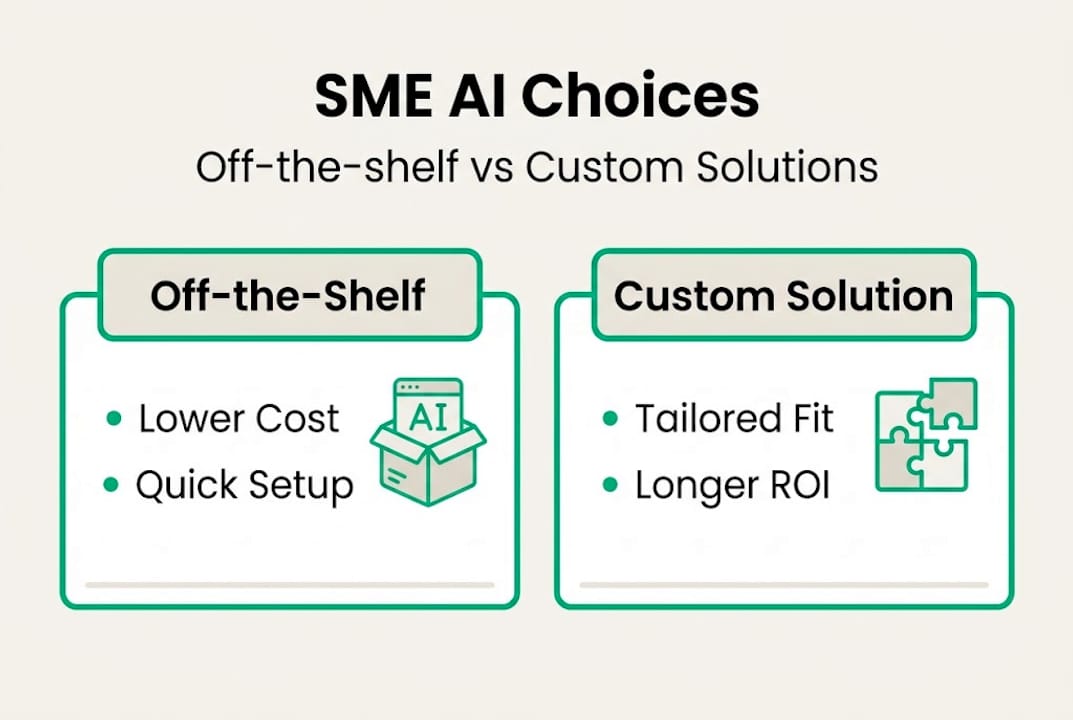
When choosing your tools, the off-the-shelf versus custom AI decision matters:
| Factor | Off-the-shelf AI | Custom AI solution |
|---|---|---|
| Upfront cost | Low to moderate | Moderate to high |
| Setup time | Days to weeks | Weeks to months |
| Fit to your process | Generic | Tailored |
| ROI timeframe | 3–6 months | 6–18 months |
| Scalability | Limited | High |
Pro Tip: Australia's AI Adopt Centres offer free or subsidised support for SMEs navigating AI adoption. These programmes can reduce both financial risk and the skills gap that blocks many businesses from moving forward.
The AI opportunity in Australia is significant, but it rewards businesses that plan deliberately. Following custom AI implementation steps tailored to your industry gives you a far better chance of breaking out of pilot purgatory. Reviewing AI industry applications relevant to your sector can also sharpen your focus before you commit resources.
Best practice use cases and measurable benefits in Australian SMEs
The businesses getting the most from AI are not the ones with the biggest budgets. They are the ones that picked the right problem and measured everything. High-impact AI use cases for Australian SMEs consistently cluster around a handful of core functions, and the productivity uplift can exceed gains seen at large firms due to the relative inefficiency of manual SME processes.
Top use cases producing measurable results:
- Admin and email automation: Reduces manual processing time by 30–50% in many businesses
- Customer service chatbots: Handle up to 70% of routine enquiries without human involvement
- Inventory and demand forecasting: Cuts overstock and stockout costs in retail and manufacturing
- Finance automation: Invoice processing, reconciliation, and reporting in a fraction of the time
- HR tools: Screening, onboarding documentation, and scheduling automation
41% of Australian SMEs that adopt AI report saving more than 25% of their labour time on targeted tasks. That is not a marginal gain. It is the equivalent of freeing up one full day per week for a five-person team.
"Australia's AI opportunity could generate $44 billion in annual economic value, with SME productivity uplift outpacing large-firm gains when integration is done well."
Sector-specific examples show just how varied the impact can be. In agriculture, AI-powered crop monitoring reduces input costs and improves yield predictions. In manufacturing, AI in manufacturing drives predictive maintenance and reduces unplanned downtime by 20–40%. In retail, AI ERP adoption is streamlining supply chains and personalising customer experiences. In health, AI tools are accelerating patient triage and reducing administrative load on clinical staff.
Following AI integration best practices ensures these gains are sustained rather than short-lived. The businesses that lock in results are those that treat AI as an operational capability, not a one-off project.
Why strategic depth, not surface adoption, unlocks real transformation
Most guides will tell you to start small and experiment freely. We agree with the first part, but not the second. Unstructured experimentation is exactly what creates pilot purgatory, where projects stall because no one defined success upfront or built the infrastructure to scale.
Optimism for AI productivity remains high among 81–90% of SME leaders, yet revenue impact stays shallow without strategic integration. That disconnect is the real problem. Business owners are enthusiastic but often lack a governance framework before they start scaling.
Australian SMEs have a genuine advantage here: agility. You can move faster than large enterprises when you decide to act. But agility without direction produces noise, not results. The businesses we see succeed are those that audit their data practices first, establish clear ownership of AI initiatives, and phase their scaling deliberately.
"Avoid pilot purgatory by phasing your scaling and measuring outcomes, not hype. The question is never whether AI works. It is whether you have built the conditions for it to work in your business."
Pro Tip: Before scaling any AI tool, audit how your data is collected, stored, and governed. Poor data quality is the single biggest reason AI pilots fail to deliver on their promise.
Building an AI strategy with governance at its core is not bureaucratic overhead. It is the foundation that makes everything else work.
Unlock tailored AI solutions for your business
Understanding AI adoption is one thing. Putting it into practice across your specific workflows, team structure, and industry context is another challenge entirely. ORVX AI works directly with Australian SMEs to move beyond theory and into measurable results.
Our team embeds with your business to map processes, identify high-ROI opportunities, and build a roadmap that fits your budget and timeline. Whether you operate in retail, manufacturing, or another sector, we bring vendor-agnostic advice and hands-on implementation support. If you are ready to move from pilot to operational advantage, talk to our AI integration consultants and find out what a tailored strategy looks like for your business.
Frequently asked questions
How do I measure ROI on an AI pilot for my SME?
Set your baseline KPIs before the pilot begins, then measure task-level gains after 90 days to determine whether productivity and efficiency targets have been met. Focus on time saved, error reduction, and cost per task rather than broad revenue figures.
Which AI tools are most effective for small businesses?
Admin automation and customer service tools, including email automation, chatbots, demand forecasting, and finance platforms, consistently deliver the highest ROI for Australian SMEs with limited resources.
What prevents SMEs from scaling AI adoption?
Skills shortages, regulatory ambiguity, and financial barriers are the primary blockers, alongside the difficulty of transitioning from a successful pilot to a fully integrated business process.
Is AI adoption really accelerating in Australia?
Basic tool use is widespread, but meaningful strategic integration sits at only 37–40% of businesses, meaning most organisations are still in early-stage adoption despite high enthusiasm.
How can SMEs access government support for AI adoption?
Programs such as AI Adopt Centres and NRF grants provide subsidised resources, skills support, and funding pathways specifically designed to help Australian SMEs reduce the cost and risk of digital transformation.