
TL;DR:
- Most Australian SMEs already use AI, saving significant labor time with proper strategy.
- Successful AI adoption relies on readiness assessment, clear objectives, and strong governance.
- Focus on compliance, staff engagement, and ongoing measurement to maximize AI benefits.
Australian small and medium businesses are under real pressure. Admin loads are growing, skilled staff are hard to find, and the pressure to do more with less is relentless. The good news? 80% of Australian businesses are already using AI tools, and 41% report saving more than 25% of their labour time. But having a tool is not the same as having a strategy. This guide walks you through a practical, step-by-step approach to building an AI strategy that actually fits your business, your team, and the unique demands of operating in Australia.
Table of Contents
- Assessing your readiness for AI
- Setting clear business objectives for AI
- Choosing and integrating the right AI solutions
- Measuring impact and scaling your AI strategy
- What most guides miss about AI strategy for Australian SMEs
- Take your business further with tailored AI solutions
- Frequently asked questions
Key Takeaways
| Point | Details |
|---|---|
| Assess digital readiness | Evaluate staff skills, data quality, and organisational mindset before starting AI adoption. |
| Set clear objectives | Target high-impact areas like admin automation and workflow efficiency for maximum value. |
| Integrate safely | Choose approved solutions and follow privacy guidelines, reviewing regularly to avoid compliance risk. |
| Track and scale results | Measure operational improvements, learn from challenges, and expand success across your business. |
Assessing your readiness for AI
Before you invest a single dollar in AI, you need an honest picture of where your business stands. Many Australian SMEs jump straight to tool selection and then wonder why adoption stalls. The real work starts earlier, with a clear-eyed look at your data, your people, and your processes.
The Australian Cyber Security Centre identifies the most common barriers for small businesses: skills gaps affect 60%+ of businesses lacking the internal expertise to implement AI effectively, alongside poor data quality, weak system integration, and cultural resistance to change. These are not small hurdles. They are the reasons most AI projects underdeliver.
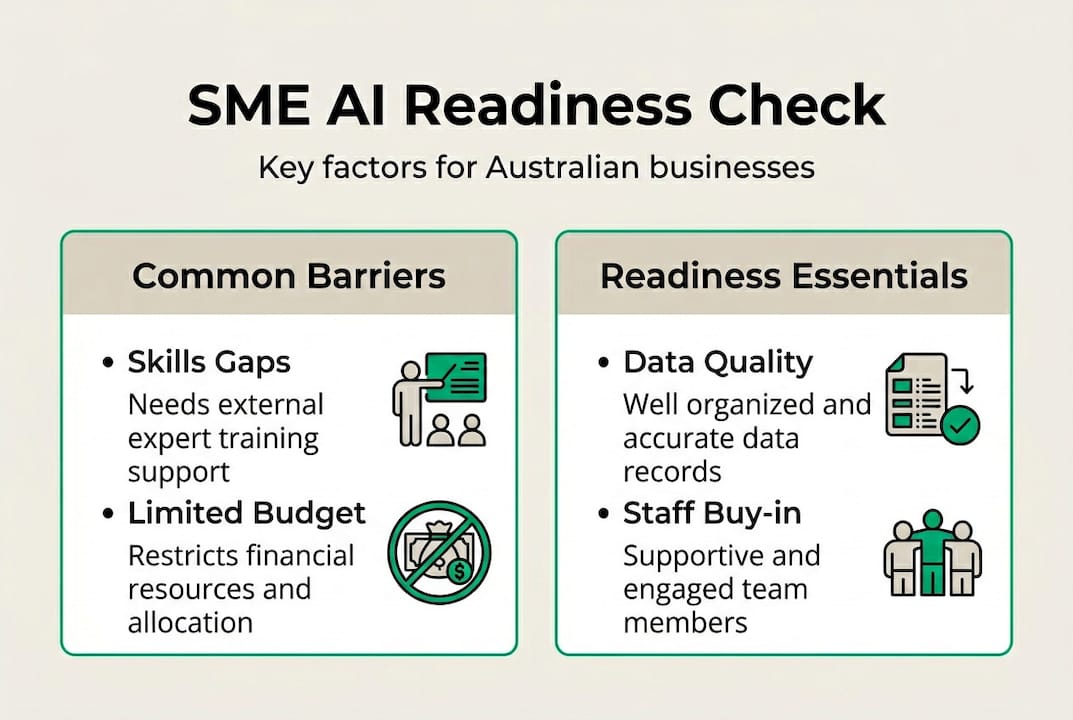
Here is a quick self-evaluation to help you gauge your starting point:
| Readiness area | Strong | Developing | Needs work |
|---|---|---|---|
| Data quality and accessibility | Clean, structured data | Some gaps | Scattered or inconsistent |
| Staff digital skills | Confident with tech | Basic users | Low digital literacy |
| Current system integration | Systems connect well | Partial integration | Siloed tools |
| Leadership buy-in | Fully committed | Cautious interest | Sceptical or resistant |
| Budget and timeline clarity | Defined and approved | Rough estimates | No plan yet |
Once you have scored yourself honestly, you will know which gaps to address before moving forward. This is not about being perfect. It is about knowing your risks before they become expensive surprises.
Key areas to review before starting:
- Data readiness: Is your business data stored in a way that AI tools can actually use? Spreadsheets buried in email threads will not cut it.
- Staff capability: Do your team members have the confidence to use new digital tools, or will training be a significant investment?
- Process documentation: Are your workflows written down and consistent, or does everything live in someone's head?
- Integration landscape: What software do you currently use, and how well do those systems talk to each other?
For a deeper look at how to approach this groundwork, the AI integration best practices guide covers the technical and cultural side of preparation in detail. You can also explore AI implementation benefits to understand what a well-prepared business can realistically expect once adoption begins.
Setting clear business objectives for AI
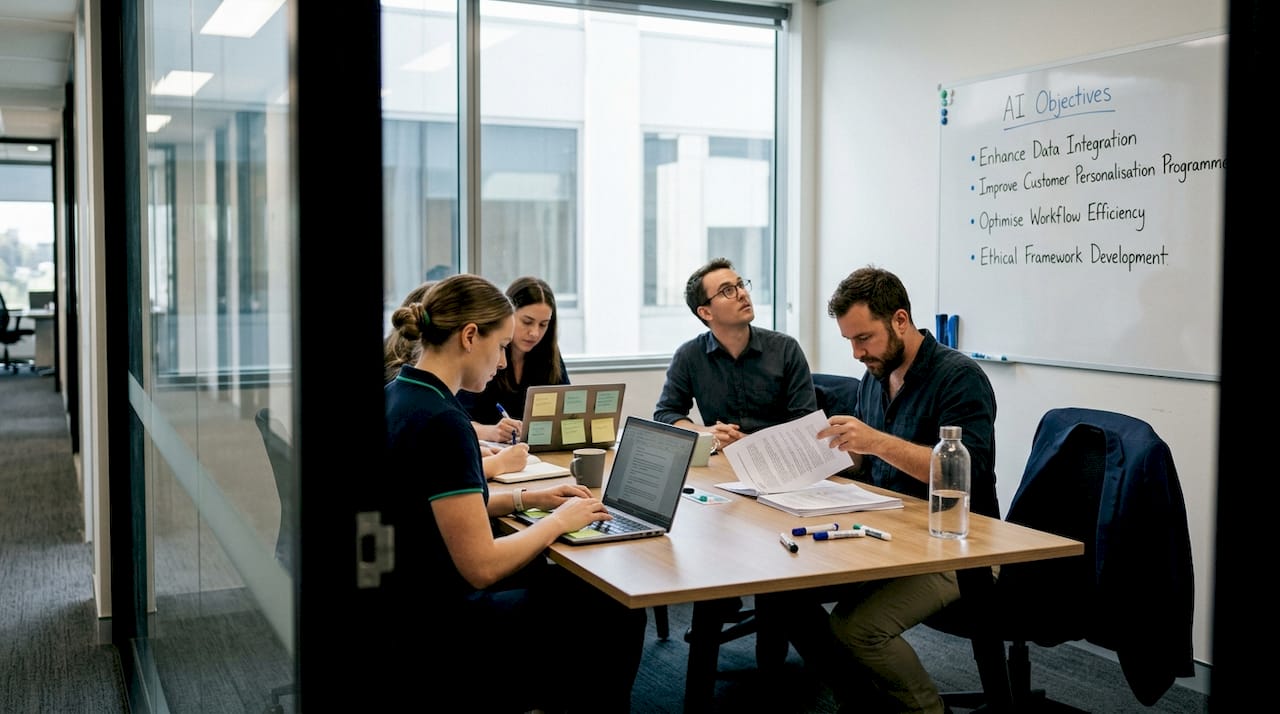
Once you know your starting point, it is time to define what you want AI to achieve for your organisation. Vague goals like "be more efficient" will not get you far. You need specific, measurable targets tied to real business pain points.
Research shows that admin and workflow automation delivers the highest future profitability uplift for Australian businesses, with gains of up to 38%. That is a significant number, and it tells you where to look first. Customer service, sales support, and document processing are close behind.
Here is how common AI use cases compare for SMEs:
| AI use case | Effort to implement | Potential ROI | Best for |
|---|---|---|---|
| Workflow automation | Low to medium | High | Repetitive admin tasks |
| Customer chatbots | Medium | Medium to high | Retail, hospitality, services |
| Sales and CRM AI | Medium | High | Professional services, real estate |
| Predictive analytics | High | Very high | Manufacturing, logistics |
| Document processing | Low | Medium | Trades, healthcare, legal |
To prioritise effectively, follow these steps:
- List your three biggest operational headaches right now.
- Map each pain point to an AI use case from the table above.
- Estimate the time or cost currently lost to each problem.
- Rank by potential impact versus implementation complexity.
- Choose one or two areas to pilot before scaling.
The step-by-step AI implementation guide goes deeper on how to sequence these decisions. If you want to see how specific industries are applying AI right now, the industry AI applications resource is worth reviewing before you finalise your objectives.
The Cyber.gov.au AI checklist also recommends documenting your intended AI use cases and communicating them clearly to your team before implementation begins.
Pro Tip: Involve your staff in the objective-setting process early. People resist what is done to them and support what they helped build. A short workshop with your team to identify their biggest frustrations often surfaces AI opportunities you would never have spotted from the top down.
Choosing and integrating the right AI solutions
With clear objectives in hand, the next step is selecting and safely implementing AI tools tailored for your SME. This is where many businesses make costly mistakes, choosing tools based on marketing hype rather than fit.
The Australian government is clear on this point. As the Cyber Security Centre advises:
"Only use approved AI tools within your organisation. Do not enter sensitive or confidential business information into public AI tools. Ensure your use of AI complies with the Australian Privacy Act and conduct regular reviews of your AI tools and processes."
This is not bureaucratic caution. Data leaks through public AI tools are a real and growing risk for Australian businesses. The Australian Privacy Act compliance requirements mean that mishandling customer data through an AI tool can carry serious legal and reputational consequences.
Here is what a safe and effective integration process looks like:
- Vet tools carefully: Check whether the vendor stores your data, where it is stored, and whether it leaves Australian jurisdiction.
- Start with a sandbox: Test the tool with non-sensitive data before connecting it to live business systems.
- Train your staff: A tool nobody uses is money wasted. Structured onboarding makes adoption stick.
- Document your AI use: Keep a record of which tools you use, what data they access, and who is responsible for oversight.
- Schedule regular reviews: Set a quarterly calendar reminder to check that tools are still performing, still compliant, and still the right fit.
Pro Tip: Assign one person in your business as the AI governance lead. This does not need to be a technical role. It just needs to be someone who checks in on tool performance, privacy settings, and staff feedback on a regular basis.
For businesses in professional services, the article on why AI matters for professional services covers sector-specific compliance considerations in more depth. The top AI trends for Australian businesses resource is also useful for understanding which technologies are gaining traction locally in 2026.
Measuring impact and scaling your AI strategy
After successful integration, evaluating results and planning your next moves is what separates businesses that get lasting value from AI and those that abandon it after a few months.
The numbers here are genuinely encouraging. 41% of Australian businesses report saving more than 25% of their labour time after AI adoption, and 17.5% report saving more than 50%. Those are not marginal gains. They represent real hours returned to your team every single week.
Tracking your AI performance:
- Measure labour hours saved per week on automated tasks.
- Track error rates before and after AI-assisted processes.
- Monitor customer response times if you have deployed a chatbot or automated service tool.
- Record staff sentiment through brief monthly check-ins.
- Compare revenue or lead conversion rates in areas where AI supports sales.
Common mistakes that stall progress:
- Setting no baseline before implementation, making it impossible to measure improvement.
- Treating AI as a set-and-forget tool rather than something that needs ongoing tuning.
- Ignoring staff feedback, which often reveals friction points before they become failures.
- Scaling too fast before a pilot has proven itself in real conditions.
Once a pilot delivers measurable results, scaling looks like this:
- Document what worked and why, including any unexpected challenges.
- Identify the next highest-impact area from your original priority list.
- Apply the same governance and training process used in the pilot.
- Set new performance benchmarks for the expanded rollout.
- Review the full AI strategy every six months to account for new tools and changing business needs.
The AI implementation guide includes practical frameworks for scaling in a controlled and sustainable way. The AI business impact study provides additional benchmarks to compare your results against industry averages.
What most guides miss about AI strategy for Australian SMEs
Most AI strategy content focuses almost entirely on technology: which tools to pick, how to integrate them, what features to look for. That is useful, but it misses what actually determines success or failure in the businesses we work with.
The real differentiator is governance and people. Specifically, how clearly you communicate the purpose of AI to your team, how seriously you take privacy and compliance from day one, and how consistently you invest in training and review. Businesses that treat these as afterthoughts spend twice as much fixing problems later.
The uncomfortable truth is that a mediocre tool with strong staff engagement will outperform a sophisticated platform that your team does not trust or understand. We have seen it repeatedly. The businesses that get the best results from AI are not necessarily the ones with the biggest budgets. They are the ones with clear internal communication, a designated person keeping an eye on governance, and a culture that treats AI as a team asset rather than a management imposition.
If you are in professional services, the why AI matters for your sector piece offers a grounded look at how governance plays out in client-facing environments. Start there before you start shopping for tools.
Take your business further with tailored AI solutions
Building an AI strategy from scratch is genuinely complex, and the stakes are higher than most guides acknowledge. Getting the right tools, the right governance, and the right team alignment takes more than a checklist.
At ORVX AI, we work directly with Australian SMEs across industries including real estate and trades and construction to build AI strategies that are practical, compliant, and scaled to your actual business size. Our approach starts with an on-site audit of your workflows, identifies the highest-impact opportunities, and walks you through implementation with hands-on support. We are vendor-agnostic, which means we recommend what fits your business, not what earns us a commission. If you are ready to move from uncertainty to a clear AI roadmap, ORVX AI is the place to start.
Frequently asked questions
How do I know if my business is ready for AI integration?
Start by assessing your data quality, staff digital skills, and openness to change. Most Australian SMEs face skills gaps and integration hurdles that need addressing before any tool is introduced.
What are common mistakes when implementing AI in SMEs?
The most frequent issues are unclear ROI goals, staff resistance, and overlooking privacy or compliance obligations. Change resistance and cyber risks like data leaks are among the most costly mistakes to fix after the fact.
How much can AI really improve efficiency in Australian businesses?
Research shows 41% of businesses save more than 25% of their labour time after AI adoption, with 17.5% reporting savings of more than 50%.
What should SMEs prioritise when developing an AI strategy?
Focus first on compliance, then on clear business objectives, staff training, and consistent performance measurement. The Cyber.gov.au AI checklist is a practical starting point for getting the foundations right.