
Eight in ten Australian small and medium businesses are already using AI tools, and 41% are saving over 25% of their labour time as a result. That is not a pilot programme or a future forecast. It is happening right now, across hospitality, retail, trades, and professional services. If you have been sitting on the fence about whether AI is worth the investment, the numbers suggest the window for a comfortable, unhurried decision is narrowing. This article cuts through the hype to give you a clear, honest picture of what AI investment actually looks like for Australian SMBs in 2026, including the benefits, the risks, and the realistic returns you can expect.
Table of Contents
- The current state of AI adoption in Australian SMBs
- Key benefits: efficiency, savings, and digital growth
- Risks, roadblocks, and what most articles miss
- ROI, timelines, and measuring success
- Expert perspective: What actually works for Australian SMBs
- Ready to unlock AI for your business?
- Frequently asked questions
Key Takeaways
| Point | Details |
|---|---|
| AI adoption widespread | Most Australian SMBs now use AI tools, with adoption rates nearing 80 percent. |
| Significant labour savings | 41 percent of SMBs see more than 25 percent reduction in labour time when using AI. |
| ROI takes time | Return on investment for AI in Australia usually occurs within two to four years, but intangible benefits may arise earlier. |
| Targeted implementation crucial | Disciplined, problem-focused adoption with strong human oversight enables lasting business gains. |
The current state of AI adoption in Australian SMBs
AI is no longer the exclusive domain of large corporations with deep technology budgets. Across Australia, 80% of SMBs are using AI tools, with reported usage ranging between 64% and 84% depending on the sector and state. That spread tells an important story: adoption is widespread, but it is not uniform. Some industries are racing ahead while others are still finding their footing.
The areas seeing the most measurable impact include customer service automation, inventory management, scheduling, and document processing. Businesses using AI for these functions report faster turnaround times, fewer manual errors, and staff who can focus on higher-value work. These are not abstract improvements. They show up directly in your operating costs and your team's daily experience.
| Business function | % of SMBs using AI | Primary benefit reported |
|---|---|---|
| Customer service | 38% | Faster response times |
| Marketing and content | 34% | Reduced content creation time |
| Inventory and logistics | 27% | Fewer stockouts and errors |
| Admin and document processing | 31% | Lower manual handling costs |
State-level variation is also worth noting. New South Wales and Victoria tend to lead adoption, partly due to higher concentrations of professional services firms and tech-adjacent industries. Queensland and Western Australia are catching up quickly, particularly in trades and logistics.
"AI adoption among Australian SMBs is no longer an emerging trend. It is a mainstream operational reality, with measurable labour savings becoming the primary driver of continued investment."
Understanding where your industry sits on this curve matters. If your competitors are already using AI to process quotes faster, respond to customer enquiries at midnight, or automate their invoicing, you are not just missing an efficiency gain. You are actively falling behind. Explore the AI advantages for SMBs and the broader AI trends in Australia shaping how businesses are competing right now.
Key benefits: efficiency, savings, and digital growth
The most compelling reason to invest in AI is straightforward: it saves time on work that does not require human judgement. Repetitive tasks like data entry, appointment scheduling, invoice matching, and basic customer queries consume enormous amounts of staff time. AI handles these reliably, at scale, without fatigue.
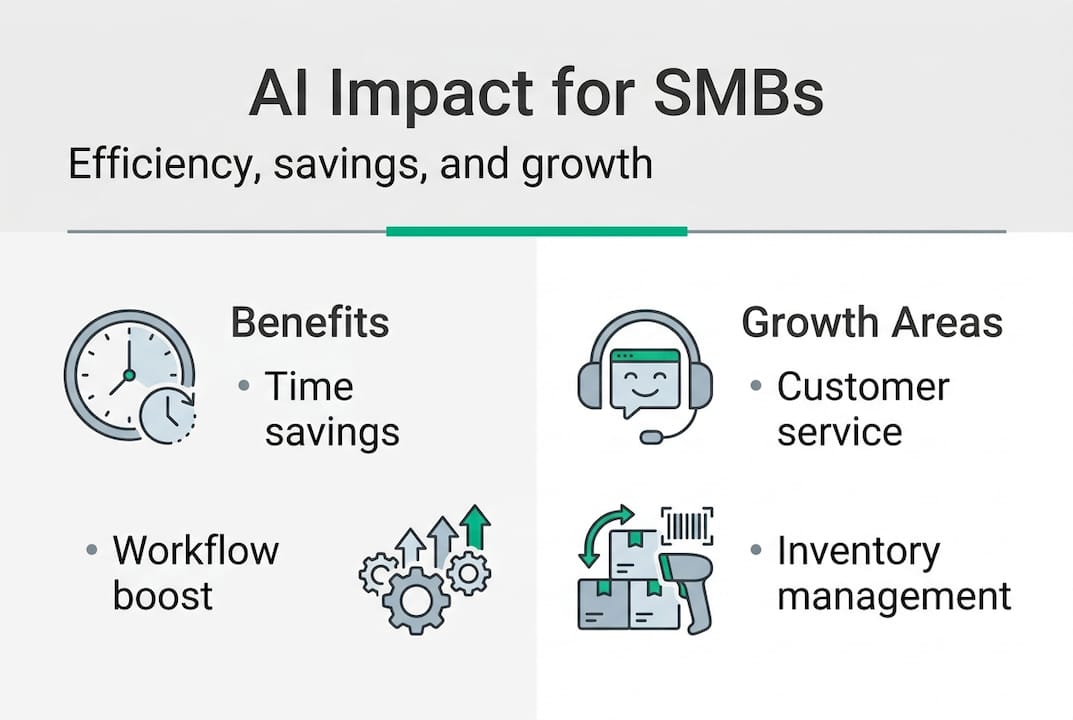
The labour savings are significant. 41% of AI users save over 25% labour time, and 17.5% report saving more than half their labour time on targeted tasks. For a business with five staff members, that could translate to the equivalent of one full-time role redirected toward growth activities rather than administrative overhead.
Here is what that looks like across common SMB scenarios:
- A trades business uses AI scheduling to eliminate double-bookings and reduce phone time by 40%
- A retail store deploys an AI chatbot that handles after-hours product enquiries and converts browsers into buyers overnight
- A professional services firm automates document review and client onboarding, cutting processing time from three days to four hours
- A logistics operator uses predictive analytics to optimise delivery routes, reducing fuel costs by 15% per quarter
Pro Tip: Do not start with the most complex AI use case you can imagine. Start with the task your team complains about most. That is usually where AI delivers the fastest, most visible return.
| Approach | Time to first result | Complexity | Typical ROI |
|---|---|---|---|
| AI chatbot for enquiries | 2 to 4 weeks | Low | High |
| Automated invoicing | 3 to 6 weeks | Low to medium | High |
| Predictive analytics | 3 to 6 months | Medium to high | Medium to high |
| Full workflow automation | 6 to 12 months | High | Very high (long-term) |
Beyond efficiency, AI enables genuine digital growth. Businesses that integrate AI into their customer experience report higher satisfaction scores and improved retention. AI-driven personalisation in eCommerce increases average order values. CRM AI tools identify which leads are most likely to convert, so your sales team focuses energy where it counts. The SME AI implementation benefits extend well beyond cost-cutting into competitive positioning, and the range of industry AI applications available today means there is almost certainly a relevant solution for your sector.

Risks, roadblocks, and what most articles miss
Here is the part most AI articles skip over. Not every SMB that adopts AI sees major gains. Only 30% of SMBs report significant results, and the difference between those businesses and the rest usually comes down to three things: problem selection, data quality, and human oversight.
Problem selection matters enormously. Businesses that try to automate everything at once, or that choose AI solutions before identifying a specific operational pain point, tend to waste money and generate frustration. The businesses that succeed start narrow. They pick one process, define what success looks like, and measure it carefully before expanding.
Data quality is the unglamorous foundation of every successful AI deployment. If your customer records are inconsistent, your inventory data is incomplete, or your historical sales figures are stored across three different spreadsheets, AI will amplify those problems rather than solve them. Garbage in, garbage out is not a cliché. It is the most common reason AI projects underperform.
Common risks to plan for:
- Implementation errors: AI systems acting on flawed logic, such as approving unapproved pricing or sending incorrect communications to customers
- Skills gaps: Staff who do not understand how to use or oversee AI tools, leading to over-reliance or outright avoidance
- Legacy systems: Older software that does not integrate cleanly with modern AI tools, creating data silos and manual workarounds
- Change resistance: Teams that feel threatened by AI rather than supported by it, reducing adoption and undermining ROI
"The businesses that struggle with AI are not the ones that moved too slowly. They are the ones that moved without a clear problem to solve."
Pro Tip: Before committing to any AI tool, map the process you want to improve end to end. Identify every input, every decision point, and every output. If you cannot describe the process clearly on paper, AI will not clarify it for you.
Human oversight is non-negotiable, particularly in the early stages. AI tools need to be monitored, corrected, and refined. Treating AI as a set-and-forget solution is one of the most expensive mistakes an SMB can make. A well-structured AI implementation for businesses always includes review cycles and escalation protocols. And if you are evaluating vendors, understanding why custom AI solutions outperform off-the-shelf tools for most SMBs will save you significant time and money.
ROI, timelines, and measuring success
Let us talk about the investment side honestly. AI is not free, and the returns are not always immediate. ROI from AI investment typically takes 2 to 4 years to fully materialise, and some of the most valuable benefits, such as improved employee satisfaction, stronger customer loyalty, and a more innovative culture, are genuinely difficult to put a dollar figure on.
That does not mean you cannot measure progress. It means you need to be deliberate about what you measure from day one.
Here is a practical approach to tracking AI ROI for your business:
- Define your baseline: Before you implement anything, document your current performance. How long does the target process take? What does it cost in staff time? What is the error rate?
- Set specific targets: Decide what improvement looks like. A 30% reduction in processing time. A 20% drop in customer service response time. Concrete numbers only.
- Track consistently: Review your metrics monthly for the first six months, then quarterly. Do not wait until the end of the year to check whether it is working.
- Account for intangibles: Note qualitative changes too. Are staff less stressed? Are customers commenting positively? These matter even if they do not appear in a spreadsheet.
- Adjust and iterate: If the numbers are not moving, investigate why before expanding the deployment.
| Return type | Typical timeline | How to measure |
|---|---|---|
| Labour time savings | 1 to 3 months | Hours saved per week |
| Error reduction | 1 to 6 months | Error rate before vs. after |
| Customer satisfaction | 3 to 9 months | NPS or review scores |
| Revenue growth | 6 to 18 months | Conversion rates, average order value |
| Full ROI | 2 to 4 years | Total cost vs. cumulative savings |
"Firms that track AI performance rigorously from the outset are significantly more likely to expand their investment. Those that do not often abandon promising tools too early."
Intangible returns deserve more attention than they typically receive. Businesses that invest in AI for professional services consistently report that their teams feel more engaged when freed from repetitive work. That translates into lower staff turnover, which is a very real cost saving that rarely appears in an AI ROI calculation but absolutely should.
Expert perspective: What actually works for Australian SMBs
After working with businesses across hospitality, trades, logistics, and professional services, the pattern is consistent. The SMBs that get genuine value from AI are not the ones that invested the most or moved the fastest. They are the ones that were the most disciplined.
Targeted implementation beats broad rollout every time. A business that automates one process well, measures it, learns from it, and then expands is far ahead of a business that deploys five tools simultaneously and cannot tell which one is working.
State-level variation in AI adoption is real, and it reflects differences in industry mix, workforce skills, and access to support. Policy support for skills and data needs to be a priority at both the business and government level if Australian SMBs are going to close the gap with larger enterprises.
The most important thing you can do right now is start small and stay curious. Pick one repetitive task, pilot a solution with clear metrics, keep a human in the loop, and build from there. A structured approach to practical AI implementation is what separates the 30% who see major gains from the rest.
Ready to unlock AI for your business?
If this article has clarified the opportunity and you are ready to take a concrete next step, ORVX AI works directly with Australian SMBs to identify exactly where AI will deliver the fastest return for your specific operation.
As experienced AI integration consultants, we embed with your team, map your workflows, and build a tailored AI roadmap that fits your budget and your goals. Whether you operate in professional services or run a trades business, we have industry-specific experience to guide your investment from first audit to full implementation. No generic packages. No vendor lock-in. Just practical, local expertise that gets results.
Frequently asked questions
What is the most effective first step for an Australian SMB to invest in AI?
Start by identifying your most repetitive tasks and pilot an AI solution with clear metrics for success. A focused pilot with measurable targets gives you real data to decide whether and how to expand.
How long does it take to see ROI from AI investment in Australia?
Most Australian SMBs experience measurable returns within 2 to 4 years, though labour time savings and efficiency gains often appear within the first few months of a well-scoped deployment.
What risks should SMBs consider before investing in AI?
Key risks include implementation errors and skills gaps, legacy system incompatibility, and poor data quality. Careful process mapping and human oversight protocols reduce these risks significantly.
Are there industry-specific AI solutions for Australian businesses?
Yes, tailored AI options exist for sectors including trades, manufacturing, retail, logistics, and professional services, with solutions designed around the specific workflows and compliance requirements of each industry.