
TL;DR:
- Australian SMEs can achieve significant labor savings by thoughtfully adopting custom AI with proper planning.
- Successful AI deployment requires assessing data quality, process maturity, staff skills, and clear objectives beforehand.
- Scaling AI involves governance, training, and continuous monitoring to prevent project failures and deliver reliable ROI.
Australian small and medium enterprises are sitting on a genuine competitive advantage, but only if they move with structure. Labour savings of 25-50% are achievable for SMEs that adopt AI thoughtfully, yet most businesses stumble because they skip the groundwork. Custom AI deployment is not about buying the flashiest tool. It is about matching the right solution to your specific workflows, data, and team. This guide walks you through every critical step, from assessing your readiness to scaling with governance, so you can implement AI with confidence and avoid the costly mistakes that derail most projects before they deliver results.
Table of Contents
- Assessing readiness for custom AI
- Identifying high-impact tasks for AI automation
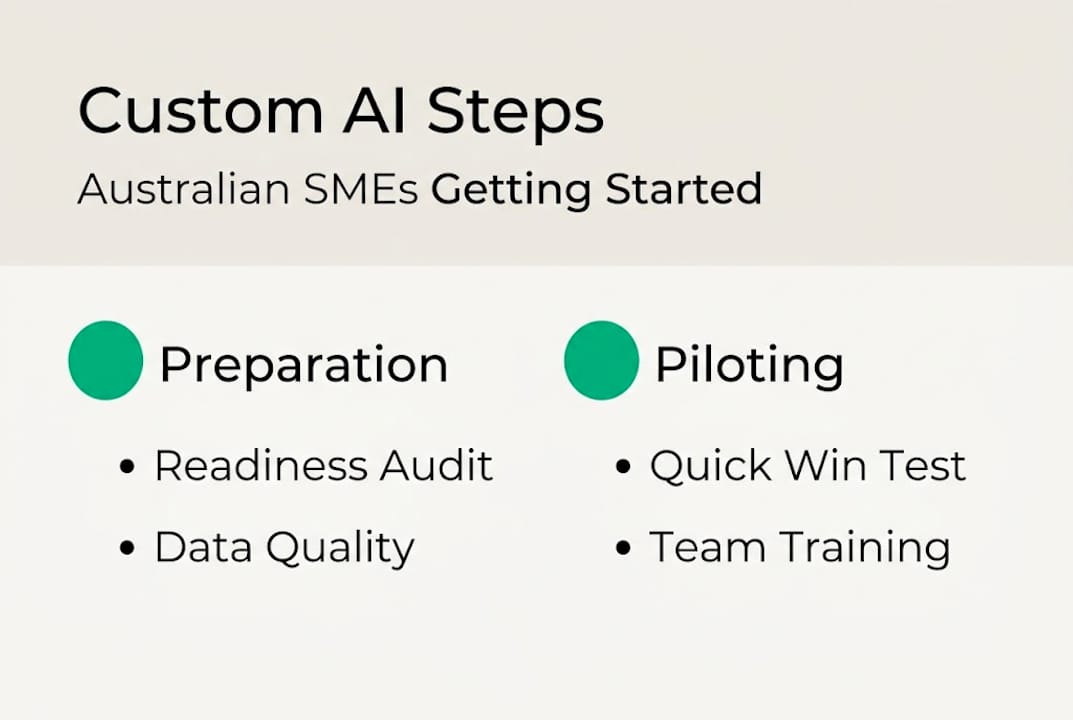
- Piloting quick wins with custom and off-the-shelf AI tools
- Scaling AI with governance, training and monitoring
- What most guides miss about custom AI deployment
- Next steps: Get custom AI solutions for Australian SMEs
- Frequently asked questions
Key Takeaways
| Point | Details |
|---|---|
| Start with readiness assessment | Evaluate your data, processes, and team skills to avoid costly mistakes. |
| Focus on high-ROI tasks first | Automate repetitive business tasks for maximum efficiency and profit gains. |
| Pilot quick wins before scaling | Test both custom and off-the-shelf AI tools through pilot projects to validate impact. |
| Establish governance as you expand | Use frameworks, training and monitoring to ensure compliance and sustainable performance. |
| Pilot-first approach avoids failure | Starting small lets you identify and fix bottlenecks before full implementation. |
Assessing readiness for custom AI
Before you spend a single dollar on AI tools, you need an honest look at where your business actually stands. A phased approach starting with readiness covering data, processes, and team skills is the foundation that separates successful implementations from expensive disappointments.
Here is what to check before moving forward:
- Data quality: Do you have clean, accessible, and well-organised data? Gaps here will break any AI project.
- Data privacy: Are your data handling practices compliant with Australian Privacy Principles? AI tools often process sensitive information.
- Process maturity: Are your key workflows documented and consistent, or do they vary depending on who is working that day?
- Staff skills: Does your team have basic digital literacy? AI does not require engineers, but it does require people willing to learn.
- Clear objectives: Can you articulate what problem you want AI to solve and how you will measure success?
Pro Tip: Run a quick internal audit before engaging any vendor. Map your top five most time-consuming processes and rate each one on data availability and consistency. This takes a few hours and saves weeks of wasted effort later.
Data quality and accessibility are consistently the most critical factors in whether an AI project succeeds or stalls. Without reliable inputs, even the most sophisticated model will produce unreliable outputs.
| Readiness factor | Minimum requirement | Common pitfall |
|---|---|---|
| Data quality | Structured, consistent records | Siloed spreadsheets with no standard format |
| Process documentation | Core workflows written down | Processes exist only in people's heads |
| Team capability | Basic digital tool comfort | Resistance to change or low digital literacy |
| Objectives | Measurable KPIs defined | Vague goals like "be more efficient" |
| Compliance | Privacy and security policies in place | Ignoring data residency requirements |
For a structured approach to this step, the AI audit guide from ORVX AI provides a practical framework. Combining this with solid integration best practices will set you up for a much smoother rollout.
Identifying high-impact tasks for AI automation
Once you know your business is ready, the next question is: where do you start? Not every task is worth automating. The goal is to find work that is repetitive, rule-based, high-volume, and currently eating into your team's productive hours.
Repetitive, high-ROI tasks like customer service, data entry, and invoice processing are consistently the best starting points. They are well-defined, measurable, and produce visible results quickly.
Here is a stepwise method for evaluating task suitability:
- List your top ten time-consuming tasks across departments, from reception to accounts to logistics.
- Score each task on volume (how often it occurs), consistency (does it follow a predictable pattern), and pain level (how much does it frustrate your team).
- Check data availability for each task. AI needs inputs to work with.
- Estimate the time cost of each task per week. Multiply by your average hourly rate to get a dollar figure.
- Rank by ROI potential and select the top two or three to target first.
Pro Tip: Your frontline staff know exactly where the pain is. Ask them directly which tasks feel like a waste of their skills. Their answers will often surprise you and point straight to your highest-value automation opportunities.
41% of Australian SMEs already save more than 25% of labour time through AI automation. That is not a future promise. It is happening right now in businesses like yours.
| Approach | Off-the-shelf tools | Custom automation |
|---|---|---|
| Speed to deploy | Days to weeks | Weeks to months |
| Cost | Low to medium | Medium to high |
| Flexibility | Limited to tool features | Built to your exact workflow |
| Compliance control | Vendor-dependent | Full control |
| Best for | Standard tasks, small teams | Complex workflows, regulated industries |
For context on where AI adds the most value by industry, the AI value in professional services article is worth reading. And if you are worried about where automation can go wrong, understanding automation failure risks will help you make smarter choices from the start.
Piloting quick wins with custom and off-the-shelf AI tools
Identifying the right tasks is only half the work. The next step is running a controlled pilot, a small-scale test that proves value before you commit serious resources. This is where many businesses get it right or wrong.
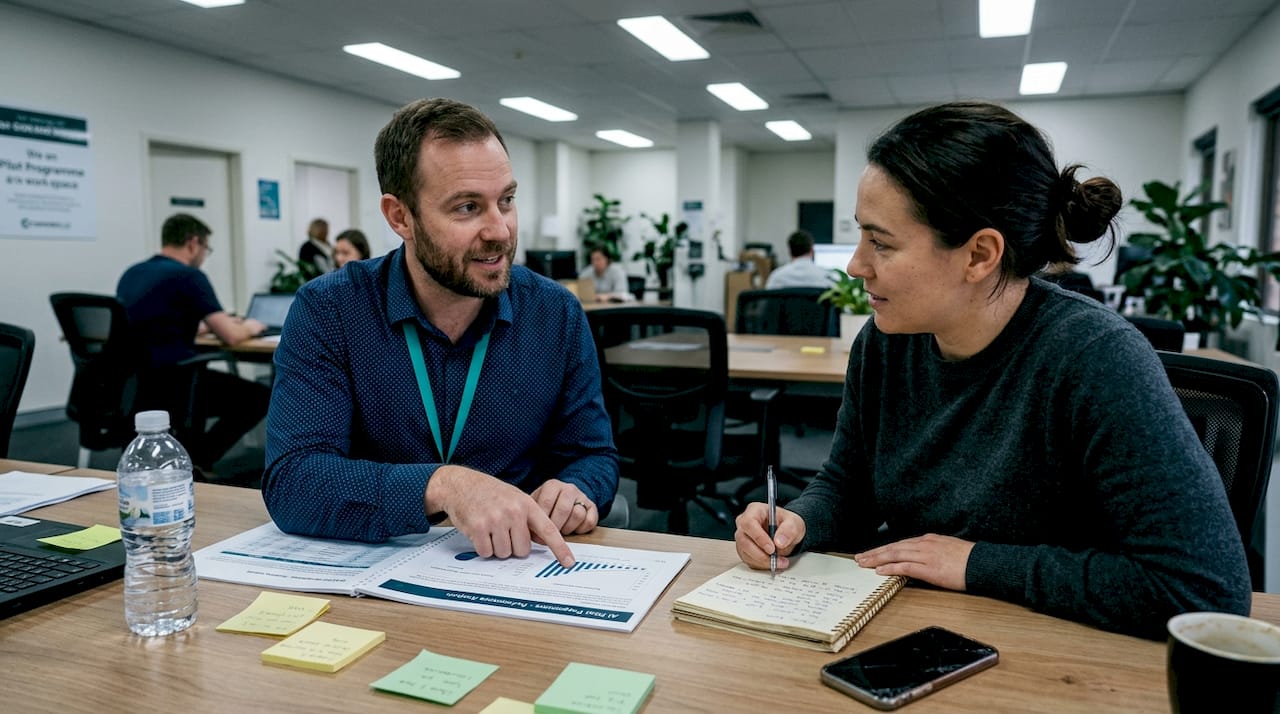
Pilot projects typically cost between $20,000 and $50,000 for SMEs, depending on complexity. That is a meaningful investment, but it is far less than the cost of a full-scale rollout that fails.
Follow these steps to run a tight, effective pilot:
- Define a narrow scope. Pick one task or one department. Do not try to automate everything at once.
- Set clear success metrics. Time saved, error rate reduction, cost per transaction. Numbers only.
- Choose your tools. For quick wins, platforms like Zapier, Make (formerly Integromat), or custom GPTs set up in hours can integrate your business knowledge rapidly.
- Set a timeline. Four to eight weeks is ideal for most pilots. Long enough to gather data, short enough to stay focused.
- Assign an owner. Someone on your team must be accountable for tracking results and flagging issues.
Common pilot tools worth exploring:
- Zapier or Make: Workflow automation between apps without custom code
- Custom GPTs or Claude projects: Knowledge-based assistants trained on your documents and processes
- CRM AI add-ons: Tools like HubSpot AI or Salesforce Einstein for sales and service automation
- Document processing tools: For invoice extraction, contract review, or data capture
The pilot benefits for SMEs are well-documented. You get proof of concept, stakeholder buy-in, and a clear picture of what full-scale deployment will actually involve. For industry-specific pilot options, the professional service pilots page covers tailored approaches across sectors.
Scaling AI with governance, training and monitoring
A successful pilot is exciting. But scaling without structure is where projects unravel. The transition from pilot to full deployment requires governance, training, and ongoing monitoring built in from the start.
"87% of AI projects fail not because of the technology, but because of missing strategy and change management." This finding from MIT research on AI implementation is the single most important number every business owner should know before scaling.
Scaling with governance and training while monitoring and optimising for operational excellence is not optional. It is the difference between AI that keeps working and AI that quietly drifts off course.
Key building blocks for full AI maturity:
- Governance framework: Define who owns each AI tool, who reviews outputs, and what the escalation path is when something goes wrong.
- Staff training programme: Invest in upskilling. Your team does not need to become data scientists, but they do need to understand what the AI does and does not do.
- Output monitoring: Set up regular reviews of AI outputs. Automated tools can develop data drift over time, producing increasingly inaccurate results without obvious warning signs.
- Compliance checks: For regulated industries, build verification loops into every AI-assisted process. Never let an AI output go unchecked in a compliance-sensitive context.
- Continuous optimisation: Schedule quarterly reviews to assess performance, update training data, and retire tools that no longer deliver value.
For businesses in the trades sector, the AI scaling in trades resource outlines practical governance approaches suited to field-based operations. And for any business preparing to scale, revisiting the AI audit for scaling process will help you identify gaps before they become problems.
What most guides miss about custom AI deployment
Most AI implementation guides focus on tools and timelines. They rarely talk about the cultural and structural factors that determine whether your investment actually pays off. Here is the uncomfortable truth: the technology is almost never the problem.
Businesses that rush straight to full-scale deployment without a structured pilot phase consistently regret it. We see this pattern repeatedly in regulated and resource-constrained sectors, where the cost of a silent failure, an AI producing wrong outputs that nobody catches, can be significant. 87% of AI projects fail due to missing strategy, not missing technology.
For Australian SMEs specifically, data residency and privacy compliance add a layer of complexity that generic global guides simply ignore. Your governance framework needs to account for where your data is stored and processed, not just what the AI does with it.
Pro Tip: Structure your pilots to surface silent failures early. Build in a human review step for the first 30 days of any AI output. You will catch data drift, edge cases, and process gaps before they scale into real problems.
The businesses that get the best custom ROI insights are not the ones with the biggest budgets. They are the ones that treat AI as a managed capability, not a set-and-forget tool.
Next steps: Get custom AI solutions for Australian SMEs
If this guide has shown you one thing, it is that structured AI implementation is entirely achievable for Australian SMEs. You do not need a large IT team or an enterprise budget. You need the right partner.
ORVX AI works directly with Australian businesses across professional services, trades, and a wide range of other industries to design and implement AI solutions that fit your actual workflows. From initial audit to full-scale deployment and ongoing support, ORVX AI provides vendor-agnostic, bespoke guidance tailored to your business context. If you are ready to move from reading about AI to actually implementing it, reach out and let us map out your first steps together.
Frequently asked questions
How long does it take to implement custom AI in an Australian SME?
Quick wins take 1-3 months; medium-term projects typically run 3-9 months depending on the complexity of your workflows and how prepared your data and team are at the outset.
What tasks should I automate first with AI?
Start with repetitive, high-ROI tasks such as customer service enquiries, data entry, or invoice processing. These deliver measurable results quickly and build internal confidence in AI adoption.
What ROI can I expect from custom AI projects?
Australian SMEs using AI report 25-50% labour savings and profitability uplifts ranging from 45% for businesses moving from basic to intermediate AI adoption, up to 111% for those reaching full enablement.
How do I ensure AI projects stay compliant and avoid failures?
Establish a governance framework early, conduct regular audits, and build verification loops into every AI-assisted process, particularly in regulated sectors where output accuracy has legal or financial consequences.
Should I buy off-the-shelf tools or build custom for my business?
Buy off-the-shelf for speed and simplicity on standard tasks. Build custom when you need full control over compliance, data residency, or integration with workflows that no generic tool was designed to handle.