
TL;DR:
- Small Australian SMBs are achieving significant productivity and revenue gains by adopting affordable AI tools.
- AI automates workflows, enhances decision-making, and shifts roles from volume tasks to judgment and oversight.
- Proactive, phased implementation with expert guidance accelerates ROI and competitive advantage.
A bookkeeper in regional Australia added eight new clients, grew her monthly revenue by AU$3,200, and still works the same hours. Her secret? An AI stack costing just AU$65 per month. Stories like hers are becoming common across Australian professional services, from accounting and legal practices to allied health and consulting firms. Yet most small business owners still believe AI is a tool reserved for Deloitte or the Big Four. That belief is costing them time, money, and competitive ground. This guide cuts through the noise and shows you, step by step, what AI actually does in professional services, what it costs, and how to start.
Table of Contents
- What is AI in professional services?
- Measurable gains: Evidence from Australian SMBs
- How AI is reshaping business models and roles
- Getting started: Practical pathway for Australian SMBs
- The uncomfortable truth: AI rewards bold SMBs, not fence-sitters
- Partner with experts for a smarter AI journey
- Frequently asked questions
Key Takeaways
| Point | Details |
|---|---|
| AI unlocks real ROI | Even small professional service firms are achieving significant revenue and productivity gains with tailored AI solutions. |
| Business models are evolving | AI is pushing firms to update pricing, structures, and staff roles to stay competitive and profitable. |
| Start with clear steps | Clarify your business need, pilot a focused process, and adapt as you scale for the best results. |
| Early adopters gain advantage | SMBs willing to experiment and act on AI now outpace those that wait for perfect certainty. |
What is AI in professional services?
With the context set, let's clarify exactly what AI means for professional services firms today.
Artificial intelligence, in a professional services context, means software that can learn from data, carry out complex tasks, and support decision making without constant human input. It is not a single product you plug in. It is a set of tools and systems configured to match how your firm actually works. Think of it as a highly capable assistant that never sleeps, never forgets a deadline, and gets better at its job the longer it works with you.
Understanding why AI matters for professional services starts with knowing what it can actually do today. The practical applications that matter most for Australian SMBs include:
- Workflow automation: Scheduling, invoicing, follow-ups, and reporting handled automatically, freeing up billable hours.
- Document review and processing: AI reads contracts, extracts key clauses, flags compliance issues, and summarises lengthy reports in seconds.
- Data analytics and reporting: AI analyses client data, identifies patterns, and generates actionable insights that would take a junior analyst hours to produce.
- Client communications: AI-driven chatbots and email tools handle routine enquiries, appointment bookings, and progress updates around the clock.
- Decision support: AI surfaces relevant information during client meetings, flags risks, and recommends next steps based on prior engagements.
What makes this generation of AI genuinely different from earlier automation is its capacity to learn and improve. Early automation was rigid. If the process changed, the tool broke. Modern AI adapts. It learns from each client engagement, refines its outputs, and encodes the expertise that previously lived only in your head or in a senior staff member's memory.
This shift is captured well in the concept of Firm OS, an emerging model for professional services where data, intelligence, and orchestration layers work together to encode firm expertise. Rather than relying on a single star consultant, a Firm OS platform makes expertise modular and scalable. Roles shift from doing repetitive tasks to exercising judgement and providing oversight.
"The firms that benefit most from AI are those that treat it as an organisational capability, not just a collection of individual tools. Learning compounds over time, and each engagement makes the whole system smarter."
For AI for professional services to deliver real returns, the foundation matters as much as the technology. A clear data structure, defined workflows, and a willingness to evolve how work gets done are the real prerequisites. The tools themselves are increasingly affordable and accessible. What separates successful adopters from those still on the fence is the decision to start.
Measurable gains: Evidence from Australian SMBs
Now, theory aside, let's look at what's actually happening for local SMBs embracing AI.
The bookkeeper case study mentioned earlier is not an outlier. Across Australian professional services, small and medium firms are documenting real, measurable improvements in productivity, revenue, and client capacity. The numbers are compelling and they matter because they come from firms similar in size and structure to yours.
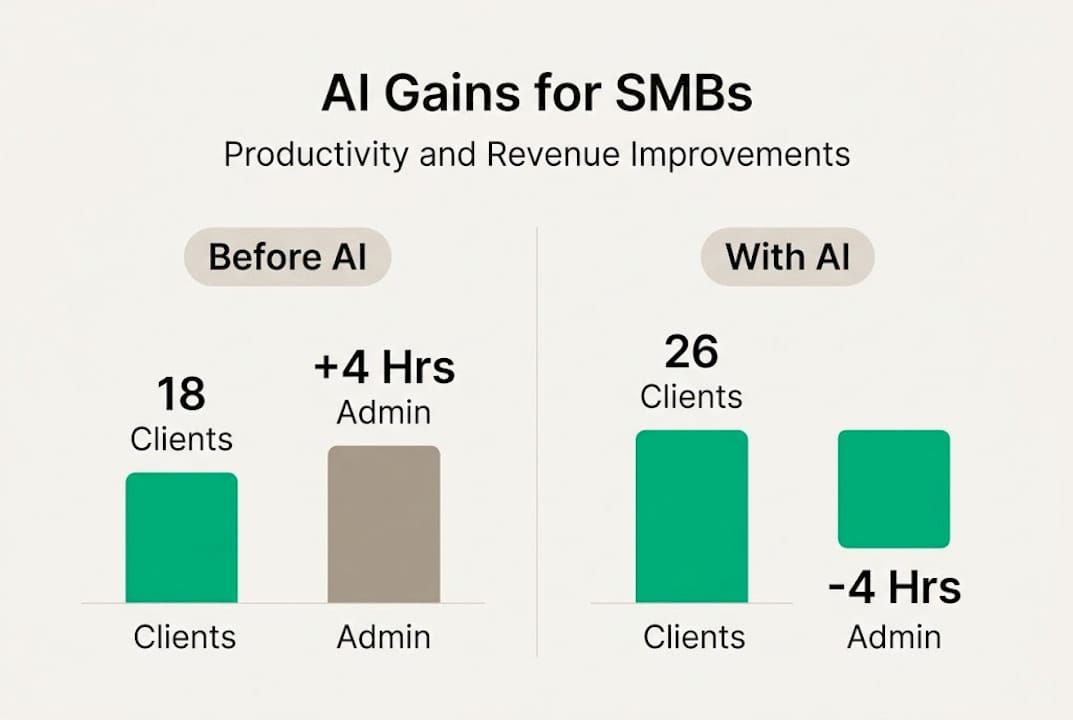
One Australian SMB case study tracked a sole trader bookkeeper who used AI tools to scale from 18 to 26 clients without adding staff or hours. Revenue grew by AU$3,200 per month. The entire AI stack cost AU$65 per month. That is a return on investment that would make any financial adviser raise an eyebrow.

The same research captured an allied health practice saving between four and five hours of admin work every week. For a sole practitioner billing at AU$180 per hour, that is potentially AU$720 to AU$900 in recovered billable time every single week. Over a year, that adds up to more than AU$40,000 in revenue potential from a single change.
| Metric | Before AI | After AI |
|---|---|---|
| Active clients (bookkeeper) | 18 | 26 |
| Monthly revenue | Baseline | +AU$3,200 |
| Monthly AI tool cost | AU$0 | AU$65 |
| Admin hours per week (allied health) | 9 to 10 hours | 4 to 5 hours saved |
| Net weekly hours recovered | 0 | 4 to 5 hours |
The productivity gains extend beyond these examples. Research consistently shows that knowledge workers using AI tools can operate at three to four times their previous output for certain task types. Document drafting, client reporting, data entry, and research tasks are the clearest examples. A junior staff member using AI can produce the volume of work previously requiring a small team.
Pro Tip: Before you implement any AI tool, measure your current baseline. Track how long specific tasks take, how many clients you serve, and your weekly admin burden. Without a before picture, you cannot prove the value of your investment or spot where to improve next.
Following AI implementation steps for SMEs with clear measurement baked in from the start is what separates firms that can demonstrate ROI from those that feel like they are spending on something intangible.
The evidence is clear. AI does not just save time in theory. For Australian SMBs willing to implement thoughtfully, it generates real revenue, real capacity, and real competitive advantage.
How AI is reshaping business models and roles
With benefits clear, let's unpack the bigger changes AI is driving in firm structures and how work gets done.
The impact of AI on professional services goes further than efficiency gains. It is fundamentally altering how firms price their services, structure their teams, and deliver value to clients. Understanding these shifts helps you position your firm for long term success rather than short term savings.
The traditional professional services model relies on a pyramid structure. Senior staff do high-value work. Junior staff handle volume tasks. Revenue scales by adding headcount. AI compresses this pyramid significantly. Research on AI productivity in consulting found that AI delivers a three to four times productivity gain for junior roles, effectively doing the work of multiple junior staff. Firms like Accenture, generating AU$34.6 billion through fixed-price managed services contracts, are already capturing these gains as margin rather than passing savings to clients.
"The billable hour model assumes that time equals value. AI breaks that assumption. Firms still billing hourly while their competitors offer fixed-price, outcome-based engagements are running a race they cannot win."
| Billing model | Revenue driver | AI impact | Risk level |
|---|---|---|---|
| Hourly billing | Time on task | Margin erosion as AI speeds tasks | High without adaptation |
| Fixed-price projects | Scope delivery | AI improves margin on fixed scope | Medium, manage scope carefully |
| Managed/outcome services | Client results | AI scales delivery, captures margin | Low, strong competitive position |
| Subscription retainers | Ongoing value | AI enables more clients per retainer | Low, scalable model |
Firms that adapt their pricing models to reflect outcomes rather than hours are better placed to capture the full benefit of AI. Here is how to start that transition:
- Identify your highest-volume, lowest-judgement services. These are the first to automate and the first to reprice as fixed-fee or subscription.
- Repackage around client outcomes. Instead of billing for hours spent on a task, price based on the result you deliver.
- Restructure team roles. Junior staff move to oversight, quality checking, and client-facing support rather than repetitive production tasks.
- Invest in upskilling. Train existing staff to work with AI tools so they can supervise, prompt, and verify outputs rather than produce everything manually.
- Pilot a managed services offering. Start with one client on a fixed monthly fee and measure your margin. Refine before rolling out broadly.
AI is also influencing how firms stay relevant by reading AI trends in business strategy and positioning ahead of industry shifts rather than reacting to them.
The firms that will dominate Australian professional services in the next five years are not necessarily the largest. They are the ones that treat AI as infrastructure and build their service delivery model around it from the ground up.
Getting started: Practical pathway for Australian SMBs
To turn these insights into results, here's your practical action plan for getting started with AI.
The most common mistake Australian SMBs make with AI is trying to do too much too fast. They buy multiple tools, attempt to automate every process at once, and then wonder why adoption is patchy and ROI is unclear. The smarter approach is sequential and evidence driven. Start narrow. Prove value. Then scale.
Here is the step-by-step pathway that consistently delivers results:
- Clarify the specific business challenge. Do not start with AI. Start with the problem. Is it the time spent on client onboarding? The volume of routine emails? Monthly reporting? Name the single process causing the most friction or consuming the most time.
- Pilot with one process only. Choose the highest-impact, most repetitive task and run a focused pilot for 30 to 60 days. Track the time saved and any quality improvements carefully.
- Measure ROI before expanding. Calculate the revenue impact of time recovered or capacity added. If the numbers are positive, you have your business case for the next step.
- Adapt roles before you add more tools. Once one process is running well, update how your team interacts with that system. Make sure staff understand their new role before introducing further automation.
- Scale to the next process. Use the learnings from your pilot to implement AI in the next highest-priority area. Each rollout gets faster and smoother.
Pro Tip: The most overlooked step is staff training. Resistance to AI usually comes not from fear of replacement but from uncertainty about how to use new tools confidently. Invest a few hours in structured training early and adoption rates improve dramatically.
Common pitfalls to avoid include:
- Over-customising tools before you understand your actual workflow requirements.
- Skipping the measurement step and assuming AI is working without evidence.
- Choosing tools based on features alone without considering how they integrate with your existing systems.
- Neglecting data quality. AI is only as reliable as the data it learns from.
- Underestimating the change management required to shift team habits and expectations.
Knowing when to use a platform like Firm OS versus a bespoke consultancy approach depends on your firm's complexity and growth ambitions. Platforms work well when your workflows are relatively standard and you need scalable infrastructure quickly. Bespoke consultancy is worth the investment when your processes are unique, your data environment is complex, or you want to encode your specific firm expertise into the AI system.
Signs it is time to seek outside help:
- You have tried AI tools and seen inconsistent results without understanding why.
- Your team is using AI reactively rather than as part of a structured system.
- You want to build a competitive moat, not just save a few hours a week.
- You are considering a shift to outcome-based or managed services pricing and need guidance on the transition.
Following AI integration best practices is the difference between a firm that experiments aimlessly and one that builds genuine, lasting advantage.
The uncomfortable truth: AI rewards bold SMBs, not fence-sitters
Here is the part most AI articles skip. Every week spent researching the perfect implementation is a week your competitors spend gaining experience. The firms seeing the strongest returns from AI are not necessarily the most technically sophisticated. They are the ones willing to pilot something imperfect, learn from it, and adjust quickly.
Understanding why AI matters in services is useful. Acting on it is what actually moves the needle. There is no risk-free AI rollout. There will be false starts, tools that do not quite fit, and processes that need rethinking. That is normal. The firms treating those moments as learning rather than failure are the ones compounding capability over time. The biggest risk for Australian SMBs is not choosing the wrong tool. It is choosing to wait until everything feels certain, because in a market moving this fast, certainty arrives after your competitors have already taken the ground you were standing on.
Partner with experts for a smarter AI journey
For those ready to move from ideas to action, expert help can boost your chances of success.
Navigating AI implementation alone is possible, but it is slower and riskier than it needs to be. Working with experienced AI integration consultants means you benefit from proven frameworks, vendor-agnostic advice, and a team that has already made the costly mistakes so you do not have to. ORVX AI embeds directly within your firm to map your workflows, identify your highest-value AI opportunities, and build a roadmap tailored to your specific situation.
Whether you are a bookkeeper, a legal practice, or a consulting firm ready to shift to managed services pricing, the right consultancy accelerates your ROI and reduces implementation risk significantly. Explore AI for your services firm to see industry-specific solutions, or reach out to arrange a discovery session and take the first concrete step towards building your AI-powered practice.
Frequently asked questions
How much does AI implementation cost for Australian professional service SMBs?
Entry-level AI tools can cost as little as AU$65 per month, though costs scale with the complexity of your processes and the number of tools required. Most SMBs see positive ROI well within the first three months of a well-scoped implementation.
What's the fastest ROI AI use case for service firms?
Workflow automation and admin reduction typically deliver the clearest and quickest returns, with some Australian firms saving four to five hours of admin work per week from a single implementation. That recovered time translates directly into billable capacity.
Does using AI mean fewer jobs for staff?
AI compresses repetitive junior tasks but shifts roles to judgement and oversight rather than eliminating positions outright. Most firms find staff become more engaged when freed from volume work and redirected towards client advisory and quality control.
Are AI platforms better than standalone tools for small firms?
For firms with growth ambitions, Firm OS platforms offer scalable orchestration and encoded expertise that isolated tools cannot match over time. Standalone tools suit simple, single-process automation needs but hit a ceiling quickly as your firm grows.