
TL;DR:
- Australian retailers face challenges distinguishing genuine AI value from distractions and navigating implementation complexities. To succeed, they must focus on solving specific problems, assess data readiness, and ensure scalable, well-governed solutions. Building lasting ROI requires prioritizing organizational readiness, transparent communication, and a tailored approach rather than chasing the latest AI trends.
Australian retailers are being bombarded with AI promises from every direction, yet most business owners and managers are still struggling to separate the genuine revenue drivers from the expensive distractions. The gap between "AI will transform your business" and "here's exactly what to implement first" is where most retailers get stuck. This guide cuts through the noise, drawing on real examples from Bunnings and Wesfarmers, to show you which AI applications are delivering measurable results, what risks to manage, and how to build a structured path from your first pilot to scalable, lasting impact.
Table of Contents
- How to identify AI opportunities that actually deliver results
- Top AI applications transforming Australian retail
- Risks and governance: What retailers must get right with AI
- Getting ROI from retail AI: Steps for measurable success
- Our take: AI in retail only works when you prioritise readiness over hype
- How we help Australian retailers unlock AI's full potential
- Frequently asked questions
Key Takeaways
| Point | Details |
|---|---|
| Start with real problems | Find the biggest friction points in your workflows or customer experience before choosing any AI. |
| Prioritise data and readiness | Strong data and integrated systems are essential for successful retail AI rollouts. |
| Risk management matters | Operational guardrails and human oversight protect against errors and lost trust. |
| Measure ROI with pilots | Test, track, and refine AI initiatives with clear goals to prove and scale value. |
How to identify AI opportunities that actually deliver results
The most common mistake retailers make is starting with the technology rather than the problem. A shiny new AI tool might look impressive in a demo, but if it doesn't address a specific friction point in your business, it will sit unused within six months. The right approach is to start with your biggest operational headaches or customer experience gaps, then work backwards to find the AI solution that fits.
Before you even look at vendors, take stock of your data and digital infrastructure. AI systems are only as good as the data feeding them. If your inventory records are inconsistent, your customer data is siloed across three platforms, or your point-of-sale system hasn't been updated since 2015, you'll need to address those gaps first. Many retailers underestimate this step and then wonder why their AI pilot underperforms.
When evaluating any AI opportunity, ask two questions. Does it improve the customer journey, the internal workflow, or ideally both? And can it scale beyond a single store or category without requiring a complete rebuild? One-off experiments that can't grow with your business are rarely worth the investment.
- Define the business problem first. Write down your top three operational or customer experience pain points before speaking to any vendor.
- Audit your data readiness. Identify where your data lives, how clean it is, and whether your systems can integrate with modern AI tools.
- Evaluate fit and scalability. Prioritise solutions that work across multiple touchpoints and can expand as your business grows.
- Design pilots with clear metrics. Set measurable targets before you start, whether that's a lift in conversion rate, a reduction in stockouts, or faster customer service resolution times.
- Build in human oversight. Every AI deployment should have a responsible person or team monitoring outputs and flagging anomalies.
"For Australian retailers, large-scale AI rollouts are being framed as multi-year partnerships and include agentic AI for both customer-facing journeys and internal workforce and workflow support." This framing from Wesfarmers' approach with Microsoft is a useful reality check: even the biggest players treat AI as a long-term commitment, not a quick fix.
Pro Tip: Map your customer journeys and internal workflows before you approach any AI vendor. The best opportunities reveal themselves when you can point to exactly where friction, delays, or drop-offs occur. A one-page process map is worth more than a hundred vendor brochures.
Understanding AI integration best practices for Australian SMBs will also help you frame your readiness assessment more accurately. And if you're still weighing up whether the investment makes sense, reviewing AI investment guidance for Australian businesses provides a grounded financial perspective.
Top AI applications transforming Australian retail
With the right evaluation criteria in place, we can now pinpoint which AI use-cases are having the biggest impact for retail businesses across Australia. The good news is that several of these are already proven at scale by major Aussie chains, which means the learning curve for smaller retailers is shorter than it was even two years ago.
AI-powered site search and personalised recommendations are consistently among the highest-ROI applications. When a customer searches for "outdoor dining set" and your search engine surfaces exactly the right products, complete with complementary items and relevant accessories, conversion rates climb and average order values grow. This kind of AI-enhanced search and personalisation is now a core part of how leading Australian retailers are competing online.
Perhaps the most talked-about example in Australian retail right now is Bunnings' AI shopping assistant, known as "Buddy." Built on Google's Gemini Enterprise platform, Buddy represents a meaningful shift from basic product search to what Bunnings describes as "project search". Instead of just finding a drill, Buddy can help a customer plan an entire deck-building project, recommending every product they'll need along the way. That's a fundamentally different and far stickier customer experience.
Supply chain and inventory AI is another area where the returns are substantial but less visible to customers. Predictive restocking tools analyse sales velocity, seasonal trends, and supplier lead times to keep shelves full without over-ordering. For retailers managing thousands of SKUs across multiple locations, this kind of automation can reduce both stockouts and excess inventory simultaneously.
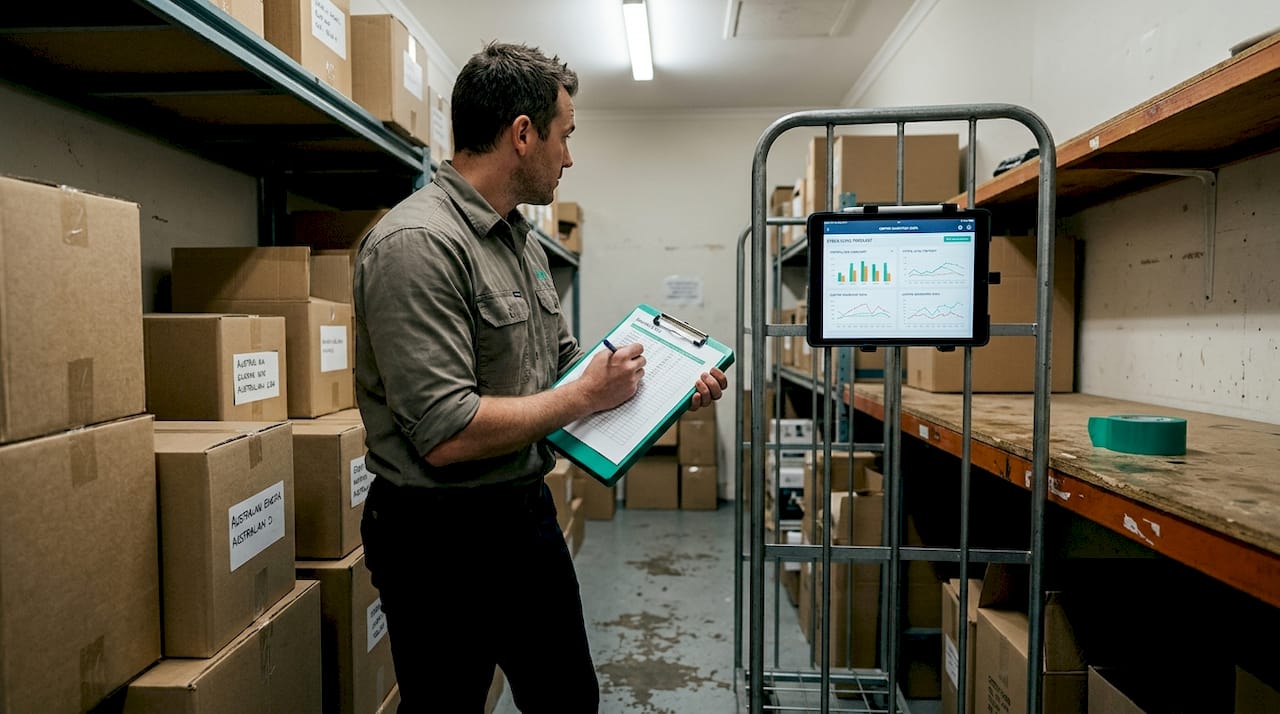
Automated pricing and promotional tools use real-time data to adjust offers based on demand, competitor activity, and stock levels. These tools can be powerful, but they require careful governance. Pricing errors at scale can damage customer trust quickly, so human review processes must be built in from the start.
| AI application | Impact area | Who's doing it in Australia | Complexity |
|---|---|---|---|
| AI-powered search and recommendations | Front-of-house, revenue growth | Wesfarmers, Bunnings | Medium |
| Agentic shopping assistants | Front-of-house, customer engagement | Bunnings (Buddy) | High |
| Predictive inventory and restocking | Back-end, operational efficiency | Major grocery and hardware chains | Medium |
| Automated pricing and promotions | Front-of-house and back-end | Large format retailers | High |
| Workforce and operations AI | Back-end, staff productivity | Wesfarmers group | Medium |
Workforce-supporting AI is also gaining traction. Tools that handle routine operational updates, shift scheduling, and internal knowledge queries free up floor staff to focus on customers rather than admin. For AI in eCommerce operations, the opportunities extend even further, covering everything from chatbot-assisted customer service to AI-driven catalogue management.
Risks and governance: What retailers must get right with AI
While the opportunities are substantial, it's just as important to understand and mitigate the risks before you dive in. AI in retail is not a set-and-forget system. Without proper governance, the same tools that drive efficiency can create serious operational and reputational problems.
The most common failure mode is automation without policy. When AI systems control pricing or promotional logic without clear guardrails, inconsistencies can appear across channels or stores. A product priced at $49 online but $79 in-store because of a conflicting AI rule is the kind of error that generates social media complaints and erodes trust fast.
System backsliding is another real risk. This happens when staff revert to spreadsheets or legacy processes because the AI tool is too complex, too slow, or not trusted. When this occurs, you end up running two parallel systems, which is worse than having no AI at all. It doubles the workload and creates data inconsistencies that are hard to untangle.
Governance and security risks are among the most serious failure modes for agentic AI, with pricing and promotion inconsistencies, system backsliding, and data security vulnerabilities all cited as genuine threats to market position and customer relationships. Retailers who skip the governance step in favour of speed are the ones who end up in damage-control mode.
Key risks to manage before going live:
- Data security and compliance. Customer data handled by AI systems must meet Australian Privacy Act requirements. Know where your data is stored and who has access.
- Pricing and promotion consistency. Build approval workflows for any AI-generated pricing changes, especially during peak trading periods.
- Model drift. AI models can become less accurate over time as market conditions change. Schedule regular performance reviews.
- Staff buy-in and training. If your team doesn't understand or trust the AI tool, they won't use it correctly.
- Vendor dependency. Understand what happens to your operations if a vendor shuts down or changes their pricing model.
Pro Tip: Don't leave AI governance solely to your IT team. Assign a cross-functional group that includes operations, marketing, legal, and frontline staff to set guidelines and review AI outputs regularly. The people closest to customers often spot problems first.
Reviewing AI for efficiency in retail through the lens of risk management, rather than just opportunity, is one of the most valuable mindset shifts a retail leader can make.
Getting ROI from retail AI: Steps for measurable success
To avoid stumbling over common pitfalls and measure real success, it's vital to take a structured approach to rolling out AI. The retailers who achieve lasting ROI are not the ones who move fastest. They're the ones who move most deliberately.
A practical methodology for retail AI starts with defining the business problem clearly, running pilots with governance and metrics built in, and treating data readiness and integration as prerequisites rather than afterthoughts. AI is not plug-and-play, and the businesses that treat it as such are the ones that end up with expensive underperforming tools.
- Clarify your business case. Write a one-paragraph summary of the problem you're solving, the metric you'll use to measure success, and the cost of doing nothing. This becomes your north star throughout the project.
- Map data, systems, and readiness. Identify every data source the AI will need, check its quality, and confirm your existing systems can integrate with the new tool. Address gaps before you start the pilot.
- Run a governed pilot. Select one store, one product category, or one workflow. Set a 60 to 90-day timeline with weekly check-ins and a clear decision point at the end.
- Iterate before scaling. Use pilot learnings to refine the tool, retrain staff, and update governance policies. Only then should you plan for broader rollout.
- Budget for the full picture. Scale-up costs include team training, data cleanup, integration work, and ongoing support. Build these into your business case from day one.
| Approach | What it suits | Time to results | Risk level | Scalability |
|---|---|---|---|---|
| Quick-win pilot (single use-case) | Smaller retailers, first-time AI adopters | 1 to 3 months | Low to medium | Moderate |
| Phased multi-use-case rollout | Mid-size chains with existing digital infrastructure | 6 to 18 months | Medium | High |
| Enterprise-wide AI transformation | Large retailers with dedicated IT and data teams | 2 to 4 years | High | Very high |
Working with AI specialists for retail who understand the Australian market can compress your timeline significantly by helping you avoid the most common scoping and integration mistakes.
Our take: AI in retail only works when you prioritise readiness over hype
With the actionable steps covered, here's how our experience reshapes the way retail leaders should think about rolling out AI. The retailers we see struggling most are not the ones who moved too slowly. They're the ones who chased the most impressive-sounding technology without building the foundations to support it.
Most flashy AI pilots fail because they ignore the gritty reality of data cleanliness, workforce training, and system silos. A beautifully designed recommendation engine is useless if your product data is incomplete, your images are inconsistent, or your inventory feed updates only once a day. These are not glamorous problems to solve, but they are the ones that determine whether your AI investment pays off.
True ROI comes from back-end readiness and from being transparent with your teams and customers about what AI does and doesn't do. Staff who understand the tool's purpose and limitations use it better. Customers who trust that AI is helping rather than manipulating them engage more openly. Both of these outcomes require honest communication, not just clever technology.
It's tempting to chase the cutting edge, especially when competitors seem to be moving fast. But the retailers who build lasting competitive advantage through AI are the ones who invest in quality data, clear governance, and adaptable systems before they invest in the most advanced models. AI should augment, not overwhelm or alienate, your people and customers. That principle sounds simple, but it's violated constantly in the rush to deploy.
Understanding why custom AI solutions consistently outperform off-the-shelf tools comes down to exactly this point. Bespoke solutions are built around your actual data, your actual workflows, and your actual customers, which means they work in the real world rather than just in a vendor's case study.
How we help Australian retailers unlock AI's full potential
For those ready to realise new opportunities, here's how our team can help you bridge the gap from insight to outcome.
At ORVX AI, we work directly with Australian retailers to scope, pilot, and scale AI solutions that are built for real operational impact, not just impressive demos. We embed within your team, map your workflows, assess your data readiness, and design a roadmap that reflects your actual business priorities rather than a templated package.
Whether you're a single-location retailer exploring your first AI use-case or a multi-site operation looking to scale an existing pilot, our vendor-agnostic approach means we recommend what actually works for your context. From AI for Australian retail strategy through to implementation and ongoing support, we stay with you through every stage. Connect with our AI advisory services team to book a strategy session, request a site audit, or explore sector-specific case studies that reflect your business model.
Frequently asked questions
What's the biggest AI opportunity for small retailers in Australia?
AI-driven product search, personalised recommendations, and customer-facing assistants can quickly boost both online and in-store conversions for smaller retailers without requiring enterprise-scale infrastructure.
How long does it take to see ROI from retail AI?
Most retailers see initial results from pilot projects within a few months, but fully scaled ROI typically takes one to two years of integration work, team training, and iterative improvement.
What risks should I check before going live with AI in my store?
Review your data security policies, pricing approval workflows, and staff training plans to avoid the governance and pricing failures that are the most common causes of costly AI rollbacks.
Is generative AI really needed, or can simpler automation help?
Simpler automation delivers reliable quick wins for routine tasks, but generative AI tools like Bunnings' Buddy unlock deeper project-level engagement and richer workflow support that basic automation simply cannot replicate.