
TL;DR:
- Genuine AI transformation integrates AI across all business operations, strategies, and decision-making, rather than just deploying isolated tools. It requires a comprehensive, organization-wide redesign focusing on strategy, process, people, technology, and governance to achieve lasting value. Success depends on leadership commitment, cultural change, data quality, and embedding continuous improvement rather than quick pilots or technology adoption alone.
Most Australian business owners assume AI transformation means signing up for a few software subscriptions and calling it done. That assumption is costing them. Real AI transformation is an organisation-wide change initiative that redesigns how value is created, embedding AI into core operations, decision-making, and strategy rather than simply layering new tools on top of old processes. If you want lasting competitive advantage, not just a temporary efficiency bump, understanding this distinction is the first step.
Table of Contents
- Defining AI transformation for Australian businesses
- Key elements of successful AI transformation
- Common pitfalls and edge cases in AI transformation
- Steps to start your AI transformation journey
- AI transformation: why a shift in mindset matters most
- Connect your business to AI expertise
- Frequently asked questions
Key Takeaways
| Point | Details |
|---|---|
| True AI transformation | It is organisation-wide and goes far beyond adopting new AI tools. |
| Essential success factors | Leadership, people, process design, technology integration, and governance all matter equally. |
| Common pitfalls | Staying in 'pilot' mode or failing to align AI with workflows limits business value. |
| Practical roadmap | Start with a focused strategy, address people and data first, and scale from early wins. |
| Mindset drives results | The right organisational culture and leadership commitment are the real enablers of AI transformation. |
Defining AI transformation for Australian businesses
AI transformation is not the same as buying a chatbot or automating a single invoice process. Those are useful steps, but they are not transformation. True AI transformation means rethinking how your entire business creates and delivers value, with AI woven into the fabric of your operations, your strategy, and your governance.
"AI transformation is an organisation-wide change initiative that redesigns how value is created by embedding AI into core operations, decision-making, and strategy, not just adding AI tools."
For Australian SMEs, this distinction matters enormously. Many business owners invest in AI tools and then wonder why the results feel underwhelming. The tools work, but the underlying processes, the decision-making structures, and the culture remain unchanged. You end up with a faster version of the same old system rather than a genuinely transformed one.
What does embedding AI actually look like in practice? Consider a mid-sized logistics company in Brisbane. Rather than simply using AI to track deliveries, a transformed business uses AI to predict demand, dynamically reroute drivers, flag customer service issues before they escalate, and feed insights directly into leadership decisions about fleet investment. Every layer of the business is touched.
Key characteristics of genuine AI transformation include:
- Operational redesign: Core workflows are restructured around AI capabilities, not just supplemented by them.
- Decision-making integration: AI informs and supports leadership choices at every level, from frontline staff to the boardroom.
- Strategic alignment: AI initiatives connect directly to business goals, not just IT projects.
- Governance and data management: Policies around data quality, privacy, and ethical AI use are embedded from the start.
- Cultural change: Staff understand, trust, and actively use AI as part of their daily roles.
Australian SMEs have a genuine opportunity here. Smaller organisations can move faster than large enterprises because they have fewer legacy systems and shorter decision chains. AI's role in Australian professional services is already demonstrating how firms that commit to full integration outperform those that dabble.
Key elements of successful AI transformation
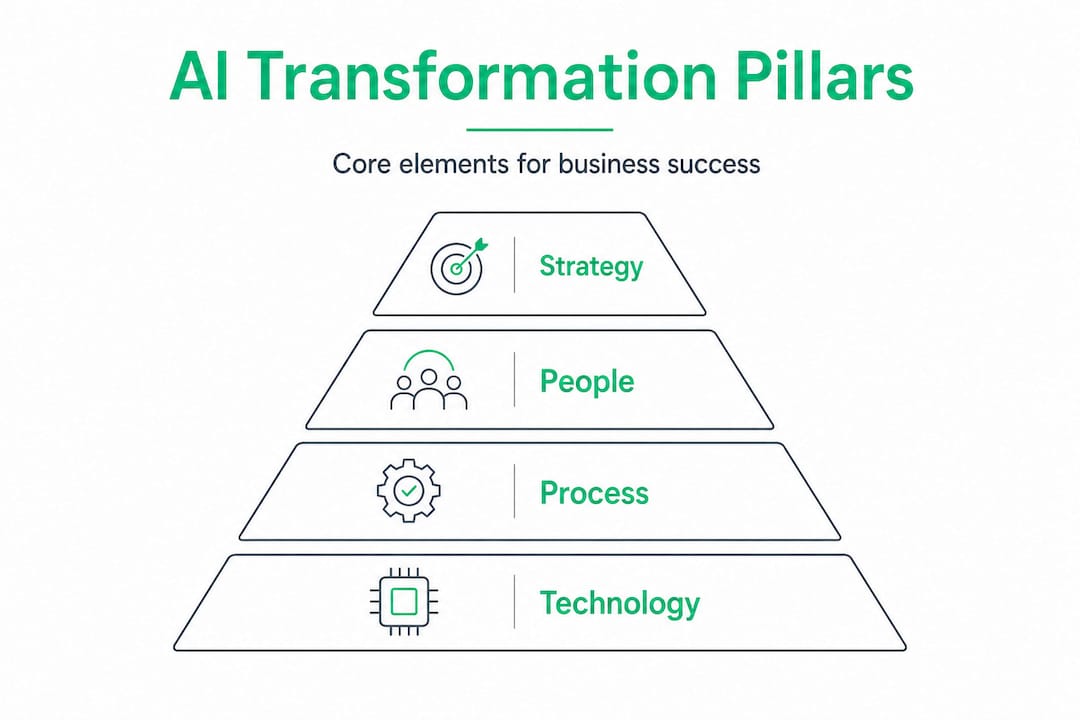
With the definition in hand, it is essential to understand the core components required for a successful AI transformation. Think of these as the five pillars that hold the whole structure together. Miss one and the rest will eventually wobble.

| Pillar | What it means | Why it matters |
|---|---|---|
| Strategy | Leadership commitment and enterprise-wide vision | Ensures AI investments align with real business outcomes |
| People | Cultural change, upskilling, and change management | Determines whether staff adopt or resist AI |
| Process | Redesigning core workflows and decision rights | Turns AI from a tool into a business capability |
| Technology | Platform integration and scalable infrastructure | Enables AI to connect across all business functions |
| Governance | Data management, compliance, and risk oversight | Protects the business and builds trust in AI outputs |
As Databricks frames it, successful AI transformation involves the strategic integration of AI across operations, products, and services, alongside the redesign of processes and operating models. That is a very different brief from "implement a new software tool."
Here is a practical sequence for building these pillars in your business:
- Start with strategy, not technology. Define what business problems you are solving and what measurable outcomes you expect. Revenue growth? Cost reduction? Faster customer response times? Be specific.
- Assess your data maturity. AI is only as good as the data feeding it. Audit your current data quality, accessibility, and governance before selecting any platform.
- Map your core processes. Identify which workflows are most ripe for AI integration. Look for repetitive, data-heavy tasks where decisions follow patterns.
- Invest in your people. Training is not optional. Staff who understand AI are far more likely to use it effectively and flag problems early.
- Choose technology that scales. Avoid point solutions that cannot integrate with your broader systems. Scalable infrastructure is essential for moving beyond pilots.
Explore AI transformation for SMEs to see how these pillars translate into real-world results across different industries. You can also review AI industry efficiency gains for sector-specific data on what genuine integration delivers.
Pro Tip: Before selecting any AI platform, map your three most critical business processes end to end. If you cannot clearly describe how a decision gets made in each process, AI will not fix it. Clarity first, technology second.
Common pitfalls and edge cases in AI transformation
Even with well-laid plans, SMEs can stumble, so it is crucial to learn from frequent missteps. The most expensive mistakes in AI transformation are not technical failures. They are organisational ones.
| Pitfall | Description | Consequence |
|---|---|---|
| Isolation trap | AI tools used in silos, not connected to core workflows | Minimal business impact, wasted investment |
| Pilot trap | Projects never move beyond small-scale testing | No ROI, staff lose confidence in AI |
| Governance gap | No data policies or change management in place | Compliance risk, poor AI outputs |
| Leadership disconnect | Executives not engaged with AI strategy | Lack of resources, conflicting priorities |
| Skill deficit | Staff untrained and unsupported | Low adoption rates, errors in AI use |
The pilot trap deserves special attention because it is so common. A retail business in Melbourne might run a successful AI pilot for personalised email marketing, see great results in the test group, and then... nothing. The project sits in limbo because no one has a clear mandate to scale it, the data infrastructure is not ready for full rollout, or leadership has moved on to the next shiny initiative.
Organisations that use generative AI without integrating it into workflows, decision rights, data governance, and change management tend to limit value and keep efforts at the pilot stage rather than transforming operations.
This is the core challenge for Australian businesses right now. The tools are accessible. The willingness to experiment is there. But the commitment to full integration, including the messy, difficult work of changing how people make decisions and how data is managed, is often missing.
Watch for these warning signs in your own business:
- AI projects are owned by IT, not operations. Transformation requires business ownership, not just technical ownership.
- No one is measuring business outcomes. If you are only tracking usage metrics rather than revenue or cost impact, you are not transforming.
- Staff are working around AI tools. If people find workarounds, the AI is not embedded in the actual workflow.
- Data lives in separate systems. Disconnected data means disconnected AI. Integration is non-negotiable.
Stay across current AI trends to understand where the landscape is heading and which pitfalls are becoming more common as AI adoption accelerates. Understanding the SME AI transformation benefits also helps you set realistic expectations for what genuine integration delivers versus what a pilot can show.
Steps to start your AI transformation journey
Understanding these pitfalls equips you to take the right steps. Here is a practical roadmap designed specifically for Australian SMEs who want to move from curiosity to committed transformation.
-
Conduct a baseline assessment. Before anything else, evaluate your current readiness. What data do you have? How mature are your processes? Where are the biggest inefficiencies? An honest audit prevents you from building AI on a shaky foundation.
-
Secure leadership alignment. AI transformation fails when it is treated as a technology project rather than a business strategy. Every senior leader needs to understand the vision, commit resources, and champion the change. This is not optional.
-
Define measurable business outcomes. Vague goals produce vague results. Set specific targets: reduce customer response time by 40%, cut document processing costs by 30%, increase lead conversion by 20%. These targets drive accountability and help you evaluate progress.
-
Invest in capability and data quality. Staff training and data infrastructure are the two most under-invested areas in AI transformation. Quality data is the fuel. Skilled people are the engine. Skimping on either will stall your progress.
-
Scale beyond pilots deliberately. Once a pilot proves value, create a formal scaling plan with clear timelines, resource commitments, and integration milestones. Treat scaling as its own project, not an afterthought.
-
Embed continuous improvement. AI transformation is not a destination. Monitor performance, gather feedback from staff and customers, iterate on your models, and stay alert to new risks. Build this review cycle into your regular business rhythm.
AI transformation is best understood as a sustained, enterprise-wide redesign across people, process, technology, and governance. That framing should shape every decision you make along this journey.
Pro Tip: Assign a dedicated AI transformation lead within your business, even if it is a part-time role. Someone needs to own the roadmap, track outcomes, and keep momentum alive between projects. Without internal ownership, transformation stalls.
One area where Australian SMEs are seeing particularly strong early returns is customer service. AI in SME customer service is proving to be one of the most accessible entry points for transformation because the data is rich, the processes are well-defined, and the customer impact is immediate and measurable.
AI transformation: why a shift in mindset matters most
Here is something we have observed working directly with Australian businesses across retail, trades, logistics, and professional services: the businesses that succeed with AI transformation are rarely the ones with the most sophisticated technology. They are the ones with the most aligned leadership and the most adaptable culture.
This might sound like a soft observation, but it has hard consequences. We have seen businesses invest significantly in AI platforms only to watch adoption stagnate because middle management felt threatened by the change. We have seen others achieve remarkable results with relatively modest tools simply because their leadership was genuinely committed and their staff were genuinely engaged.
The uncomfortable truth is that most AI transformation failures trace back to a lack of change management, not technology limitations. The technology is rarely the bottleneck. The people are.
There is also a deeper strategic point worth making. AI should not just automate what you already do. The most ambitious use of AI transformation is to redefine what your business does and how it creates value. A trades business that uses AI only to schedule jobs faster is not transforming. A trades business that uses AI to predict which customers are likely to need maintenance, proactively reach out, and offer service packages before the problem occurs is redefining its business model entirely.
That shift in thinking, from "how do we do this faster" to "how do we create value differently," is the real engine of transformation. And it requires leadership courage, not just technical investment. Explore AI integration insights to see how this mindset shift translates into practical strategy for Australian businesses.
Connect your business to AI expertise
If this article has clarified what AI transformation really involves, the next question is where to start for your specific industry and business context.
At ORVX AI, we work directly with Australian SMEs to move beyond tool adoption and into genuine, organisation-wide transformation. Whether you are in trades and construction, looking to personalise customer experiences in retail, or ready to modernise how you manage listings and client relationships in real estate, we build tailored AI roadmaps that fit your actual workflows and business goals. Our approach starts with an on-site audit, maps your processes honestly, and delivers a clear plan for scaling AI across your operations without the guesswork.
Frequently asked questions
How is AI transformation different from digital transformation?
AI transformation specifically embeds artificial intelligence into core strategies and processes, whereas digital transformation focuses more broadly on IT systems and digital platforms. As defined by COMPEL, AI transformation redesigns how value is created through AI integration, which goes well beyond digitising existing workflows.
What are the biggest risks for businesses attempting AI transformation?
The biggest risks include lack of staff buy-in, insufficient data governance, and remaining stuck in the pilot phase. Australian businesses that use AI tools without integrating them into decision rights and change management consistently find their efforts stall before delivering real operational value.
How long does a typical AI transformation take for SMEs?
AI transformation is a multi-year journey, typically taking one to three years for SMEs to fully embed AI across core operations. It is best understood as a sustained enterprise-wide redesign rather than a one-off implementation project.
Can AI transformation be done without hiring technical staff?
Yes. Many Australian SMEs successfully manage AI transformation by partnering with external consultants rather than building large in-house technical teams. The critical internal investment is in leadership alignment and staff training, not necessarily in hiring data scientists or engineers.