
TL;DR:
- By 2027, AI is expected to handle up to 60% of Australian customer queries, emphasizing workflow redesign over headcount reduction. AI accelerates routine resolution, enhances consistency, and supports real-time agent assistance, transforming service operations through integrated workflows. Effective implementation requires focus on accuracy, trust, and strategic use of time to amplify human capabilities and drive business outcomes.
By 2027, AI could resolve 60% of Australian customer service queries, up from just 31% recently. Most business leaders hear that figure and immediately think about headcount reduction. That instinct is understandable, but it misses the point entirely. The real transformation happening right now is not about replacing your team. It is about redesigning how work flows through your business, who handles what, and where your people can create the most value. This guide cuts through the noise and gives you a clear, practical picture of what AI actually changes in customer service operations.
Table of Contents
- The new face of customer service: what AI actually changes
- How AI transforms workflows: from queue to collaboration
- AI, people, and the productivity paradox: what business leaders need to know
- Designing for trust and accuracy: controlling the risks of AI in customer service
- A smarter path forward: what most SME leaders miss about AI in customer service
- How ORVX helps Australian SMEs unlock AI's true potential
- Frequently asked questions
Key Takeaways
| Point | Details |
|---|---|
| AI handles routine queries | AI is on track to resolve most low-complexity customer questions, freeing staff to focus on higher-value work. |
| Collaboration is key | AI and humans work best together, with AI assisting and preparing, and humans handling complex or sensitive issues. |
| Work redesign matters | Actual benefits are realised when businesses redesign workflows and redeploy saved time into valuable customer or strategic activities. |
| Trust through design | Implementing guardrails and escalation paths ensures AI delivers accurate answers, maintaining reliability and customer trust. |
The new face of customer service: what AI actually changes
Understanding how AI changes the fundamentals of customer service forms the basis for mapping out its influence on your team and workflows.
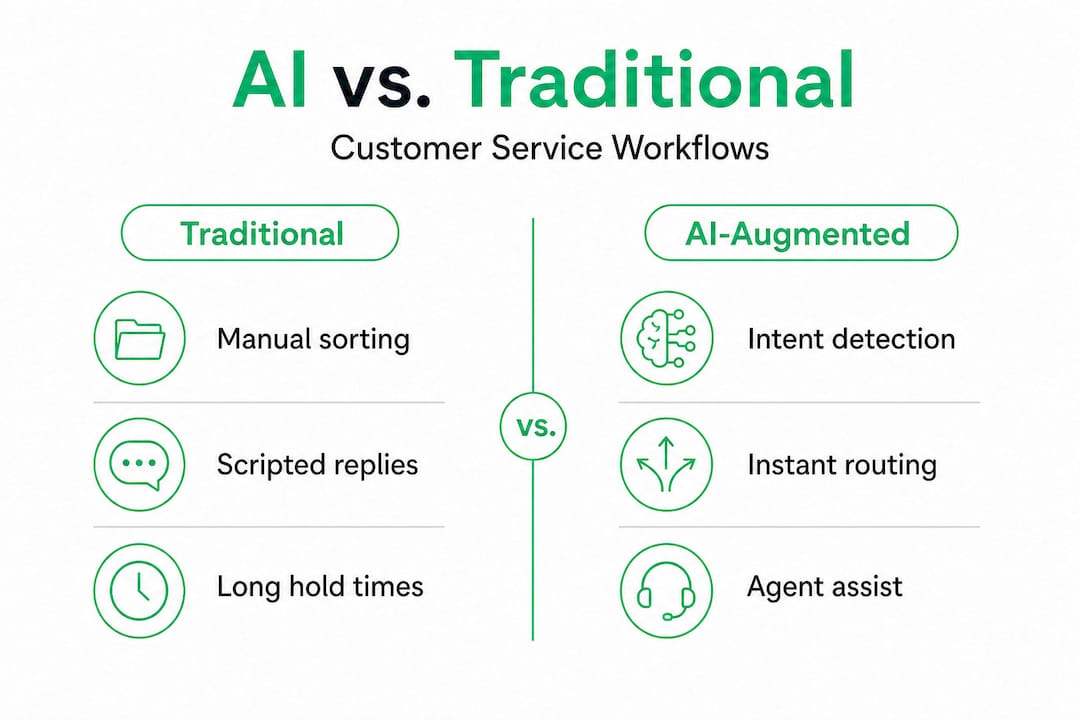
The shift is already well underway. AI is automating and accelerating the resolution of routine enquiries while reserving human agents for complex, sensitive, or high-value cases. That is not a future prediction. It is happening in Australian businesses right now, across retail, healthcare, logistics, and professional services.
What does this look like on the ground? Think about the volume of repetitive queries your team fields every week. Order status checks. Password resets. Opening hours. Refund policy questions. These interactions are important to your customers, but they do not require the nuanced judgement of an experienced staff member. AI handles them instantly, at scale, across multiple channels simultaneously.
The channel-agnostic nature of modern AI is one of its most underappreciated qualities. Your customers might reach you via live chat on your website, an interactive voice response system on the phone, an email inbox, or a social media message. AI can operate across all of these touchpoints with consistent quality and zero wait time. That kind of availability was previously only possible with large, expensive teams.
"The real shift is not from human to machine. It is from reactive, queue-based service to a proactive, mixed-model operation where every interaction lands in the right hands at the right time."
One of the more sophisticated applications emerging in Australian firms is the AI supervisory role. Zendesk describes an approach where AI monitors agent conversations in real time and provides immediate coaching, flagging tone issues, suggesting responses, or alerting supervisors when a conversation is escalating. This is not AI replacing agents. It is AI making agents better, faster.
The businesses benefiting most from this are those that have moved away from thinking about AI as a standalone product and started treating it as an integrated part of their workflows. The transformation in business operations is most pronounced when AI is embedded into the process, not bolted on as an afterthought.
Key shifts AI brings to customer service:
- Faster resolution for routine queries, often in seconds rather than minutes or hours
- Consistent quality across every interaction, regardless of time of day or staff mood
- Reduced queue pressure on human agents, allowing them to focus on meaningful work
- Data collection at scale, giving you insights into customer behaviour and pain points
- 24/7 availability without the cost of overnight staffing
How AI transforms workflows: from queue to collaboration
With the core changes outlined, it is critical to examine the mechanics of how AI and human staff work as complementary forces in delivering modern service.

The most important thing to understand about AI in customer service workflows is that it is not a single tool. It is a set of interconnected capabilities that each play a distinct role. AI changes service operations through intent detection, intelligent routing, automated summarisation, and real-time agent assist. Understanding each of these helps you design a workflow that actually works.
Intent detection is the AI's ability to understand what a customer is trying to accomplish, even when they express it in different ways. A customer who types "where's my order" and one who types "I haven't received my delivery yet" are asking the same thing. AI recognises this and routes both to the same resolution path.
Intelligent routing ensures that once intent is identified, the query goes to the right place. Simple queries go to automated resolution. Complex or sensitive queries go to a human agent with the relevant skills. Escalations are flagged immediately.
Automated summarisation means that when a query does reach a human agent, they are not starting from scratch. The AI has already summarised the conversation history, identified the customer's issue, and pulled relevant account information. The agent walks in ready to solve, not to gather.
Real-time agent assist provides suggested responses, relevant knowledge base articles, and compliance reminders as the agent types. This is particularly valuable for newer staff members who are still building product knowledge.
Traditional vs. AI-augmented service workflows
| Aspect | Traditional workflow | AI-augmented workflow |
|---|---|---|
| Query intake | Manual triage by agent | Automated intent detection |
| Routing | Supervisor or queue-based | AI-driven, skills-based routing |
| Resolution time | Minutes to hours | Seconds for routine queries |
| Agent preparation | Manual account lookup | AI-generated summary |
| Quality assurance | Post-call review | Real-time AI coaching |
| After-hours support | Limited or costly | Always-on AI coverage |
| Data capture | Inconsistent | Systematic and structured |
Here is how a typical ticket moves through an AI-assisted workflow:
- Customer submits a query via chat, email, or phone
- AI detects intent and classifies the query by type and urgency
- Routine queries are resolved automatically with no human involvement
- Complex queries are routed to the most appropriate available agent
- Agent receives an AI-generated summary and suggested responses
- Agent resolves the issue with AI coaching support in real time
- Interaction is automatically logged, tagged, and added to the knowledge base
This is the kind of AI implementation that delivers genuine operational improvement. The best practice approach is to map your existing workflows first, identify where the friction points are, and then design AI into those specific areas rather than attempting a wholesale replacement of your current systems.
Pro Tip: When redesigning agent roles around AI, focus on outcomes and escalation skills rather than task completion speed. Your best agents should be solving the problems AI cannot, not re-checking what AI already handled.
AI, people, and the productivity paradox: what business leaders need to know
Once you understand how AI fits into the team, it is vital to examine the real-world effects on productivity, motivation, and business outcomes.
Here is a finding that surprises most business leaders. AI tools can save individual employees around 5.5 hours per week. That sounds like a significant productivity gain. But research shows that AI does not automatically replace staff or deliver productivity gains. The real impact depends entirely on work redesign and how saved time is redeployed.
The uncomfortable reality is that up to 60% of employees are not inclined to take on more complex or higher-value tasks after AI automates their routine work. Without deliberate redesign, that freed-up time simply disappears into longer breaks, slower pacing, or low-priority tasks. This is the productivity paradox at the heart of most failed AI rollouts.
Where AI time savings actually go
| Outcome | Proportion of businesses | Notes |
|---|---|---|
| Redeployed to higher-value work | ~25% | Requires active workflow redesign |
| Absorbed into general downtime | ~40% | No redesign, no benefit realised |
| Used for additional training | ~20% | Positive but often unplanned |
| Leads to role reduction | ~15% | Rare without strategic planning |
"The real business-operations engineering problem is not whether AI can save time. It is whether your organisation has the design discipline to capture that time and redirect it toward outcomes that actually matter."
This is why building a proper AI strategy before implementation is so critical. Without a clear plan for what your team will do with the capacity AI creates, you are likely to see modest returns at best.
Practical strategies to avoid the productivity paradox:
- Redesign job descriptions to reflect the new mix of AI-assisted and human-led tasks
- Set new performance metrics that reward quality and complexity, not just volume
- Invest in upskilling so staff can handle the more demanding work AI surfaces
- Create feedback loops where staff report what AI is getting wrong or missing
- Celebrate wins when AI frees up time that leads to measurable business outcomes
The AI productivity tools available to Australian SMEs today are genuinely powerful. But the tool is only as effective as the strategy behind it.
Designing for trust and accuracy: controlling the risks of AI in customer service
Now that you see the productivity and workflow impacts, planning for accurate and trustworthy customer responses becomes paramount for Australian businesses.
Speed means nothing if the AI gives your customers wrong information. Hallucinations, which is the term used when an AI generates plausible-sounding but factually incorrect responses, are a real and underappreciated risk in customer service deployments. A customer who receives an incorrect refund policy from your AI chatbot is not just confused. They are potentially making decisions based on false information, which creates legal and reputational exposure for your business.
To control hallucination risk, the approach must prioritise accuracy-oriented design, including grounding responses in an approved knowledge base, setting guardrails that prevent the AI from speculating, and deferring low-confidence or high-stakes requests to human agents.
Methods for grounding AI responses and managing escalation risk:
- Knowledge base retrieval: AI pulls answers only from your verified, up-to-date content rather than generating responses from general training data
- Confidence thresholds: Set a minimum confidence level below which the AI automatically escalates to a human
- Topic guardrails: Define categories of questions the AI is not permitted to answer, such as legal, medical, or financial advice
- Escalation triggers: Programme specific phrases or emotional cues that automatically route the customer to a human agent
- Regular auditing: Review AI conversation logs weekly to identify errors, gaps, or emerging query types the AI is not handling well
- Version control: Ensure your knowledge base is updated whenever products, policies, or pricing change
Pro Tip: Always design your AI deployment with a clear human override capability. Every customer should be able to reach a human at any point in the interaction. This is not just good design. In many contexts, it is what Australian consumer expectations demand.
AI's impact is realised when workflows ensure agents are not re-checking or re-doing what AI has already completed without a clear reason. That means your quality control processes need to be smart too. Train your staff to understand when to trust the AI, when to verify, and when to escalate. This is a skill, and it needs to be taught deliberately. The custom AI implementation steps that work best for Australian SMEs always include a trust and accuracy design phase, not just a technical setup phase. Pairing your AI with the right productivity tools also helps staff stay on top of quality without adding to their workload.
A smarter path forward: what most SME leaders miss about AI in customer service
With practical design principles in view, it is worth challenging standard assumptions and reframing AI as the catalyst for deeper business transformation.
Here is the contrarian view we hold at ORVX, and it is backed by what we see working in Australian businesses every day. The SMEs that get the best returns from AI are not the ones who use it to cut headcount. They are the ones who use it to amplify what their people are already good at.
When you treat AI as a replacement, you get a cost reduction. When you treat it as an amplifier, you get a capability expansion. Those are fundamentally different outcomes, and the second one is far more valuable over the long term.
The businesses that get this right do three things consistently. First, they upskill their staff rather than simply redeploying them. They invest in training that helps people work alongside AI confidently, understand its limitations, and use it as a tool for deeper customer insight. Second, they redesign their performance metrics. If you are still measuring your customer service team on call volume or tickets closed per hour, you are measuring the wrong things. AI handles volume. Your people should be measured on resolution quality, customer satisfaction, and the complexity of cases they manage. Third, they use AI's freed-up time for strategic projects. Not cost-cutting. Not headcount reviews. Strategic projects: building better customer relationships, identifying product improvement opportunities, developing new service offerings.
The custom AI ROI strategies that deliver the strongest results are always built around this amplifier mindset. The businesses that treat AI as a force multiplier for their team's potential consistently outperform those that treat it as a labour-saving device. That is not a philosophical position. It is a measurable business outcome.
Pro Tip: Use the time AI frees up for one strategic project per quarter. Assign it deliberately, measure it, and report on it. This turns AI savings into visible business value rather than invisible efficiency gains.
How ORVX helps Australian SMEs unlock AI's true potential
For business leaders ready to apply these concepts, here is how to take the next step with expert support.
Knowing what AI can do and knowing how to implement it well in your specific business are two very different things. That gap is exactly where most SMEs get stuck. At ORVX AI, we work directly alongside your team to map your current workflows, identify the highest-value AI opportunities, and build a roadmap that fits your industry, your budget, and your goals.
Whether you are in retail managing high volumes of customer enquiries, or in health and beauty where trust and accuracy are non-negotiable, we build solutions tailored to your context. No templated packages. No vendor lock-in. Just practical, vendor-agnostic advice from a team that understands Australian business. If you are ready to move from curiosity to implementation, explore what ORVX AI can do for your business today.
Frequently asked questions
Will AI replace all my customer service staff?
No. Research confirms that AI is primarily automating routine queries, and humans remain essential for complex, sensitive, or escalated cases where judgement and empathy are required.
How much of my customer service can AI actually handle?
By 2027, AI is projected to resolve up to 60% of Australian customer service queries, up from 31% recently, though the exact proportion depends heavily on your industry and query mix.
What can I do to ensure AI doesn't provide incorrect answers to customers?
Use knowledge-based retrieval so AI only draws from verified content, and set confidence-based guardrails that escalate uncertain or high-risk queries to a human agent automatically.
Does AI improve customer satisfaction, or just save money?
When implemented thoughtfully, AI improves both satisfaction and efficiency, but only when workflows are redesigned for quality outcomes rather than pure cost savings.