
TL;DR:
- Small Australian real estate agencies are successfully using AI to reduce admin time, improve lead response speed, and enhance pricing accuracy.
- AI tools like valuations, chatbots, and predictive analytics boost efficiency, engagement, and decision-making, delivering measurable results.
- Full AI adoption is still developing, with challenges including skills gaps, compliance concerns, and technology integration, emphasizing a hybrid human-AI approach.
Australian real estate agencies are discovering that AI isn't reserved for Silicon Valley giants or ASX-listed property groups. Smaller agencies across Melbourne, Brisbane, and Perth are using AI to cut admin time, respond to leads faster, and make sharper pricing calls. Automating routine tasks like enquiry handling, document processing, and predictive maintenance is already saving firms significant time and money. This guide breaks down exactly how AI works in property, what it genuinely delivers, where it falls short, and how you can start using it without making costly mistakes.
Table of Contents
- What does AI do in real estate?
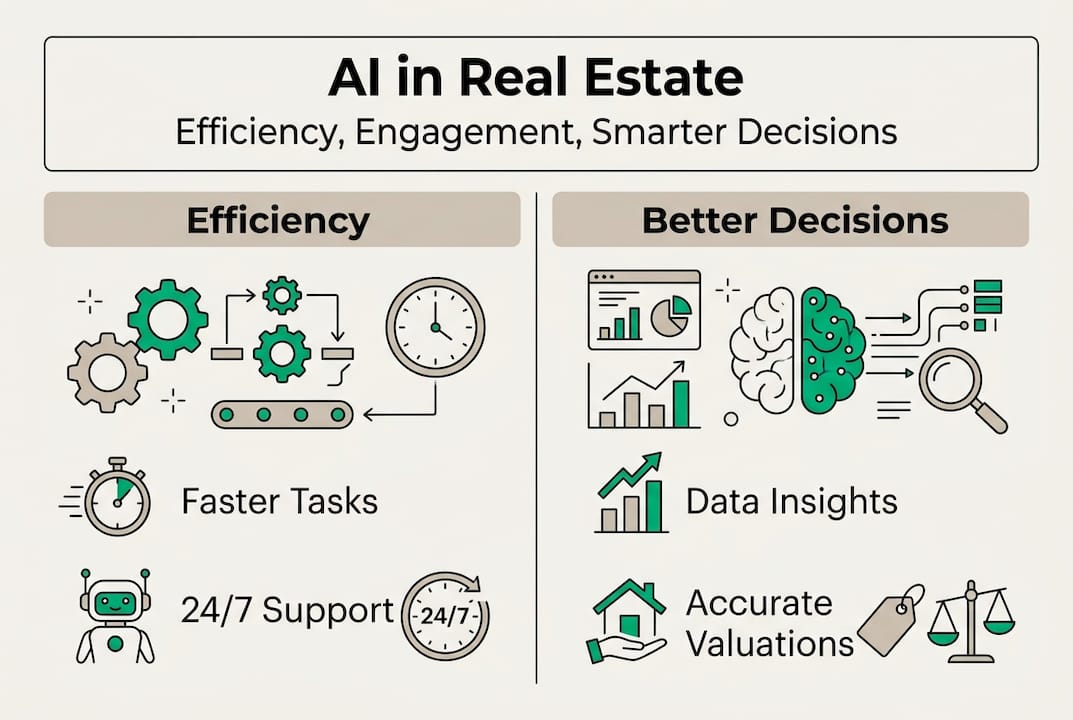
- The real-world benefits: Efficiency, engagement, and better decisions
- Adoption benchmarks and why many firms lag behind
- Risks, limits, and how to avoid AI pitfalls
- A smarter way forward: The real edge in combining human insight with AI
- Next steps: Bringing AI into your property business
- Frequently asked questions
Key Takeaways
| Point | Details |
|---|---|
| AI boosts efficiency | Automating routine real estate tasks saves time, energy, and operational costs. |
| Customer experience wins | AI-powered chatbots and instant service increase lead conversion and client satisfaction. |
| Smarter decisions | AI combines big data with human insight for better property valuations and risk assessments. |
| Know the limits | AI needs quality data and shouldn't replace expert judgement, especially for unique assets. |
| Hybrid approach excels | Real competitive advantage comes from blending AI technology with human expertise. |
What does AI do in real estate?
AI in real estate isn't one single tool. It's a collection of technologies working together to handle tasks that used to eat up hours of your team's day. Understanding the mechanics helps you make smarter choices about where to invest.
At its core, machine learning, chatbots, and predictive models power the three main pillars of real estate AI: valuations, customer engagement, and risk forecasting. Automated Valuation Models (AVMs) analyse thousands of comparable sales, suburb trends, and property attributes to generate price estimates in seconds. Natural Language Processing (NLP) drives chatbots that can answer buyer and tenant enquiries around the clock. Predictive analytics flags maintenance risks before they become expensive repairs.
Here's a snapshot of day-to-day problems AI solves for property professionals:
- Responding to after-hours enquiries without hiring extra staff
- Generating draft contracts and tenancy agreements from templates
- Sorting and qualifying leads by likelihood to convert
- Scheduling inspections based on agent availability and buyer preferences
- Flagging properties at risk of maintenance issues before they escalate
To understand the difference in decision-making styles, consider this comparison:
| Decision type | Human only | AI only | Hybrid |
|---|---|---|---|
| Speed | Slow | Instant | Fast |
| Local context | Strong | Limited | Strong |
| Data volume handled | Low | Very high | Very high |
| Accuracy on unique assets | High | Variable | High |
| Regulatory compliance | Manual | Automated checks | Balanced |
"Cotality analyses 5.5 billion property records to power its valuation models, a scale no human team could replicate."
For a full picture of how these tools apply to property businesses, explore the AI solutions for real estate available to Australian agencies today.
The real-world benefits: Efficiency, engagement, and better decisions
Knowing how AI works is one thing. Seeing what it actually delivers for Australian agencies is another. The numbers are compelling, and they're coming from businesses operating in the same market you are.
AI improves operational efficiency, lifts customer engagement through personalised chatbots, and sharpens decision-making with real-time data analysis. One standout example is Enliven AI, a property management platform that handles over 700 tenant enquiries per week and has saved clients an estimated $2.8 million in operational costs. That's not a pilot programme. That's a live result from an Australian business.

The data from 2026 reinforces this picture. Inspection bookings increase by 300% when AI-powered scheduling and chatbots are used, and listings sell 32% faster when supported by AI-generated visuals and descriptions. Valuation error rates in Australia currently sit between 10 and 11%, a figure that hybrid AI-human models are actively reducing.
| Metric | Without AI | With AI |
|---|---|---|
| Enquiry response time | Hours to days | Under 2 minutes |
| Inspection booking rate | Baseline | Up 300% |
| Days on market | Baseline | Down 32% |
| Admin hours per week | 15 to 20 hours | 5 to 8 hours |
The benefits extend beyond speed:
- Higher lead conversion through instant, personalised responses
- Reduced vacancy periods via smarter tenant matching
- Lower energy costs through AI-driven building management
- More accurate appraisals that build vendor trust
Pro Tip: Use AI-generated property descriptions combined with automated social media scheduling to cut listing preparation time by half. Pair this with a chatbot that qualifies leads before your agents follow up, and you'll spend more time closing deals and less time chasing cold enquiries.
Learn how AI boosts efficiency in real estate and explore AI tools for property management to see which solutions fit your agency's workflow.
Adoption benchmarks and why many firms lag behind
The value is clear. So why aren't all Australian real estate firms running on AI? The honest answer is that adoption is uneven, and the gap between early movers and late adopters is widening fast.
37% of Australian property firms currently use AI in some capacity, 92% are piloting or exploring it, but only 18% have fully scaled their AI operations. That gap between piloting and scaling is where most agencies are stuck right now. Meanwhile, the global AI market in real estate is projected to reach $41 billion by 2033, which signals that the window for competitive advantage is open but won't stay that way.
"The agencies that move from pilot to full implementation in the next 12 to 24 months will set the benchmark others scramble to match."
The three most common obstacles holding Australian firms back are:
- Skills gap: Most property professionals weren't trained in AI tools, and without internal champions or external support, adoption stalls at the trial stage.
- Governance and compliance concerns: Data privacy obligations under Australian law create hesitation, particularly around tenant data and automated decision-making.
- Technology integration challenges: Connecting AI tools to legacy CRM systems, property management software, and existing workflows requires planning and technical expertise.
Understanding where your agency sits on the Australian AI adoption benchmarks curve helps you prioritise the right moves. If you're still evaluating the business case, reviewing AI investment trends for Australian SMBs gives you a grounded starting point.
Risks, limits, and how to avoid AI pitfalls
AI in real estate is genuinely powerful. It's also genuinely limited in ways that matter, and ignoring those limits can cost you clients, compliance, and credibility.
AI is less reliable for unique or specialty properties such as rural acreage, heritage-listed buildings, or high-end prestige homes where comparable sales data is thin. Regional markets with lower transaction volumes produce weaker model accuracy. Bias in training data can also skew valuations, particularly in areas with historically underrepresented demographics.
Common misconceptions that get agencies into trouble:
- "AI is always right": Models are only as good as the data they're trained on. Outdated or incomplete data produces flawed outputs.
- "It replaces human judgement": AI surfaces patterns. Humans interpret context, emotion, and local nuance that algorithms miss.
- "Set and forget": AI tools require ongoing monitoring, retraining, and governance to stay accurate and compliant.
- "All tools are equal": A generic chatbot is not the same as a purpose-built real estate AI. Fit matters enormously.
Relying solely on AI for property decisions is described by industry experts as reckless and dangerous, particularly when governance frameworks and data quality checks are absent.
The solution isn't to avoid AI. It's to build a workflow where AI handles volume and speed, and humans handle judgement and accountability. Review your AI governance and compliance obligations before you scale, and design your processes around hybrid human-AI decision-making from the start. For specifics on where models underperform, understanding AI limitations in property valuations is essential reading.
Pro Tip: For every AI-generated valuation or recommendation your agency uses externally, assign a senior agent to review and sign off. This simple step protects you legally, maintains client trust, and catches the edge cases AI consistently misses.
A smarter way forward: The real edge in combining human insight with AI
Here's the view we've formed working with Australian property businesses: the agencies winning with AI aren't the ones who've replaced their people. They're the ones who've freed their people to do the work that actually requires a human.
Hybrid human-AI models outperform both humans working alone and AI operating without oversight. That's not a compromise position. It's the optimal design. AI handles the data crunching, lead sorting, and document drafting. Your agents handle the negotiation, the relationship, and the judgement call that no algorithm can make.
The professionals who will thrive in this market are those who treat AI literacy as a core skill, not an optional extra. That means understanding what your tools can and can't do, knowing when to trust the output and when to question it, and building workflows that make the most of combining AI and human experience.
Pro Tip: Dedicate two hours per month to reviewing the outputs your AI tools are producing. Compare their recommendations against actual outcomes. This habit builds your intuition for where the models are strong and where they need a human override.
The competitive edge in Australian real estate isn't AI alone. It's the judgement to use it well.
Next steps: Bringing AI into your property business
If you're ready to move from curiosity to action, start by mapping your current processes and identifying the tasks your team repeats most often. Those are your first automation targets.
ORVX AI works directly with Australian property businesses to assess existing workflows, identify AI opportunities, and build implementation plans that fit your agency's size, goals, and compliance requirements. From chatbot setup to CRM integration and predictive analytics, the AI solutions for real estate firms we support are built around your specific needs, not generic templates. If you're not sure where to begin, our team of AI integration consultants can walk you through a no-obligation audit of your current operations and show you exactly where AI will move the needle.
Frequently asked questions
How do Australian real estate agencies use AI every day?
Automating enquiry handling, scheduling viewings, generating property valuations, and flagging maintenance risks are the most common daily applications in Australian agencies right now.
Can AI increase property sales or leads?
Yes. AI-powered chatbots and visuals have been shown to lift inspection bookings by 300% and reduce days on market by 32%, based on 2026 Australian data.
What are the risks of relying only on AI for property decisions?
Relying solely on AI is risky because models struggle with unique properties and thin data sets, making expert human review an essential safeguard.
How do I start using AI in my real estate agency?
Begin with simple, repeatable tasks like enquiry responses or document drafting, then work with an AI consultant to scale solutions that match your compliance obligations and business goals.