
TL;DR:
- Australian businesses must integrate responsible AI principles to meet evolving ethical and regulatory expectations.
- Operationalising these principles builds trust, reduces risks, and provides a competitive advantage in the market.
Most Australian business owners approach AI adoption as a technology and ROI conversation. They ask: what tool, what cost, what return? That framing misses something increasingly critical. Australia now operates under eight voluntary principles that define what responsible AI looks like, and regulators, customers, and employees are starting to notice who is taking them seriously. This guide cuts through the abstract language around AI ethics and gives you a practical, plain-English roadmap for embedding ethical AI into your operations without slowing growth or adding unnecessary complexity.
Table of Contents
- What are Australia's AI ethics principles?
- Common ethical risks in business AI adoption
- Turning principles into practice: Governance frameworks and strategies
- The business case: AI ethics as a driver of value and trust
- Why a compliance-only approach misses the real value of AI ethics
- Implement AI ethics confidently with Australian expertise
- Frequently asked questions
Key Takeaways
| Point | Details |
|---|---|
| Understand core principles | Australia's eight AI ethics principles guide how businesses should use AI responsibly. |
| Mitigate practical risks | Address bias, privacy, and transparency issues with real-world solutions for SMEs. |
| Adopt proven frameworks | Use structured governance and step-wise planning to embed ethics into your AI lifecycle. |
| See long-term benefits | Ethical AI drives trust, compliance, and measurable performance gains. |
| Access local expertise | Leverage Australian SME-specific resources and consulting for practical AI ethics support. |
What are Australia's AI ethics principles?
Australia's national AI Ethics Principles were developed by the Department of Industry and are designed to guide responsible AI use across both the public and private sectors. They are voluntary, but they carry real weight. Customers increasingly expect them. Courts and regulators are beginning to reference them. And they are shaping the foundation of stronger legislation on the horizon.
Here is what each principle actually means for your business:
- Human, societal and environmental wellbeing: Your AI systems should benefit people, not harm them. This includes staff, customers, and the wider community affected by your decisions.
- Human-centred values: AI must respect human rights and allow people to remain in control of decisions that affect their lives.
- Fairness: AI should not discriminate unlawfully or produce biased outcomes across different groups.
- Privacy protection and security: Personal data used in AI must be protected and handled lawfully under the Privacy Act 1988.
- Reliability and safety: AI systems must behave consistently, safely, and predictably across real-world conditions.
- Transparency and explainability: People should be able to understand how an AI system makes decisions that affect them.
- Contestability: Individuals must have a meaningful way to challenge or seek review of AI-driven decisions.
- Accountability: There must be a clear human or organisational owner responsible for the outcomes of any AI system.
"These principles are not aspirational statements for tech companies. They are practical benchmarks for how any business using AI should operate." This distinction matters enormously for SMEs who assume ethics is someone else's responsibility.
For a small or medium business, this is not about abstract philosophy. It is about building the kind of AI strategy for SMEs that your customers and staff can trust. Think of a retail business using AI to recommend products. The fairness and transparency principles require that the recommendation engine does not systematically exclude certain demographics, and that customers can understand why they are seeing certain offers. Simple in concept, but it requires deliberate design to achieve.
Common ethical risks in business AI adoption
Understanding the principles is a start, but real-world ethical risks can trip up any business moving to AI. The gap between knowing what ethical AI looks like and actually avoiding missteps in practice is where most SMEs struggle.
The most common risks fall into three categories:
- Data privacy and over-collection: Many AI tools, especially third-party SaaS products, process customer data on external servers. Without careful contract review and data minimisation practices, businesses can inadvertently expose personal information or breach their obligations under the Privacy Act. Practical implementation for SMEs includes using only the data you genuinely need within AI prompts, stating this clearly in privacy policies, and avoiding tools that train their models on your customer data without consent.
- Bias in automated decisions: If your business uses AI for hiring shortlisting, credit assessments, or customer scoring, you face a real risk of encoded bias. Automated decision edge cases such as screening job applicants or assessing loan eligibility are prime areas where AI systems can replicate historical inequalities at scale. A human-in-the-loop review step is not optional here. It is essential.
- Lack of explainability and no appeals process: If a customer is denied a loan, refused service, or scored poorly by your AI system, they need a way to understand why and a path to challenge that outcome. Most SMEs have not built this into their AI workflows at all.
Pro Tip: Before deploying any AI tool that touches customer or staff data, ask the vendor three questions: where is the data stored, is it used to train their models, and can you get it deleted on request? The answers will tell you a great deal about your exposure.
Building an AI audit compliance process early means you catch these risks before they become incidents. Compared to the cost of a privacy breach or an unfair dismissal claim fuelled by biased AI, the investment in prevention is modest.
It is also worth noting that cost-effective AI adoption does not require you to sacrifice ethics. In fact, the most cost-efficient AI implementations tend to be the ones that are well-scoped and governed from the start, because they avoid costly rework, legal disputes, and brand damage down the track.

Turning principles into practice: Governance frameworks and strategies
Once you are aware of the risks, the challenge becomes translating ideals into repeatable, everyday practices. Governance sounds bureaucratic, but for an SME it simply means having clear answers to: who decides, who checks, and what happens when something goes wrong.
The most widely respected approach is based on Plan-Do-Check-Act (ISO 42001), a cyclical governance model originally used in quality management and now adapted for AI lifecycle management. Applied to ethical AI, it looks like this:
- Plan: Define your ethical values and assess where AI poses the greatest risk in your operations. Map each of Australia's eight principles to specific business processes. Assign an accountability owner for each.
- Do: Implement the controls you have designed. This includes data minimisation protocols, privacy disclosures, vendor assessments, and staff training on ethical AI use.
- Check: Monitor your AI systems against your defined metrics. Are decisions consistent? Are there complaints or anomalies? Run periodic internal audits.
- Act: Review findings, update your approach, and repeat the cycle. This is not a one-off exercise.
For Australian SMEs, the starting point is simpler than it sounds. Mapping Ethics Principles to practices like impact assessments and clear accountability roles does not require a dedicated compliance team. It requires a documented process that your existing managers can own.
| AI ethics principle | Practical SME action | Responsible owner |
|---|---|---|
| Fairness | Audit hiring and scoring tools for bias annually | HR manager or director |
| Privacy and security | Review all AI vendor data agreements quarterly | Operations or IT lead |
| Transparency | Document how AI decisions are made in customer-facing materials | Marketing or compliance lead |
| Contestability | Create a written appeals process for AI-influenced decisions | General manager |
| Accountability | Assign a named AI responsible officer | Business owner or CEO |
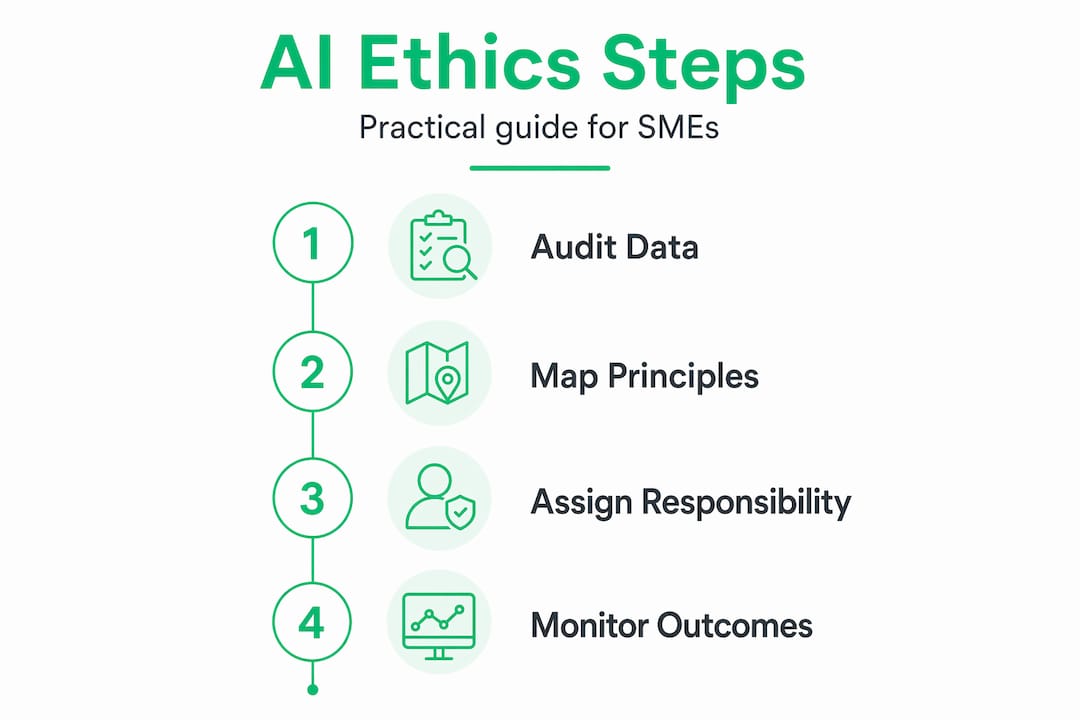
The SAAM initiative from the University of Technology Sydney provides free, SME-friendly tools built directly on Australia's AI Ethics Principles and the Voluntary AI Safety Standard. This is one of the most practical resources available to Australian businesses right now and it is widely underused.
Pro Tip: Do not wait until you have a "complete" AI governance framework before acting. Start with a one-page accountability map that names who is responsible for each ethical risk area. That alone puts you ahead of most competitors.
When you follow structured AI implementation steps that bake ethics in from the start, the governance work becomes part of the deployment process rather than an afterthought bolted on later.
The business case: AI ethics as a driver of value and trust
Operationalising AI ethics is an investment that pays off, not just for risk reduction but for genuine business advantage. The evidence for this is growing and it is compelling.
Only 13% of companies have any AI oversight policy in place, and fewer than 3% have a formal complaints mechanism. That means businesses that implement even basic ethical AI governance immediately stand out. In a market where trust is increasingly scarce, this is a real competitive edge.
Research published in a leading management journal found that responsible AI governance directly improves a company's market value as measured by Tobin's Q, an indicator of financial performance relative to assets. The effect was strongest for businesses emphasising fairness, transparency, and accountability, which are three of Australia's eight principles.
"Ethical AI is no longer a cost centre. It is a strategic differentiator for businesses willing to lead rather than follow."
The customer experience evidence is equally strong. A recent analysis of all seven EU ethical AI dimensions found each one positively correlated with user satisfaction, with human-centred aspects scoring highest. Customers want to feel treated fairly, and AI that visibly respects that desire builds loyalty.
Key business benefits of ethical AI implementation include:
- Reduced legal and regulatory exposure: Privacy compliance and contestable AI decisions lower the risk of regulatory fines and costly disputes.
- Higher staff retention: Employees are more likely to stay with businesses they perceive as fair and transparent in how they use technology to manage work.
- Stronger customer trust and repeat business: Transparency in how decisions are made builds the kind of trust that converts into long-term loyalty.
- Better access to partnerships and procurement: Larger clients and government tenders increasingly require suppliers to demonstrate responsible AI practices.
Companies that treat ethics as purely a compliance matter are missing the AI implementation benefits that flow from embedding trust into their brand. There is also growing relevance for professional services firms, where client confidentiality and ethical conduct are already core values that AI governance can reinforce rather than threaten.
Pro Tip: When pitching your ethical AI approach to potential clients or partners, frame it around outcomes, not process. "We have a human review step for any AI-influenced decision affecting your account" is far more compelling than "we comply with the Privacy Act."
Why a compliance-only approach misses the real value of AI ethics
Here is an uncomfortable truth that most AI consultants will not say out loud: compliance is the floor, not the ceiling. The businesses winning with AI ethics are not the ones that ticked eight boxes on a government checklist. They are the ones that made ethical AI part of how they think, hire, and serve customers every single day.
The compliance-only mindset treats ethics as a constraint on AI. The result is governance frameworks that gather dust, privacy policies no one reads, and appeal processes that technically exist but are practically inaccessible. The business gets the liability of having deployed AI without the cultural readiness to use it well.
Contrast this with SMEs that bring their team into the AI adoption conversation from the start. When staff understand why the business is using AI, what guardrails are in place, and how they can flag concerns, the entire organisation becomes a quality-control mechanism. That is something no audit checklist can replicate.
The most forward-thinking businesses we work with use their ethical AI commitments as recruitment and retention tools. In a tight labour market, telling a prospective hire that your AI systems are audited for bias, your data practices are transparent, and no automated system makes a final call on their employment without human review is a genuine differentiator. It signals that you are the kind of organisation that takes people seriously.
There is also an innovation angle that gets overlooked. Ethical AI frameworks force clarity about what your AI systems are actually doing and why. That clarity tends to surface opportunities. When you document how a customer-facing AI tool makes decisions, you often discover that the logic is flawed, the data is incomplete, or there is a smarter way to achieve the same outcome. Governance is not bureaucracy. It is structured thinking.
Building AI adoption strategies that treat ethics as a value driver rather than a compliance burden requires a mindset shift, but it is one that pays compounding dividends. The SMEs that make that shift now will be the ones competitors are scrambling to catch in three years.
Implement AI ethics confidently with Australian expertise
Armed with understanding and strategy, it is time to turn ethical AI from a goal into a practical reality. That is exactly where expert local support makes a measurable difference.
ORVX AI works directly with Australian SMEs to build ethical, compliant, and high-performing AI integrations that fit your industry and your team. Whether you operate in trades, real estate, or any other sector, the approach is the same: a hands-on audit of your current workflows, a custom AI roadmap built around Australia's Ethics Principles, and end-to-end implementation support from a team that understands local compliance requirements. No templated packages. No offshore advice. Just tailored, vendor-agnostic guidance from a consultancy that is embedded in your market. Explore the full range of solutions at ORVX AI and take the first step toward AI that your customers, staff, and regulators can trust.
Frequently asked questions
What are the main ethical principles for using AI in Australian businesses?
The eight voluntary principles are wellbeing, human values, fairness, privacy, reliability, transparency, contestability, and accountability. These guide responsible AI use across all sectors in Australia.
How can SMEs ensure their AI systems are ethical and compliant?
Data minimisation, transparent policies, and human appeal processes for AI decisions are the three most practical starting points for SMEs looking to meet their ethical and legal obligations.
Does ethical AI really improve business performance?
Yes. Responsible AI governance demonstrably improves market value, and ethical AI adoption is linked to higher user satisfaction and stronger ESG outcomes across industries.
What is the biggest risk if I don't consider AI ethics in my business?
Ignoring AI ethics exposes your business to privacy breaches, discriminatory decisions, reputational damage, and growing regulatory risk. Data minimisation and human oversight are the most direct ways to reduce that exposure.
Are there simple tools to help Australian SMEs manage AI ethics?
Yes. The SAAM initiative from UTS offers free, practical tools designed specifically for SMEs and grounded in Australia's AI Ethics Principles and Voluntary AI Safety Standard.