
TL;DR:
- Australian SMEs can save up to 35% on costs by strategically adopting AI for routine tasks.
- Effective AI implementation involves auditing processes, starting small pilots, and measuring outcomes before scaling.
- Proper planning, verification, and local support are crucial to achieving and maintaining AI-driven cost reductions.
Rising labour costs, shrinking margins, and the pressure to do more with less, these are realities every Australian SME owner knows well. The good news is that 35% median cost savings are now being reported by Australian SMEs that have adopted AI strategically. This guide cuts through the noise and gives you a practical, risk-aware roadmap for using AI to meaningfully reduce costs in your business, without wasting money on tools that don't deliver. Whether you run a trades business, a retail shop, or a professional services firm, the steps here apply to you.
Table of Contents
- Understand the cost reduction opportunity with AI
- Get ready: Audit, prioritise, and plan your AI adoption
- Step-by-step: Implement and pilot AI in your SME
- Verify, scale, and safeguard your AI savings
- What most guides miss about reducing costs with AI
- Get tailored guidance and maximise your AI savings
- Frequently asked questions
Key Takeaways
| Point | Details |
|---|---|
| Start with an audit | Assess repetitive tasks and data readiness to maximise AI cost savings potential. |
| Begin small, measure often | Test AI in one or two areas, track results, and scale what works for reliable ROI. |
| Prioritise compliance | Protect your business and data by following Australian privacy and ATO requirements from day one. |
| Avoid common pitfalls | Learn from failed projects: skip overhype, focus on incremental, risk-aware improvements with expert support. |
Understand the cost reduction opportunity with AI
Let's start with what the numbers actually say. Australian SMEs are now reporting cost savings of 30 to 60% on repetitive tasks when AI is implemented properly. The median saving across the board sits at 35%. That's not a rounding error. For a business spending $20,000 a month on admin and customer service, that could mean $7,000 back in your pocket every single month.
Where do these savings come from? The three biggest areas are:
- Customer service: AI chatbots handle routine enquiries around the clock, reducing the need for front-line staff to answer the same questions repeatedly.
- Administration: Invoice processing, scheduling, data entry, and document management can all be automated with the right tools.
- Operations: Inventory forecasting, supplier communication, and workflow routing all benefit from AI, especially in logistics and manufacturing.
Here's a snapshot of typical savings by function:
| Business function | Typical time saved | Typical cost reduction |
|---|---|---|
| Customer service | 40 to 60% | 30 to 50% |
| Invoice and admin processing | 50 to 70% | 25 to 45% |
| Inventory and stock management | 30 to 50% | 20 to 40% |
| Staff scheduling | 25 to 40% | 15 to 30% |
Despite the opportunity, outcomes vary widely. 78 to 80% of Australian SMEs now use some form of AI, but not all are seeing meaningful returns. The difference between businesses that save and those that stall comes down almost entirely to how well they plan and execute. Adoption without a strategy is just spending money on software.
"The businesses getting the best results from AI are not the ones with the biggest budgets. They're the ones that started with a clear problem, a focused pilot, and a plan to measure everything." — ORVX AI
You're a strong candidate for AI-driven savings if your team spends significant hours each week on repetitive tasks, if customer enquiries follow predictable patterns, or if manual data handling causes errors and delays. Explore the broader AI adoption benefits for Australian SMEs and check out where AI trends in Australia are heading in 2026. For a compelling real-world example, small firms saving $1,500 monthly within 90 days shows exactly what's possible with the right start.
Get ready: Audit, prioritise, and plan your AI adoption
Knowing there's a cost reduction opportunity is one thing. Knowing where to find it in your specific business is another. That's why an internal audit is your first real step.
An internal audit helps identify where AI can save time and money, and working with a consultancy partner makes this process faster and more accurate. Start by mapping out every task your team performs in a typical week. Flag anything that is repeated more than five times, follows a predictable pattern, or takes more than 30 minutes per occurrence.
Here's a quick comparison of common AI use cases by effort and impact:
| Use case | Implementation effort | Time to ROI | Best for |
|---|---|---|---|
| Customer service chatbot | Low | 2 to 4 weeks | Retail, hospitality, trades |
| Invoice automation | Low to medium | 3 to 6 weeks | Professional services, manufacturing |
| AI-assisted scheduling | Medium | 4 to 8 weeks | Healthcare, logistics |
| Predictive inventory | Medium to high | 6 to 12 weeks | Retail, eCommerce |
Before you commit to any tool, assess your data readiness and compliance posture. Australia's Privacy Act governs how customer data is collected and stored, and the ATO has specific requirements around financial records. Reviewing the Australian AI privacy resources from the Australian Government is a practical starting point that most SMEs skip and later regret.
Here's a simple prioritisation process to follow:
- List every repetitive, manual task your team handles each week.
- Estimate the total hours spent on each task per month.
- Rank tasks by time cost multiplied by staff hourly rate to find your biggest dollar leaks.
- Match top tasks to proven AI tools or automation approaches.
- Check compliance requirements before selecting any vendor or platform.
Pro Tip: Don't try to automate everything at once. Pick one or two low-risk use cases for your first pilot. Success there will build internal confidence and give you real data to justify the next investment. Review the AI audit steps and the AI implementation process for a structured framework.
Step-by-step: Implement and pilot AI in your SME
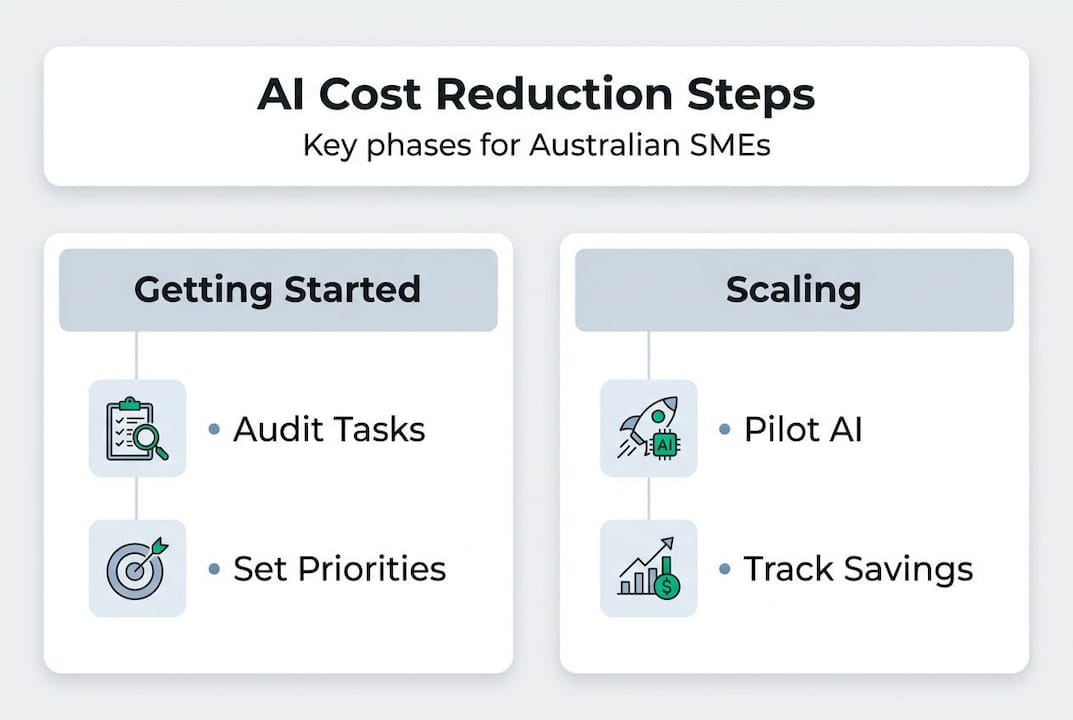
With your plan in place, it's time for hands-on action. The most effective SMEs start small, pilot one use case, measure with defined metrics, and iterate based on real results before scaling.
Here's a proven implementation sequence:
- Choose your pilot: Select the highest-priority, lowest-risk task from your audit. A chatbot for customer enquiries or automated invoice matching are classic first moves.
- Set your baseline: Before switching anything on, record your current time and cost for the task. This is your comparison point.
- Configure and test: Set up the AI tool in a controlled environment. Run it alongside your existing process for two to four weeks.
- Measure outcomes: Track time saved, error rates, cost per transaction, and staff feedback. Use a simple spreadsheet if needed.
- Review and refine: Identify what's working and what isn't. Adjust configurations before any wider rollout.
- Scale with confidence: Once your pilot proves ROI, apply the same approach to the next priority on your list.
The numbers back this approach. Up to 41% of AI-enabled businesses report saving more than 25% of labour time, and well-run pilots often show ROI within 30 to 60 days. That's not an outlier result. It's what happens when you measure properly and choose the right starting point.

Pro Tip: Budget for trial and error. Your first pilot will teach you more about your own operations than any consultant briefing ever will. That knowledge is worth the investment even if the tool itself needs replacing.
Review integration best practices for Australian SMBs before you start, and study common causes of avoiding AI failures to protect your investment. For a broader view, SMB implementation pitfalls are well-documented and avoidable with proper planning.
Verify, scale, and safeguard your AI savings
Implementation isn't the end. Now you need to lock in and expand your savings, safely. The single most common reason AI projects fail is skipping the verification step. 67% of AI projects fail from poor measurement and weak risk management. Don't be in that group.
Start your verification process with these key checks:
- Compare actual cost and time savings against your baseline from the pilot phase.
- Calculate your return on investment: divide total savings by total cost of the AI solution.
- Survey the staff who use the tool daily. Their feedback will flag problems before they become expensive.
- Review any outputs the AI produces for accuracy, especially in customer-facing or financial contexts.
- Confirm ongoing compliance with Australia's Privacy Act and any relevant ATO data obligations.
Here's a simple scaling readiness table:
| Readiness check | Status to proceed |
|---|---|
| ROI confirmed via baseline comparison | Positive or break-even |
| Data privacy review completed | No outstanding gaps |
| Staff trained on the tool | At least 80% confident |
| Vendor support and SLA confirmed | Documented and signed |
| Escalation process in place | Defined and tested |
The key risks include data privacy breaches, unreliable outputs, and supply chain dependencies on vendors. Reviewing your vendor contracts and internal policies every six months is not optional if you want sustainable savings.
"Scaling AI without verification is like expanding a shop before you know if the first location is profitable. Check the numbers first, then grow."
Australian trades, health, and retail firms have demonstrated that scaling pilots unlocks ongoing savings once strong verification is in place. The pattern is consistent: verify, document, then expand. For sector-specific context, see how AI in services is reshaping professional businesses across Australia.
What most guides miss about reducing costs with AI
Here's something most AI articles won't tell you: the biggest barrier to cost reduction with AI is rarely the technology. It's the expectation that AI will fix a broken or unmeasured process overnight.
We've seen businesses spend tens of thousands on AI platforms, only to realise six months later that no one tracked the baseline, no one owned the rollout, and the tool was solving a problem that wasn't actually their biggest cost driver. That's not an AI failure. It's a planning failure.
The businesses that consistently unlock real savings treat AI as a tool for augmentation, not transformation. They improve one workflow, measure it, then move to the next. Augmentation, not replacement, is the sustainable path. Maximum savings come from steady, incremental gains, not a single big-bang automation project.
Local support matters here too. A consultancy that understands Australian compliance, local labour dynamics, and your specific industry will always outperform a generic offshore platform. See AI case examples from Australian businesses that got this right by keeping the focus on people, process, and measured progress.
Get tailored guidance and maximise your AI savings
Knowing what to do and having the support to do it well are two different things. ORVX AI works directly with Australian SMEs to deliver hands-on audits, focused pilots, and full AI integration, all tailored to your industry and budget.
Our team embeds within your business to understand your real workflows, identify your highest-value automation opportunities, and manage implementation from start to finish. We're vendor-agnostic, locally based, and focused entirely on delivering measurable savings for your business. Whether you're in retail, trades, healthcare, or professional services, we build solutions that fit your operation, not a template. Explore our industry AI services or visit ORVX AI to book an initial consultation and take the first step toward genuine cost reduction.
Frequently asked questions
What is the typical cost to implement AI for cost reduction in an Australian SME?
Most Australian SMEs pay between $500 and $2,000 per month for AI solutions, with payback often inside 90 days when the right use case is selected from the outset.
How quickly can I see ROI from AI-powered cost reduction?
Many SMEs report meaningful savings within 30 to 60 days of their first pilot, particularly when they start with a focused use case and track results from day one.
Are there risks with using AI for cost reduction?
The main risks are data privacy breaches and unreliable outputs. Reviewing vendor policies and oversight before deployment is the most effective way to manage these risks.
Does AI ever replace employees when reducing costs?
Most successful implementations use AI to augment staff productivity rather than replace roles, generating savings through efficiency gains and freeing people for higher-value work.