
TL;DR:
- Most Australian businesses underestimate AI's potential outside big tech, risking costly missed opportunities.
- Business-centric AI tailored to specific workflows and compliance needs enhances efficiency and delivers measurable value.
Most Australian business owners still believe AI belongs in the domain of big tech companies with dedicated R&D budgets and specialist engineering teams. That assumption is costing them real money. Business-centric AI, meaning artificial intelligence designed around your specific workflows, compliance requirements, and industry context, is now within reach for trades businesses, health practices, professional services firms, and manufacturers alike. This article breaks down exactly what business-centric AI is, how it works across Australian industries, what the core benefits look like, and how to avoid the pitfalls that stop most AI projects from delivering lasting value.
Table of Contents
- What business-centric AI really means
- Core pillars and benefits of business-centric AI
- Business-centric AI in action: Australian industry examples
- Pitfalls and must-haves for scaling AI business-wide
- A smarter way forward: perspective on AI for Australian businesses
- Take the next step: find your industry's AI fit
- Frequently asked questions
Key Takeaways
| Point | Details |
|---|---|
| Business-centric focus | AI delivers most value when tailored to address industries' and businesses’ specific needs, not one-size-fits-all solutions. |
| Clear ownership vital | Scaling AI successfully requires defined decision rights, governance, and post-pilot support from the very start. |
| Measurable impact | Business-centric AI enables faster workflows, reduced costs, and easier compliance—often saving SMEs 25% or more in time. |
| Sector-specific advantage | Industries like professional services, manufacturing, and health see the biggest efficiency gains with sector-tailored AI. |
What business-centric AI really means
Generic AI tools are built for broad audiences. They automate common tasks, answer standard questions, and generate content. They are not built for your specific workflows, your compliance obligations under Australian law, or the way your team actually operates. Business-centric AI is different. It starts with your operational reality and works backwards to find the right technology.
A business-centric approach means the AI solution adapts to your industry context. A logistics company needs AI that understands delivery windows, route costing, and supplier SLAs. A healthcare clinic needs AI that respects privacy legislation, appointment workflows, and referral pathways. These are not problems that generic tools solve well. That distinction is why AI advantages for SMBs look very different from the theoretical benefits promoted in vendor marketing materials.
Key characteristics that separate business-centric AI from standard automation include:
- Workflow alignment: The AI maps to how your staff already work, rather than forcing a process change just to accommodate the tool
- Industry compliance: Solutions account for relevant regulations, whether that is the Privacy Act, Fair Work obligations, or sector-specific standards
- Cost control focus: Implementation is scoped to measurable ROI, not feature counts
- Staff usability: Interfaces and outputs match the skill level and daily context of the people using them
- Iterative improvement: The solution evolves as your business does, rather than being a set-and-forget deployment
The danger of taking a "tech-first" approach instead of a "business-first" approach is very real. When businesses select a tool because it is popular or because a vendor pitches it well, they skip the critical step of aligning the solution to actual problems. This is a common failure mode across industries. As the research confirms, many businesses fail to capture AI value due to missing governance and clarity about who owns what within the process.
"Many AI pilots work technically but fail at scale because no one has defined decision rights, process ownership, or governance structures from the start."
Understanding AI in professional services shows how even straightforward implementations, like contract review or client communications automation, can fail when ownership is unclear. The technology is rarely the problem. The business model around it usually is. Exploring industry AI applications across different sectors reveals a consistent pattern: businesses that define problems before selecting tools succeed at far higher rates. There is also growing evidence from AI tools for business productivity research that matching tool to context is the single biggest predictor of whether an AI investment pays off.
Core pillars and benefits of business-centric AI
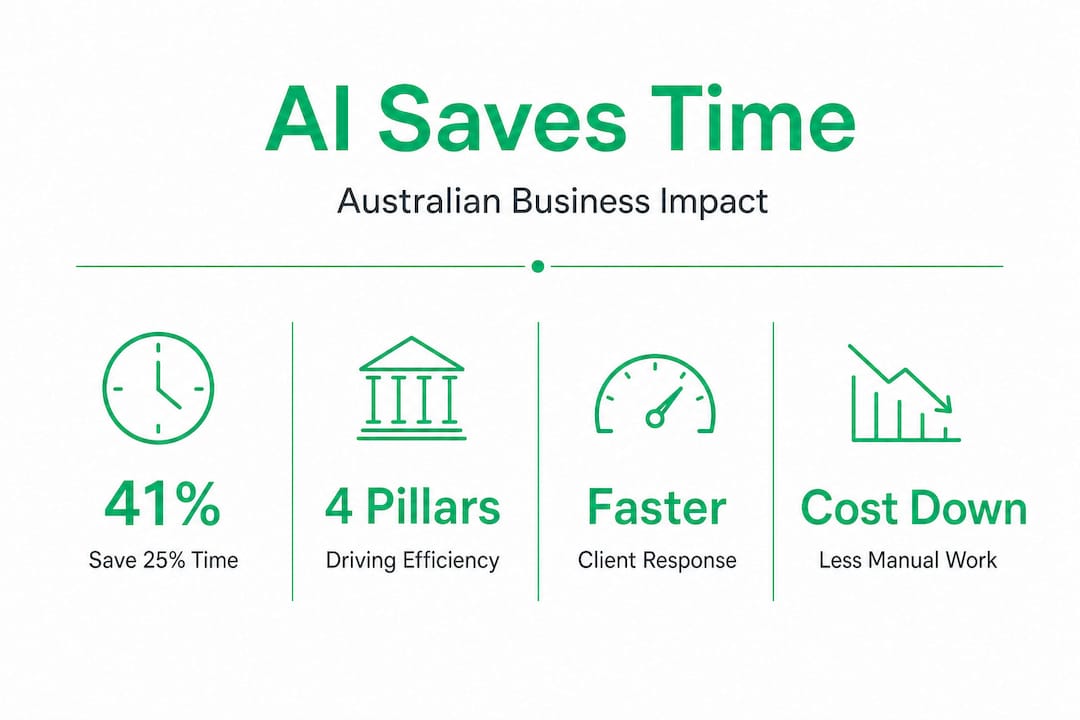
Once you understand what business-centric AI is, the next step is knowing what it is actually built from. There are four foundational pillars that every well-designed business AI solution should include.
Customisation means the solution is configured or built for your specific context, not installed as a default package. Integration means it connects meaningfully with your existing systems, your CRM, your scheduling platform, your accounting software, rather than operating as an island. Lifecycle governance means someone is accountable for the solution throughout its life, from pilot through to full deployment and ongoing performance review. Observability means you can see what the AI is doing, why it made a decision, and whether it is performing against your defined KPIs.

Following AI integration best practices ensures these pillars are not just theoretical. They need to be embedded in how you plan, contract, and manage any AI engagement.
| Benefit | What it looks like in practice |
|---|---|
| Cost reduction | Fewer manual hours on repetitive admin tasks |
| Time savings | Faster processing of documents, quotes, and schedules |
| Improved accuracy | Reduced data entry errors and compliance gaps |
| Better compliance | Automated flagging of regulatory requirements |
| Decision support | Real-time dashboards and analytics for management |
The numbers back this up. 41% of Australian SMBs save at least 25% of their time with proper AI integration, a significant operational shift that compounds over months and years. Those savings do not come from deploying the most sophisticated tool available. They come from deploying the right tool with the right process support around it.
Research into AI tools that boost productivity consistently shows that the businesses seeing the best results are those that treat AI implementation as a process redesign exercise, not a software purchase.
Pro Tip: Before you evaluate a single AI product, write down three specific, measurable problems you want to solve. If you cannot articulate the problem clearly, no tool will solve it reliably.
Immediate impacts that well-integrated AI delivers include faster response times to client enquiries, streamlined approval and review workflows, better scheduling efficiency, and reduced dependency on individual staff members for institutional knowledge. These are not abstract benefits. They show up in your weekly operations within weeks of a well-scoped deployment.
Business-centric AI in action: Australian industry examples
These principles come alive when applied in actual Australian business settings. The following comparison illustrates what business-centric AI changes in real operational terms across four sectors.
| Industry | Traditional workflow | Business-centric AI-enhanced workflow |
|---|---|---|
| Professional services | Manual document review and client follow-up | Automated contract analysis and scheduled communication triggers |
| Trades | Paper-based job scheduling and quote management | AI-driven scheduling, quote generation, and supplier order automation |
| Healthcare | Phone-based bookings and manual referral tracking | Intelligent appointment management and automated referral pathways |
| Manufacturing | Reactive maintenance scheduling and manual supplier management | Predictive maintenance alerts and AI-assisted procurement optimisation |
The pattern is consistent across all four. The AI does not replace the core expertise of the business. It removes the administrative burden that surrounds that expertise, freeing your people to do what they were actually hired to do.
Industry-specific solutions see greater scalability and adoption rates across Australian sectors, and the efficiency gains are substantial, with some applications improving operational efficiency by up to 111%. That figure reflects what happens when the solution matches the sector's specific bottlenecks rather than addressing generic inefficiencies.
For businesses ready to move from concept to action, the implementation journey follows a clear sequence:
- Identify your pain points: Work through your weekly operations and flag the tasks that consume the most time with the least strategic value. Be specific. "Admin is slow" is not a pain point. "Quoting takes three hours per job and the information is scattered across three systems" is a pain point.
- Pilot with a defined scope: Select one workflow for your first AI pilot. Keep it contained. Set a measurement period of eight to twelve weeks and define success before you start.
- Integrate with existing systems: Ensure your pilot connects properly with the tools your team already uses. Isolated AI deployments almost always fail to scale.
- Review and iterate: After the pilot, review performance data honestly. Adjust the configuration, refine the process, and capture learnings before expanding.
- Scale with governance: Roll out to additional workflows or teams only once ownership, training, and performance monitoring are firmly in place.
The business advantages of AI are not delivered by the technology alone. They are delivered by the combination of the right tool, applied to the right problem, with the right process management around it. That is what custom AI implementation looks like in practice. ORVX AI's industry services are structured around exactly this phased, context-specific approach.
Pitfalls and must-haves for scaling AI business-wide
But what gets in the way, and what makes AI adoption stick? Here's what to watch out for.
The most common barriers to successful AI scaling are not technical. They are organisational. Unclear ownership is the biggest single failure factor. When no one person or team is accountable for the AI solution's ongoing performance, it drifts. Updates do not happen. Edge cases are not addressed. Staff revert to manual workarounds. Within months, an investment that showed early promise is quietly abandoned.
The second major barrier is the absence of lifecycle planning. Many businesses treat AI implementation as a project with a finish line, where once the tool is deployed, the work is done. In reality, AI solutions require ongoing monitoring, reconfiguration as business processes evolve, and regular performance reviews against defined KPIs.
A third barrier is staff buy-in. Even well-designed AI tools fail when the people using them do not understand why the tool is there, how it helps them specifically, or what they are expected to do differently. Training is not optional. It is a core part of the implementation.
The must-haves for AI that scales successfully across a business include:
- A clear roadmap: Document the sequence of workflows you plan to automate or augment, with realistic timelines and resource requirements
- Defined ownership: Name the person or team responsible for each AI solution's performance and ongoing management
- Transparent KPIs: Set specific, measurable targets before deployment and review them at defined intervals
- Stakeholder engagement: Involve the staff who will use the tool in the design and pilot phase, not just management
- Post-pilot support: Plan for at least three months of active support after go-live, including regular check-ins and configuration adjustments
The AI step-by-step guide provides a structured framework for working through these requirements in a practical sequence suited to Australian businesses.
As confirmed by expert research, AI pilots work technically but fail to capture value if decision rights and governance are not established from the outset.
"The gap between a successful AI pilot and business-wide value is almost always a governance gap, not a technology gap."
Pro Tip: Before scaling any AI solution beyond its pilot phase, document who owns it, who monitors it, and what triggers a performance review. Without that structure, scaling creates chaos rather than efficiency.
Understanding the business impact of AI at a sector level helps frame these decisions in terms that resonate with your board, your operations team, and your finance function.
A smarter way forward: perspective on AI for Australian businesses
Here is an uncomfortable observation. Most "AI transformations" in Australian businesses fail not because the technology is poor, but because the business never actually changed. A new tool was installed. Some tasks were automated. But the underlying decision structures, process ownership, and accountability frameworks stayed exactly as they were. That is not transformation. That is a new layer of software on top of an old way of working.
The businesses that get lasting value from AI are the ones that treat it as an organisational change initiative with a technology component, not a technology project with an occasional training session. The distinction sounds subtle, but in practice it changes everything about how you plan, how you resource, and how you measure success.
There is also a contrarian point worth making directly. Many business owners are drawn to AI because of what they see it doing in demos and case studies. The technology is genuinely impressive. But the right starting point is never the technology. It is the problem. Start with the business pain, the specific workflow that is costing you money, losing you clients, or burning out your staff, and then ask what kind of tool could address it. That sequence, pain first, then solution, produces far better outcomes than the reverse.
As the research consistently confirms, ownership gaps stall AI initiatives regularly, and strategy must precede code every time.
Businesses must also resist the temptation to fully outsource the change. A consultant or AI partner can design the solution, manage the implementation, and provide ongoing support, and a good one absolutely should. But your internal team needs to own the outcome. The SME AI benefits that endure are the ones where the business has built genuine capability around the tool, not just dependency on it.
The businesses winning with AI right now are not the ones with the most sophisticated technology. They are the ones that were clearest about what they needed and disciplined enough to build the right foundations before they started adding complexity.
Take the next step: find your industry's AI fit
If the principles in this article resonated, the next move is straightforward. You do not need to figure out your AI strategy in isolation.
ORVX AI works directly with Australian businesses across professional services, trades, health and beauty, manufacturing, retail, logistics, and more. The approach is hands-on. That means embedding within your team to understand your actual workflows, mapping where AI creates real value, and building a roadmap that fits your operations and your budget. There are no templated packages and no vendor lock-in. Every engagement starts with understanding your business first, then identifying the right tools. If you are ready to move from uncertainty to a clear, practical AI strategy, explore ORVX AI's industry services and find the fit for your sector.
Frequently asked questions
How is business-centric AI different from regular AI solutions?
Business-centric AI customises tools for specific industry needs, workflows, and compliance requirements, while regular AI tends to be generic. Business-centric AI adapts to context, not just general automation patterns.
What are the first steps to implementing business-centric AI?
Start by identifying your key business challenges, set measurable goals, and engage your stakeholders to define scope and ownership. Clear goal setting and ownership are prerequisites for capturing genuine AI value.
Can small businesses benefit from business-centric AI?
Yes, absolutely. Small and medium Australian businesses can see significant operational improvements and cost savings with well-targeted, business-first AI projects. 41% of Australian SMBs save at least 25% of their time with the right AI approach.
What common mistakes do businesses make when adopting AI?
Many businesses roll out AI pilots without a lifecycle plan or clear ownership, causing value and momentum to stall quickly. Ownership gaps and weak governance are the most consistent reasons AI scaling fails.
Which industries gain the most from business-centric AI in Australia?
Professional services, health, manufacturing, and trades see the strongest gains, particularly where workflow optimisation and compliance are central. Sectoral AI applications consistently deliver higher efficiency outcomes when solutions match industry-specific requirements.