
TL;DR:
- Industry-specific AI is tailored tools designed for particular sectors, offering higher accuracy and better workflow fit. Many Australian SMEs are already using such off-the-shelf solutions embedded into their operations to save time, improve decision-making, and ensure compliance. Proper security, vendor due diligence, and targeted integration are essential to maximize benefits and mitigate risks.
Most Australian small business owners picture AI as something reserved for tech giants with million-dollar budgets and entire departments of data scientists. That picture is wrong. Right now, across trades businesses in regional Queensland, law firms in Melbourne's CBD, and manufacturing operations in South Australia, industry-specific AI is quietly doing the heavy lifting in ways that are affordable, practical, and genuinely transformative. This guide clears up the confusion, explains exactly what industry-specific AI is, how it actually works, and walks you through what getting started looks like for a real Australian SME.
Table of Contents
- Defining industry-specific AI
- How industry-specific AI works under the hood
- Practical benefits for Australian SMEs
- Key risks, security and governance for SME adoption
- Why most SMEs underestimate industry-specific AI (and how to spot real value)
- Next steps: find the right industry-specific AI solution for your business
- Frequently asked questions
Key Takeaways
| Point | Details |
|---|---|
| Tailored AI boosts value | AI tools designed for your industry work better and save more time than generic solutions. |
| Practical SaaS options | Most Australian SMEs implement AI through cloud or workflow solutions, not by building their own models. |
| Security is essential | Small businesses must prioritise cyber security and governance when adopting AI, even for off-the-shelf systems. |
| Everyday benefits | Industry-specific AI can automate admin, quoting, and support—making SMEs more competitive right now. |
Defining industry-specific AI
"Industry-specific AI" gets thrown around a lot, but most explanations make it sound either impossibly technical or frustratingly vague. Let's fix that.
At its core, industry-specific AI refers to artificial intelligence tools and systems that have been designed, trained, or configured specifically for the context of a particular sector. A legal AI tool understands Australian contract terminology. A trade quoting tool knows how to calculate materials and labour rates for plumbing or electrical work. A healthcare triage assistant recognises clinical language and safety protocols. The AI doesn't need to be "taught" what your industry does from scratch because it already comes loaded with relevant knowledge.
This is fundamentally different from a general-purpose AI tool. When you ask a generic AI assistant to summarise a legal contract or generate a trade quote, it can produce something plausible. But "plausible" and "accurate" are not the same thing, and in business, errors cost money.
Here are the key distinctions that set industry-specific AI apart:
- Domain vocabulary: it understands the specific language your industry uses, from legal clauses to engineering specifications
- Workflow alignment: it fits into how your team already works, not the other way around
- Contextual accuracy: outputs are grounded in sector-relevant data, reducing errors and rework
- Regulatory awareness: many industry-specific tools account for Australian compliance requirements relevant to their sector
- Practical integration: it connects to the software platforms your business already uses
"For SMEs, industry-specific AI is usually implemented as practical solutions embedded into workflows — such as document processing, support triage, and scheduling or quoting — rather than building a custom AI model from scratch."
One important misconception worth clearing up: industry-specific AI does not mean custom-built AI. You don't need to hire developers to build something from the ground up. Many excellent industry-specific AI solutions are off-the-shelf products. A legal document automation tool is industry-specific. A quoting app built for electricians is industry-specific. Neither requires you to write a single line of code.
For a deeper look at how this applies to service businesses, AI in professional services is worth exploring as a real-world context.
How industry-specific AI works under the hood
Having defined industry-specific AI, let's break down how these solutions actually function and why they outperform generic options in real business scenarios.
The technical mechanism is simpler than most people expect. Industry-specific AI works by narrowing the AI's focus. General AI models are trained on enormous, broad datasets covering virtually everything. Industry-specific models either start with a specialised dataset or take a general model and ground it with domain-specific data, rules, and examples. The result is a tool that produces answers relevant to your world rather than answers that could apply to anyone, anywhere.
Domain-specific tailoring is the main technical mechanism here, commonly achieved through specialised models or by grounding general models with domain data and workflows. This might involve feeding the AI your industry's standard documents, terminology, pricing structures, or compliance rules so it "thinks" within that context.
Here's a side-by-side comparison to make this concrete:
| Feature | Generic AI | Industry-specific AI |
|---|---|---|
| Vocabulary | General language | Sector-specific terms |
| Output accuracy | Variable, needs review | Higher, context-aware |
| Workflow fit | Requires manual adaptation | Designed to embed directly |
| Compliance awareness | Minimal | Often built in for the sector |
| Setup complexity | Low but limited | Low to moderate with greater ROI |
| Cost to implement | Low | Low to moderate |
So how does an Australian SME actually put this to work? The process typically looks like this:
- Identify the workflow: Pinpoint a specific task that is repetitive, time-consuming, or error-prone in your business.
- Find an industry-fit tool: Look for software that already serves your sector and incorporates AI for that task.
- Connect to existing systems: Most modern tools integrate with CRMs, accounting platforms, or job management software you already use.
- Configure with your data: Add your templates, pricing structures, or client categories to sharpen accuracy.
- Test and refine: Run the tool on real tasks, review outputs, and adjust settings before full deployment.
Pro Tip: The most effective industry-specific AI implementations don't live in a standalone app. They embed directly into the workflow tools your team is already using every day, whether that's your job management system, your accounting software, or your CRM. Bolting AI onto existing processes gets adoption up and friction down.
For a broader look at how different sectors are putting this into practice, exploring practical AI industry examples gives a useful real-world perspective.
Practical benefits for Australian SMEs
Understanding how AI works is useful but what does this look like when put into practice for actual small and medium businesses across Australia?
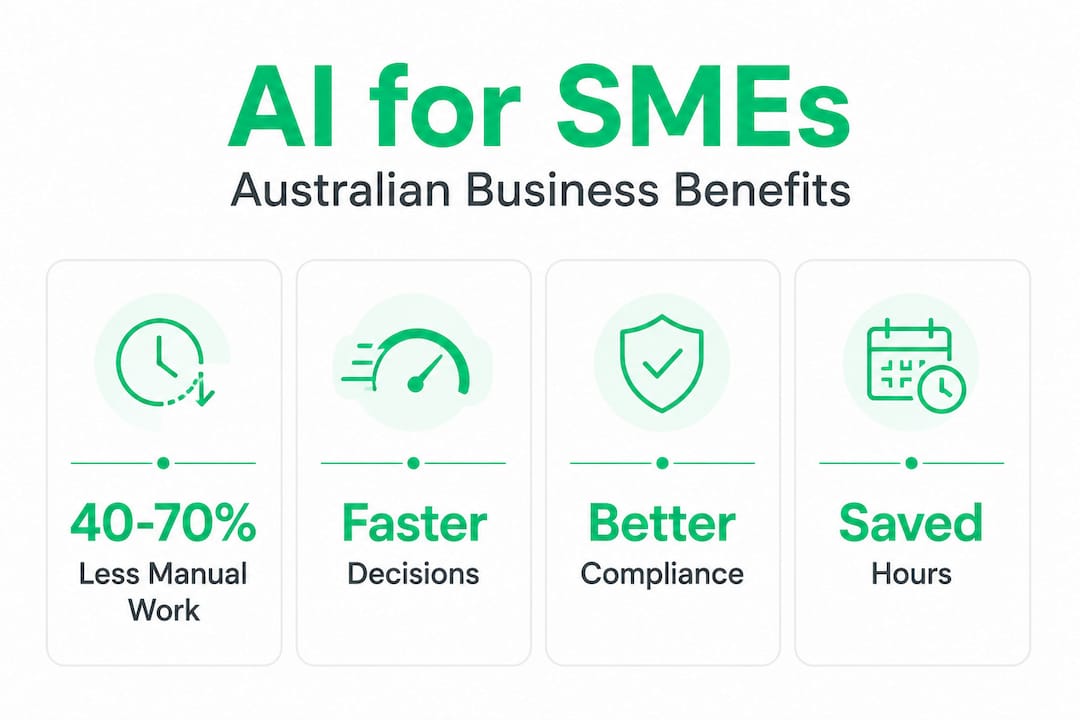
The benefits show up in three main areas: time savings, smarter decisions, and better compliance. None of these are abstract. They translate directly into dollars and hours recovered each week.
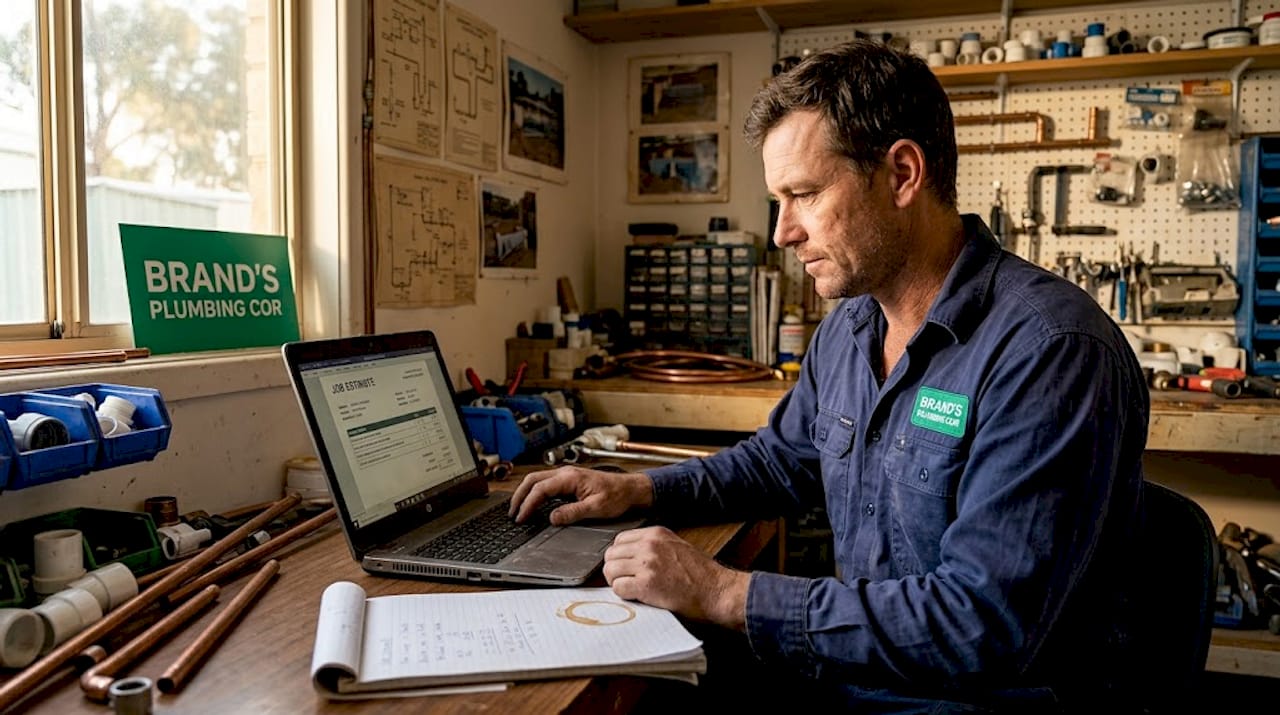
Consider a small plumbing company in Perth. Before adopting an industry-specific quoting tool, the owner spent around three hours per day manually preparing quotes, cross-checking supplier pricing, and formatting proposals. With AI-assisted quoting embedded in their job management platform, that process now takes under thirty minutes. The AI knows standard labour rates, common material costs, and job categories specific to plumbing work. That owner reclaimed over two full days of productive time per week.
Or consider a two-partner law firm in Brisbane using AI-assisted document review. Instead of manually checking every contract against a template, their AI tool flags deviations, highlights unusual clauses, and suggests standard language. Review time dropped by roughly sixty per cent, and the risk of missing a critical clause dropped with it.
Here's a summary of the key operational benefits reported by Australian SMEs adopting industry-specific AI tools:
| Benefit area | Typical SME outcome |
|---|---|
| Document processing | 40 to 70% reduction in manual review time |
| Customer support triage | 50% reduction in first-response time |
| Quoting and scheduling | 60 to 80% faster turnaround |
| Compliance management | Fewer manual errors, better audit trails |
| CRM and lead handling | Higher lead conversion with less manual follow-up |
These numbers come from real-world adoption patterns, and they are consistent with what AI adoption benefits research reveals across Australian SMEs.
The benefits go beyond simple time saving. Industry-specific AI also improves decision quality. When your CRM uses AI trained on your customer data and industry patterns, the recommendations it surfaces are far more relevant than generic prompts. For example, AI CRM examples show how SMEs in retail and professional services are using AI-driven CRM tools to identify their best upsell opportunities with existing clients rather than chasing cold leads.
Key outcomes Australian SMEs are seeing right now include:
- Reduced administrative overhead through automated document generation, scheduling, and follow-ups
- Better cash flow visibility via AI-assisted forecasting in accounting platforms
- Faster customer response times through AI-powered support triage that routes queries to the right person instantly
- More accurate job pricing in trades and construction using AI that accounts for current material costs
- Lower compliance risk in industries like healthcare and finance where regulatory requirements are embedded in the AI's logic
The implementation details reinforce that SMEs do not need to build AI. They need to use AI that is already built for their context.
Key risks, security and governance for SME adoption
Of course, with any major technology comes responsibility. Here's how SMEs can stay safe and compliant while embracing industry-specific AI.
Cloud-hosted AI adoption increases the importance of cyber security risk management and governance, even when the AI is not custom built. This is the part many SMEs skip over in their excitement to get started, and it is exactly where problems emerge six months down the track.
The most common mistake is treating cloud AI services as "set and forget." You sign up, connect your data, and assume the vendor handles everything from that point on. That assumption is costly. You remain responsible for what data you share, how it is stored, who can access it, and whether the vendor's practices align with Australian privacy law.
Here is a practical checklist of what to ask any AI solution provider before you commit:
- Data residency: Is your business data stored in Australia or offshore? This matters for privacy law compliance.
- Access controls: Who within the vendor's team can see your data, and under what conditions?
- Data retention and deletion: Can you delete your data from their systems if you stop using the service?
- Compliance certifications: Does the vendor hold relevant certifications such as ISO 27001 or SOC 2?
- Transparency of AI outputs: Can the tool explain why it produced a particular output, especially important in regulated industries?
- Incident response: What does the vendor do if there is a data breach, and how quickly do they notify you?
Pro Tip: Before any AI tool touches your client data or financial records, review your own cyber security posture first. Even the best AI vendor cannot protect you from weak passwords, unpatched software, or staff clicking phishing links. Your AI governance should sit inside a broader security framework.
For a step-by-step approach to managing these risks during rollout, the guide on AI implementation steps covers the practical governance side in detail.
Why most SMEs underestimate industry-specific AI (and how to spot real value)
With those practicalities in mind, here is a perspective you won't get from a sales brochure: the unexpected ways industry-specific AI is already transforming small businesses, often completely unnoticed.
The conventional wisdom says AI success belongs to companies investing millions in custom development. We see a completely different reality in our work with Australian SMEs. The biggest productivity gains are not coming from companies that built something bespoke. They are coming from businesses that simply chose the right off-the-shelf tool for their sector and embedded it properly into their workflow.
The irony is that many SMEs are already using industry-specific AI without realising it. That scheduling feature in your field service management platform? AI. The smart inbox triage in your customer support tool? AI. The anomaly detection in your accounting software? Also AI. The question is not whether you are using AI. It is whether you are using it intentionally and extracting its full value.
The businesses pulling ahead right now are not necessarily spending more. They are being more deliberate. They are asking which specific task is costing the most time or money, finding the industry-specific tool that addresses exactly that task, and integrating it cleanly. That focused approach consistently outperforms a scattered, "let's try everything" strategy.
We also see SMEs fall for AI hype regularly. A vendor promises the world, the tool gets adopted company-wide, and six months later it is barely being used because it never quite fitted how the team actually worked. The way to avoid this is simple: demand a working demonstration using your type of data before you commit. If a legal AI tool cannot accurately summarise a sample Australian contract, it is not ready for your firm. If a quoting tool does not know your trade's material categories, it will create more work than it saves.
Genuine custom AI ROI comes from alignment between the tool and the workflow, not from how sophisticated the technology looks on a demo call. And the AI implementation benefits that matter most to SMEs are almost always the simple ones: fewer hours on admin, faster turnaround for clients, and fewer costly mistakes.
Next steps: find the right industry-specific AI solution for your business
The gap between knowing AI exists and knowing which solution is right for your specific business can feel wide. That's exactly where working with a team who understands both the technology and your industry makes the difference.
At ORVX AI, we work directly with Australian SMEs across industries to identify where industry-specific AI will deliver real, measurable results for your business. Whether you're in manufacturing and need AI for production workflows, or you run a trades business needing smarter quoting and scheduling, we embed within your team, map your workflows, and build a roadmap that fits your budget and goals. The ORVX AI consultancy team brings vendor-agnostic advice and hands-on support from first audit through to full implementation. No templated packages. Just the right fit for your business.
Frequently asked questions
What makes AI 'industry-specific' versus general purpose?
Industry-specific AI is trained or adapted for a particular field, using data and processes relevant to that industry. This domain-context tailoring delivers higher accuracy and far more practical results than a general-purpose tool.
How do Australian SMEs typically use industry-specific AI?
Most SMEs use industry-specific AI through workflow tools rather than custom builds, automating admin, customer service, or quoting. Practical embedded solutions like document processing and scheduling tools are the most common entry point.
Is adopting industry-specific AI riskier for my business?
Cloud AI services do require solid cyber security and data governance practices. However, with proper vendor due diligence, the cyber security governance risks can be managed effectively without specialist IT staff.
Do I need a huge IT budget to benefit from industry-specific AI?
No. Most SME value comes from off-the-shelf AI tools integrated with existing software. Workflow-embedded AI solutions are typically subscription-based, affordable, and don't require custom development.