TL;DR:
- Most Australian SMBs use AI superficially, with only 5% fully enabled for measurable impact.
- Moving up AI maturity levels significantly boosts profitability and cost savings, giving a competitive edge.
- Structured, phased AI adoption strategies and internal capability development are crucial for success.
Australian small and medium businesses are adopting AI at a striking pace, with adoption rates ranging from 42% to 84% depending on the sector. Yet only 5% of those businesses are fully enabled, meaning the vast majority are leaving serious gains on the table. The gap between using AI and truly benefiting from it is wider than most business owners realise. In 2026, that gap is becoming a competitive fault line. This guide breaks down where Australian SMBs really stand, what the evidence says about outcomes, and exactly how to build a practical AI strategy that delivers real operational efficiency and growth.
Table of Contents
- The state of AI adoption for Australian SMBs: Fact vs. fiction
- Why adopt AI in 2026? Efficiency, profitability, and growth
- Smart AI adoption tactics for Australian SMBs: What works
- Risks, barriers, and how to overcome them
- A balanced perspective: AI adoption is essential, but maturity matters
- Ready to future-proof your business with AI?
- Frequently asked questions
Key Takeaways
| Point | Details |
|---|---|
| AI boosts efficiency | SMBs using AI can cut operating costs by up to 60% and save staff time substantially. |
| Profit potential is huge | Intermediate and mature AI adopters see profit uplifts of 45% to 111%. |
| Strategy trumps tools | Success depends on a tailored roadmap and maturity, not just technology adoption. |
| Barriers can be overcome | Australian SMBs can address skills, data, and privacy issues with phased pilots and training. |
The state of AI adoption for Australian SMBs: Fact vs. fiction
SMBs across Australia are asking whether real bottom-line results are within reach. To answer that honestly, we first need to understand where most businesses actually stand.
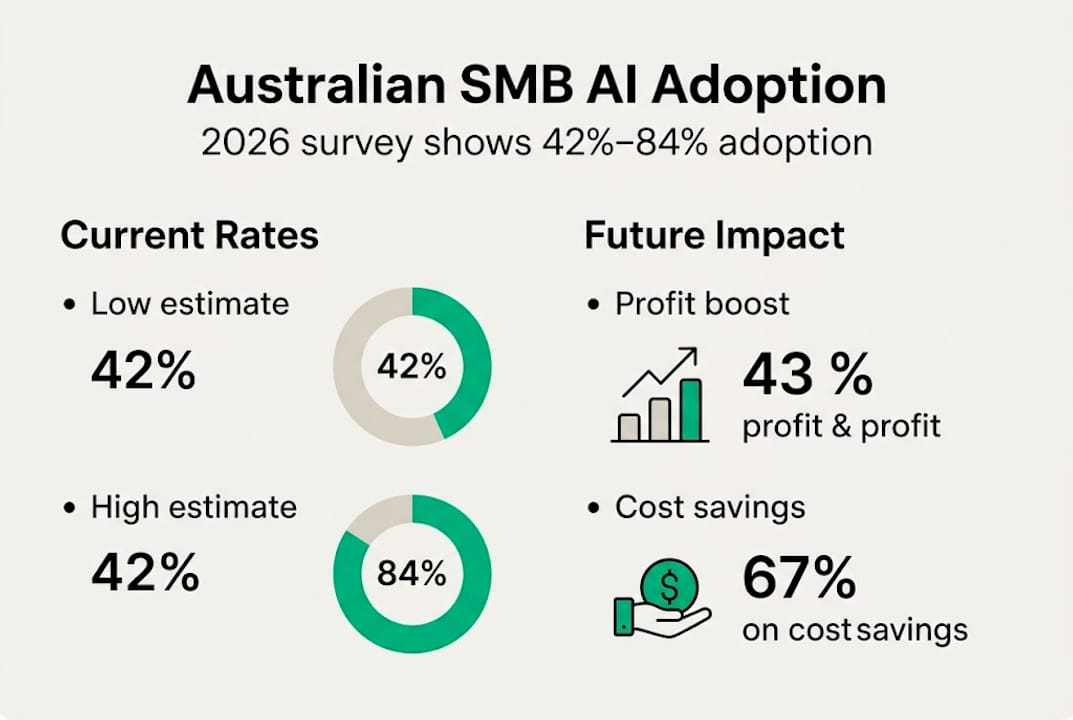
The headline numbers look encouraging. AI adoption among Australian SMBs sits between 42% and 84% in 2026, depending on the industry and how you define "adoption." But dig a little deeper and a different story emerges. Most of that adoption is surface level: a chatbot here, an auto-reply there. Fewer than one in twenty SMBs has reached what researchers call "fully enabled" status, meaning AI is deeply integrated into core workflows and generating measurable, sustained impact.
The maturity gap is the real story. "Fully enabled" businesses are not just using AI tools. They have mapped their processes, aligned AI with specific business outcomes, and built internal capability to iterate. That is a fundamentally different posture to simply signing up for a subscription tool and hoping for the best.
| Maturity level | Estimated % of SMBs | Headline outcome |
|---|---|---|
| Interested (exploring) | ~45% | Minimal gains, awareness building |
| Intermediate (piloting) | ~50% | 45% average profit uplift |
| Fully enabled (scaled) | ~5% | 111% average profit uplift |
The Deloitte AI edge findings put this starkly: if just 10% of Australian SMBs advanced their AI maturity by one level, it could add $44 billion to the national economy. The opportunity is enormous, and it is being underutilised.
"The maturity gap between those who explore AI and those who embed it is not a technology problem. It is a strategy problem."
Understanding the AI advantages for Australian SMBs that accrue at each maturity level is the first step. Moving up even one stage, from interested to intermediate, can transform a business's cost structure and competitive positioning. A well-built AI roadmap guide is what separates those who experiment endlessly from those who scale with confidence.
Why adopt AI in 2026? Efficiency, profitability, and growth
Clarifying where SMBs stand sets the stage for understanding what is at stake. Here is what adopting AI now actually unlocks.
The profitability data is hard to ignore. Intermediate AI users see around a 45% profit uplift compared to non-adopters, while fully enabled businesses report an extraordinary 111% uplift. These are not projections. These are outcomes being recorded right now across Australian businesses in retail, trades, professional services, and logistics.
On the cost side, operational savings from AI range from 30% to 60%, with a median reduction of 35% within the first 12 months. More than 41% of SMB AI users report reclaiming over 25% of their labour time, which is hours that can be redirected to higher-value work or growth activities.
| SMB AI maturity | Profit uplift | Cost reduction | Labour time saved |
|---|---|---|---|
| Interested | Minimal | <10% | Negligible |
| Intermediate | ~45% | 20-35% | 10-25% |
| Fully enabled | ~111% | 30-60% | 25%+ |
Australia is also moving into a two-speed economy for local businesses, where early AI adopters are pulling ahead on margins, customer experience, and speed to market, while laggards face increasing pressure. The longer a business waits, the harder the catch-up becomes.
Here are the top reasons Australian SMBs are prioritising AI right now:
- Automate repetitive tasks like data entry, scheduling, and invoicing
- Improve decision-making with real-time analytics and forecasting
- Scale operations without proportionally increasing headcount
- Deliver faster, more personalised customer service
- Reduce human error in compliance and document-heavy workflows
The AI investment benefits compound over time. Businesses that start now build institutional knowledge and internal capability that cannot be replicated overnight. Explore industry-specific AI efficiency gains to see how businesses in your sector are already moving.
Pro Tip: Start by auditing your three most time-consuming manual processes. These are almost always your highest-ROI targets for an initial AI pilot, and they give you a clear baseline to measure against.
Smart AI adoption tactics for Australian SMBs: What works
Now that the "why" is clear, let us get practical with proven adoption tactics.
The most reliable framework for SMB AI adoption is the Crawl-Walk-Run phased approach. It sounds simple, but most businesses skip the crawl phase entirely and end up with fragile, under-performing implementations. Slow, deliberate progress in the early stages pays dividends later.
Here is how to apply it step by step, drawing on proven AI adoption tactics:
- Identify your highest-friction workflows. Map out where time, money, or errors are consistently lost. Invoice processing, customer enquiries, and scheduling are common starting points for Australian SMBs.
- Select a low-risk pilot. Choose one focused use case, such as a customer-facing chatbot or automated invoice matching. Low risk means low cost, limited integration, and easy rollback if needed.
- Set clear success metrics before you start. Define what "working" looks like: reduction in processing time, cost per transaction, or number of staff hours freed up each week.
- Run the pilot for 60 to 90 days. Collect real data. Do not judge too early. Many AI tools improve as they process more of your specific business data.
- Review, learn, and expand. Use what you learned to refine the approach before rolling out to additional workflows or teams.
Pro Tip: The Australian Government's National AI Centre offers resources and sometimes funding pathways for SMBs exploring AI. It is worth a look before you commit any significant budget to external vendors.
Staff training is not optional. AI tools underperform when your team does not understand how to use them or, worse, does not trust them. Building internal capability, even at a basic level, dramatically improves outcomes. Review the custom AI implementation steps suited to Australian SMEs, and consider AI integration best practices before committing to any vendor.
Risks, barriers, and how to overcome them
Even with all the excitement around AI, real-world challenges remain. Here is what to watch out for, and practical solutions for each.
Australian SMBs face a genuine set of barriers that go beyond budget. Here are the most common ones:
- Skill shortages: 67% of SMBs lack the in-house expertise to select, implement, or manage AI tools effectively
- Data quality issues: AI is only as good as the data it learns from. Poor, incomplete, or inconsistent data produces unreliable outputs
- Privacy and compliance concerns: Handling customer data through AI tools creates obligations under Australian privacy law that many businesses are not across
- ROI uncertainty: Many SMBs struggle to define what success looks like before they start, making it hard to justify ongoing investment
- Over-reliance on technology: Automating a broken process just makes the problem faster. AI is not a fix for poor workflow design
"The top AI risks for SMBs include data leakage, inaccurate outputs (hallucinations), and staff over-reliance, all of which are manageable with the right governance in place."
The OECD's research on SME AI adoption reinforces that the skills gap is the single biggest drag on maturity progression globally. For Australian SMBs, the most effective responses are: partner with a specialist consultancy to bridge the expertise gap, run phased pilots before scaling, establish a basic data governance policy, and build staff capability through structured training. Addressing these barriers through planning rather than reaction makes AI adoption sustainable, not fragile. Explore AI adoption benefits and strategies for a deeper look at how Australian businesses are navigating these issues.
A balanced perspective: AI adoption is essential, but maturity matters
Here is something most AI content will not tell you. The danger in 2026 is not failing to adopt AI. It is adopting AI without intention.
At ORVX AI, we see this pattern constantly. A business signs up for three or four AI tools, sees modest gains, and then declares "we've done AI." In reality, they have created digital busywork: more software to manage, more outputs to verify, and no meaningful change to how the business operates. AI maturity in professional services and across other industries shows the same truth: tools without strategy deliver tools, not transformation.
The businesses seeing 100%+ profit uplifts are not using more AI. They are using it more intentionally. They started with real pain points, not trend-following. They embedded AI into the way their teams actually work, rather than bolting it on as an afterthought. They measured business outcomes, not just tech metrics.
Our contrarian view: if you cannot clearly articulate which business problem your AI adoption is solving and how you will measure success, you are not ready to scale. Go back to the crawl phase. That is not a failure. That is discipline.
Pro Tip: Schedule a quarterly "AI outcome review" that measures business results, revenue, cost, time saved, not just usage statistics. This keeps your strategy grounded in value rather than activity.
Ready to future-proof your business with AI?
If the evidence in this article has landed, you already know that acting decisively in 2026 is the move. The maturity gap is real, the competitive pressure is building, and the businesses pulling ahead are the ones with a clear, guided strategy behind their AI adoption.
At ORVX AI, we work alongside Australian SMBs to close that maturity gap with tailored strategies, not templated packages. Whether you operate in trades or retail, we embed with your team to map your workflows, identify genuine AI opportunities, and manage implementation end-to-end. Our vendor-agnostic approach means you get the right solution for your business, not whoever pays the highest referral fee. Get in touch and let's build your AI roadmap together.
Frequently asked questions
What is the main benefit for Australian SMBs adopting AI in 2026?
The primary benefit is significant gains in operational efficiency and profitability, with businesses achieving 30-60% cost savings within the first 12 months of a focused AI implementation.
Is AI adoption expensive for small businesses?
Not necessarily. Many entry-level solutions like chatbots and invoice automation are cost-effective to pilot, and government programmes can help offset early costs for eligible businesses.
What is the biggest risk in adopting AI for my SMB?
The key risks include inaccurate outputs, data privacy breaches, and skill shortages affecting 67% of SMBs, though each is manageable with proper planning, phased rollouts, and the right external support.
How quickly can I see results after adopting AI?
Most SMBs start seeing measurable efficiency improvements within 3 to 12 months, particularly when they begin with high-impact workflows like invoicing, customer service, or scheduling automation.