
TL;DR:
- Australian creative agencies can achieve significant productivity gains by implementing AI for automation and augmentation.
- AI enhances efficiency in creative production, audience targeting, insights, and admin tasks, freeing human creativity.
- Thoughtful, strategic AI adoption allows agencies to maintain distinctiveness and achieve sustainable competitive advantage.
Australian creative agencies are sitting on one of the most significant productivity opportunities in recent memory. A 30% efficiency gain at Australia Post and BRX through AI-assisted creative production is not a forecast. It is a real result, already achieved on Australian soil. Yet many agency leaders remain caught between genuine curiosity and understandable scepticism, unsure whether AI represents a transformational tool or just another wave of vendor hype. This guide cuts through that noise and shows you exactly where AI is already delivering value for creative agencies in Australia, and how to approach adoption in a way that is practical, measured, and built for your team.
Table of Contents
- Understanding the role of AI in Australian creative agencies
- How AI boosts efficiency and client outcomes
- Opportunities and risks: AI as amplifier or disruptor?
- Implementing AI in your creative agency: steps and pitfalls
- Our take: Creative edge comes from strategy, not just tools
- Take your agency further with tailored AI solutions
- Frequently asked questions
Key Takeaways
| Point | Details |
|---|---|
| Efficiency dividend | Australian creative agencies see up to 30% time savings from AI in routine production work. |
| Amplifies creativity | AI frees staff for strategic problem-solving and highly creative tasks rather than replacing them. |
| Balanced approach needed | Successful agencies blend human insight with AI systems to maintain originality and client value. |
| Start small, scale smart | Piloting targeted AI projects and building staff buy-in lead to smoother, lower-risk adoption. |
Understanding the role of AI in Australian creative agencies
When agency leaders hear "AI," the mental image often swings between two extremes: a robot replacing the creative director, or a shiny dashboard that nobody actually uses. The reality sits somewhere far more useful. In the creative agency context, AI operates across three main modes: automation (handling repetitive, rule-based tasks), augmentation (supporting human decision-making with better data and tools), and analysis (processing large datasets to surface insights that would take a team weeks to find manually).
Local evidence is already compelling. Australia Post achieved a 30% efficiency gain by using AI to automate commodity creative tasks, freeing their teams for more strategic work. Zenith Media has focused its AI investment on augmenting its teams during fast-moving media cycles rather than replacing human judgement. Flight Centre used AI-powered targeting to drive 84% more conversions, a result that would be nearly impossible to replicate manually at scale.
For creative agencies specifically, AI is already making a measurable difference across these areas:
- Creative production: Automating asset resising, copy variations, and image tagging
- Audience targeting: Building smarter segments and personalised campaign logic
- Client insights: Synthesising reporting data and surfacing key trends faster
- Admin and project management: Scheduling, briefing, and workflow tracking
- New business: AI-powered lead scoring and CRM enrichment
The distinction worth holding onto is this: AI does not replace creative instinct. It removes the friction around it. As one senior strategist put it, "The goal is to take the drudgery out so that humans can do the work only humans can do." That framing is more useful than any vendor pitch. If you are exploring AI for professional services contexts similar to agency work, the pattern of augmentation over replacement holds consistently.
How AI boosts efficiency and client outcomes
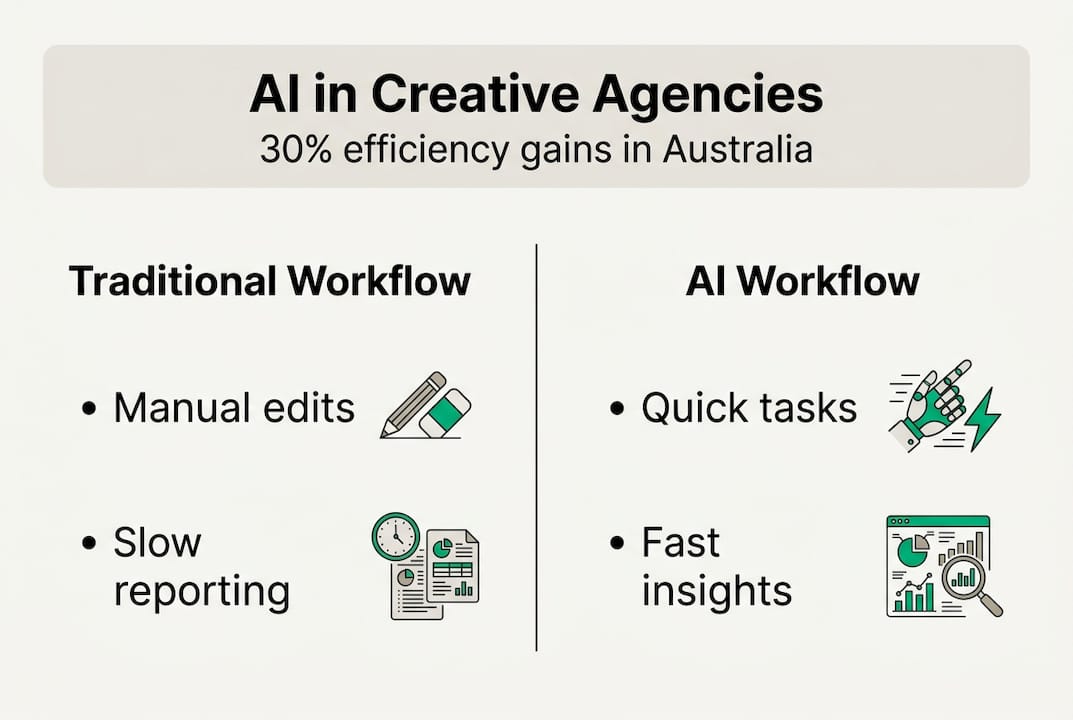
The productivity argument for AI in creative agencies is not speculative. Australia Post and BRX's 30% efficiency gain came directly from automating the commodity end of creative production, the tasks that consume hours without producing strategic value. That 30% figure is worth pausing on. For an agency team working on 10 concurrent campaigns, it effectively returns the equivalent of three campaigns worth of capacity without adding headcount.
The difference between AI-supported and traditional creative workflows is stark when you look at it side by side:
| Area | Traditional approach | AI-supported approach |
|---|---|---|
| Asset production | Manual resising and variations | Automated at scale in minutes |
| Campaign reporting | Hours of data consolidation | Near real-time dashboards |
| Audience segmentation | Analyst-built, weekly cycles | Dynamic, updated continuously |
| Client personalisation | Limited by team bandwidth | Delivered at volume with consistency |
| Brief turnaround | 2 to 5 business days | Same-day with AI-assisted templating |
For your clients, this translates directly into faster turnarounds, more personalised campaigns, and reporting that is actually useful in the meeting rather than delivered after the fact. Clients increasingly expect speed and precision, and agencies that cannot deliver both are losing pitches to those who can.

Exploring AI applications for efficiency across industries reveals a consistent pattern: the agencies and businesses seeing the most benefit are those that started with a clear problem to solve, not a tool to deploy. The tools are widely available now through AI for creative services, but the strategy behind choosing them still matters enormously.
Pro Tip: Start by mapping your team's most time-consuming weekly tasks and rank them by how much creative judgement they actually require. Any task in the bottom quartile of creative input is a strong candidate for AI automation, and that is where your first efficiency gains will come from.
Opportunities and risks: AI as amplifier or disruptor?
Not everyone in the industry is celebrating. The conversation around AI in creative agencies is genuinely divided, and both sides have points worth taking seriously.
The optimist case runs like this:
- AI removes low-value work, giving teams more time for strategic thinking and genuinely creative output
- Data-driven creativity becomes achievable without a dedicated analytics team
- Agencies can scale campaign personalisation without proportional cost increases
- New revenue streams open up as AI capabilities become a service offering in their own right
- Better targeting leads to measurably improved client results, strengthening retention
The sceptic case is less comfortable but equally real. 62% of marketers agree that AI can free humans for strategic roles, yet the same conversations surface persistent concerns: homogenisation of creative output, liability questions around AI-generated content, and the risk that cost savings pressure agencies to reduce headcount rather than reinvest in capability.
"CMOs are adopting AI more slowly than it is evolving, not because they lack interest, but because the liability, governance, and talent questions have not been answered yet."
That tension is real inside Australian agencies right now. Some leaders are moving quickly because the competitive pressure to do so feels acute. Others are deliberately cautious, waiting for clearer governance frameworks before committing significant resources. Neither position is wrong, but staying still is increasingly a decision with consequences. Understanding AI growth for SMBs shows that inaction carries its own risk profile, particularly as competitors build capability advantages that compound over time. Reviewing custom AI steps can help agencies frame adoption in a way that manages these concerns rather than ignoring them.
Implementing AI in your creative agency: steps and pitfalls
Knowing that AI works is not the same as knowing how to make it work for your specific agency. The implementation journey matters as much as the tools you choose, and agencies that skip the strategy phase tend to produce expensive pilot programmes that quietly die after six months.
Here is a sequence that works:
- Conduct a needs analysis: Map your workflows, identify where time is lost, and clarify what problem you are actually solving before selecting any technology
- Select tools with purpose: Match tools to specific use cases rather than adopting platforms because they are popular or well-marketed
- Upskill your team: AI adoption stalls when staff feel threatened or undertrained. Invest in capability building early and visibly
- Review data governance: Understand what client data can be used to train or inform AI tools, and establish clear policies before you start
- Run a bounded pilot: Test in one team or on one account type before scaling. The 30% efficiency result at Australia Post came from disciplined, targeted implementation, not a company-wide switch
- Iterate with feedback loops: Build in structured reviews so you can adjust the approach based on what your team and clients are actually experiencing
The pitfalls are predictable but still common. Agencies frequently underestimate the change management required. Staff who feel AI is being imposed on them will find ways to work around it. The AI automation explained framework is useful here: when people understand what automation actually does and does not do, resistance drops considerably. Reviewing SME AI implementation case studies reinforces how important cross-functional buy-in is at the start.
Pro Tip: Invite your most sceptical team members into the pilot design process, not just the rollout. Sceptics who co-design the experiment become your most credible internal advocates when it produces results.
Our take: Creative edge comes from strategy, not just tools
Here is the view we hold after working across Australian businesses through multiple waves of technology adoption: the agencies that win with AI are not the ones who adopted it first. They are the ones who adopted it thoughtfully.
There is a real risk that the race to be "AI-powered" becomes a race to look like every other agency. When everyone uses the same generative tools with the same default settings, the output starts to converge. Distinctiveness erodes. The clients who chose your agency for its creative voice may find themselves looking at work that could have come from anywhere.
The top AI trends transforming Australian business strategy consistently point toward the same conclusion: sustainable advantage comes from how you apply AI, not merely that you apply it. The agencies that will define Australian creative work in the next decade are those that use AI to sharpen their strategic clarity, not substitute for it. Tools change. Thinking does not.
Take your agency further with tailored AI solutions
The distance between knowing AI can improve your agency and actually making it happen is where most leaders get stuck. Choosing the right tools, managing the team transition, and maintaining client trust through the process are all real challenges that benefit from experienced guidance.
At ORVX AI, we work directly inside Australian creative agencies to identify where AI will have the most immediate impact, map the implementation path, and support your team through the change. Our approach is vendor-agnostic, which means we recommend what works for your context, not what benefits a platform partner. Explore industry-specific AI services built for Australian agencies, or visit ORVX AI to learn how a tailored strategy session could put your agency on the right track.
Frequently asked questions
What are the main benefits of using AI in a creative agency?
AI helps creative agencies save time, deliver more personalised campaigns, and focus team effort on higher-value strategic ideas. Australian agencies like Australia Post have already demonstrated 30% efficiency gains through targeted AI implementation.
Are creative jobs at risk due to AI in agencies?
Some repetitive roles may shift, but most agencies find AI amplifies human creativity rather than replacing it. In fact, 62% of marketers see AI as a tool that frees people for more strategic, higher-value work.
How should a creative agency start implementing AI?
Begin with a needs analysis to identify your biggest workflow bottlenecks, pilot relevant tools on a single account or team, train your staff, and measure results against clear benchmarks. The 30% result from Australia Post shows what disciplined, focused implementation can achieve.
Is AI expensive for small or mid-sized agencies in Australia?
AI solutions are increasingly affordable, particularly when you start with targeted pilot projects focused on clear efficiency gains. The key is matching the investment to a specific, measurable problem rather than adopting broad platforms without a defined purpose.