
TL;DR:
- Most AI projects fail due to poor planning rather than technology issues.
- A structured six-phase AI roadmap improves success and measurable outcomes.
- Addressing skills gaps, change management, and governance is crucial for scaling AI effectively.
Australian businesses are investing in AI at record rates, yet many are left wondering why results fall short of expectations. The gap between hype and reality is real, and 70% of AI projects fail because of poor planning rather than poor technology. Without a structured approach, you end up with disconnected tools, frustrated staff, and wasted budget. This article walks you through exactly what a successful AI roadmap looks like, the barriers that derail most initiatives, and the practical steps that turn investment into measurable results.
Table of Contents
- Why every Australian business needs an AI roadmap
- The six phases of a successful AI roadmap
- Common barriers and pitfalls when scaling AI
- Making AI deliver: Practical steps for Australian SMEs
- What most business leaders get wrong about AI adoption
- Take your next steps with expert help
- Frequently asked questions
Key Takeaways
| Point | Details |
|---|---|
| AI needs a roadmap | Simply adopting AI isn’t enough—Australian businesses succeed when they follow a clear, phased roadmap tailored to real goals. |
| Six-phase approach works | Phasing from opportunity to governance creates sustainable, measurable gains and avoids common pitfalls. |
| Main barriers are human | Skills gaps, privacy, change management, and leadership commitment make or break Australian AI projects. |
| SMBs: Buy, don’t build | For almost all SMBs, off-the-shelf SaaS platforms offer faster, more reliable AI results than custom solutions. |
| Measure value early | Fast-track AI success by focusing on tangible metrics like time savings, cost reduction, and operational efficiency from day one. |
Why every Australian business needs an AI roadmap
AI adoption in Australia is no longer a fringe activity. 80% of Australian businesses now use AI in some capacity, yet the outcomes vary wildly. A significant 41% report over 25% labour savings, but many others see little to no return. The difference between those two groups almost always comes down to planning.
When AI is implemented thoughtfully, the upside is substantial. Research suggests that well-executed AI could deliver up to 38% higher profitability for businesses that get it right. That is not a marginal improvement. It is a competitive shift that separates businesses that thrive from those that stagnate.
The problem is that most SMBs approach AI the wrong way. They trial a tool here, automate a task there, and call it a strategy. Without clear goals, defined processes, and a sequenced plan, these efforts rarely compound into genuine operational change. An AI strategy guide for SMEs consistently shows that businesses with formal roadmaps outperform those taking an ad hoc approach.
Here is how the two approaches compare:
| Approach | Planning | Outcomes | Risk level |
|---|---|---|---|
| Ad hoc AI adoption | Minimal | Inconsistent, often poor | High |
| Structured AI roadmap | Formal and phased | Measurable, scalable | Low to medium |
The common pitfalls of unplanned AI adoption include:
- Unclear goals: Tools get deployed without tying them to business outcomes.
- Overcomplication: Businesses attempt custom builds when off-the-shelf solutions would suffice.
- Siloed implementation: AI tools operate in isolation rather than integrating across workflows.
- No change management: Staff are not prepared, so adoption stalls regardless of how good the technology is.
A well-structured AI roadmap guide removes these risks by giving your business a clear path from first experiment to full-scale integration. The HP roadmap phases framework is one widely referenced model that Australian businesses are using to structure this journey.
The six phases of a successful AI roadmap
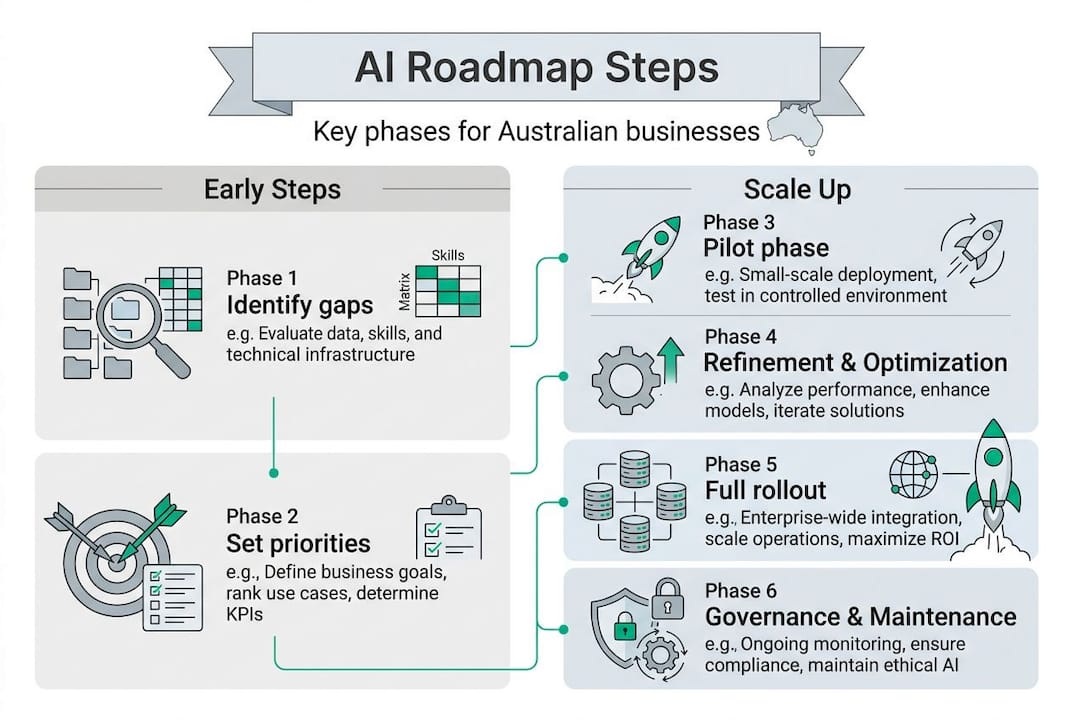
A proven six-phase AI roadmap model gives Australian businesses a repeatable structure for moving from curiosity to capability. Each phase builds on the last, and skipping any one of them significantly increases the risk of failure.
- Opportunity identification: Audit your current workflows to find where AI can add the most value. Focus on repetitive, high-volume tasks first.
- Goal setting and prioritisation: Define specific, measurable outcomes. Tie AI initiatives directly to business KPIs like cost reduction or customer response time.
- Technology selection: Evaluate tools based on your needs, not vendor hype. For most SMBs, buying SaaS products beats building custom solutions every time.
- Pilot and proof of concept: Test your chosen tools in a controlled environment. Measure results against your baseline before scaling.
- Full implementation: Roll out across the business with proper training, change management, and integration support.
- Governance and optimisation: Monitor performance, manage compliance, and continuously improve your AI systems over time.
For most Australian SMBs, completing this cycle takes around 18 to 24 months. That might sound long, but quick wins often emerge in the first 90 days when you target the right processes.
| Phase | Key activity | Typical duration |
|---|---|---|
| Opportunity identification | Workflow audit | 2 to 4 weeks |
| Goal setting | KPI alignment | 1 to 2 weeks |
| Technology selection | Vendor evaluation | 2 to 4 weeks |
| Pilot | Controlled testing | 4 to 8 weeks |
| Implementation | Rollout and training | 3 to 6 months |
| Governance | Ongoing review | Continuous |
Businesses in professional services often find the pilot phase most revealing, as it exposes integration gaps that were not obvious during planning. Following AI integration best practices during each phase reduces costly rework.

Pro Tip: Do not wait until you have the perfect data set or the ideal tech stack. Start your pilot with what you have. Imperfect action at phase four teaches you more than perfect planning ever will.
Research on readiness gaps shows that many Australian SMBs stall between phases three and four, often because they overthink technology selection. Keep it simple and move forward.
Common barriers and pitfalls when scaling AI
Knowing the phases is one thing. Getting through them without losing momentum is another. Australian SMBs face a specific set of barriers that derail even well-intentioned AI programmes.
Research reveals that 54% of growing businesses say removing AI would have little impact on their operations, which tells you that most businesses are not yet using AI in ways that truly matter. The main barriers cited include time constraints and data privacy concerns.
The most common obstacles include:
- Skills gaps: Staff do not have the knowledge to use AI tools effectively, and training is often an afterthought.
- Data privacy concerns: Uncertainty around Australian Privacy Act obligations causes hesitation, particularly when using cloud-based AI tools.
- Lack of organisational buy-in: When leadership does not champion AI adoption, middle management and frontline staff resist change.
- Legacy systems: Older infrastructure does not integrate easily with modern AI platforms, creating technical debt.
- Regional disparities: Businesses outside major cities often have limited access to skilled AI consultants and reliable connectivity.
The scaling phase is where most projects collapse. Some estimates suggest that between 70% and 95% of AI initiatives fail to scale beyond the pilot stage. Governance and change management are the two most neglected areas, yet they are the most critical for long-term success.
"Technology is rarely the reason AI projects fail. Culture, communication, and governance are the real culprits."
Regular AI audits help you catch compliance issues early and keep your systems aligned with Australian regulations. Addressing implementation hurdles proactively rather than reactively saves significant time and cost.
Pro Tip: Before you scale any AI tool, run a structured change management process. Brief your team, explain the why, and involve them in shaping how the tool fits into their daily work. Resistance drops sharply when people feel included rather than replaced.
Making AI deliver: Practical steps for Australian SMEs
Barriers are real, but they are not insurmountable. The businesses that get AI right follow a straightforward pattern: start small, measure everything, and scale what works.
The first step is identifying your easy-win use cases. Look for tasks that are:
- High volume and repetitive: Data entry, invoice processing, appointment scheduling.
- Rule-based: Processes with clear inputs and predictable outputs.
- Time-consuming but low-skill: Tasks that consume staff hours without requiring judgement.
- Already documented: Processes with existing SOPs are far easier to automate.
For high-volume, rule-based tasks, buying a SaaS solution is almost always the right call. Building custom AI is expensive, slow, and risky. Off-the-shelf tools like AI-powered CRMs, automated scheduling platforms, and document processing software deliver results in weeks, not months.
Here is a practical action plan:
- Audit your workflows this week. List every repetitive task your team performs and estimate the hours spent.
- Rank by impact. Score each task by time saved and business value delivered if automated.
- Select one tool. Choose a SaaS solution that addresses your top-ranked task. Trial it for 30 days.
- Measure against baseline. Track time saved, error rates, and cost before and after.
- Scale or pivot. If results are positive, expand the tool's use. If not, adjust your approach before moving on.
Exploring AI-driven automation options relevant to your industry will help you shortlist the right tools faster. Australian businesses across retail, logistics, and professional services are already seeing measurable savings and profitability gains from this approach.
Pro Tip: Assign a single internal champion for each AI tool you adopt. This person owns the rollout, collects feedback, and reports on results. Shared ownership usually means no ownership.
What most business leaders get wrong about AI adoption
Here is an uncomfortable truth: most AI roadmaps stall not because the technology fails, but because the business is not ready to change. Leaders focus heavily on which tools to buy and very little on how their organisation will absorb the shift.
We see this constantly. A business invests in a sophisticated AI platform, runs a successful pilot, and then watches adoption collapse because no one managed the cultural transition. The tech worked. The people did not follow.
The businesses that sustain AI gains over time share a common trait. They treat AI adoption as an organisational learning journey, not a one-off project. They celebrate small wins, build internal capability, and govern their AI systems with the same rigour they apply to financial controls.
Following AI adoption trends is useful for context, but chasing the latest tools without building stewardship is a fast path to wasted investment. Prioritise governance, invest in your people, and let the technology serve the strategy rather than define it.
Take your next steps with expert help
Building an AI roadmap that actually delivers results takes more than good intentions. It takes structured thinking, the right tools, and someone who knows your industry.
At ORVX AI, we work directly alongside Australian businesses to turn roadmaps into real outcomes. Whether you are in professional services looking to automate client workflows, or in manufacturing seeking to optimise production processes, we tailor every engagement to your specific context. Our team embeds within your business, maps your workflows, and builds a plan that fits your goals and budget. Visit ORVX AI to find out how we can help you move from planning to performance, faster.
Frequently asked questions
What is an AI roadmap and why do I need one?
An AI roadmap is a structured plan that guides how your business implements and scales AI for real results. Without one, 70% of AI projects fail due to poor planning, leading to wasted investment and missed opportunity.
How long does AI implementation typically take?
For most Australian SMBs, a complete AI roadmap takes around 18 to 24 months to fully implement, though targeted quick wins are achievable within the first 90 days.
What are the most common barriers to successful AI in SMBs?
The most common barriers are skills gaps, data privacy concerns, limited time, and poor change management. Addressing these proactively is essential before scaling.
Should I build my own AI tools or use off-the-shelf solutions?
For nearly all Australian SMBs, buying AI SaaS solutions is faster, less risky, and more cost-effective. 99% of SMBs are better served by proven off-the-shelf products than custom builds.
How can I measure if AI is delivering real value?
Track labour savings, cost reduction, and workflow efficiency against your pre-AI baseline. Businesses seeing strong results report over 25% labour savings once AI is properly embedded in their operations.