
TL;DR:
- Business process automation uses software and AI to streamline repetitive and complex tasks across departments.
- Australian SMBs save time, cut costs, and achieve high ROI by automating high-volume, rule-based processes.
- Successful automation requires understanding processes first, redesigning workflows, and involving staff to avoid common pitfalls.
Business process automation is not a luxury reserved for corporations with massive IT budgets. Business process automation isn't limited to large enterprises, and Australian SMBs are already proving it, saving tens of thousands of dollars and hundreds of hours each year with targeted, practical automation. Whether you run a small law firm in Brisbane, a trades business in Perth, or an allied health practice in Melbourne, the opportunities are real and the payback is fast. This guide breaks down exactly what business process automation means, how it works, where it delivers the biggest wins, and the mistakes to avoid on your way in.
Table of Contents
- What is business process automation and how does it work?
- Key benefits of business process automation for Australian SMBs
- Core steps to successfully automate your business processes
- Common pitfalls, risks, and how to avoid failed automation projects
- Why the smartest SMBs in Australia balance automation with the human touch
- Ready to streamline your business? Unlock the benefits of BPA with ORVX AI
- Frequently asked questions
Key Takeaways
| Point | Details |
|---|---|
| Automate for efficiency | Business process automation can free up dozens of hours each week for Australian SMBs. |
| Target quick ROI | The best BPA projects break even in less than 6 months and deliver 300–500% returns. |
| Start with high-impact areas | Focus on time-consuming, rule-based processes like invoicing, onboarding, or admin. |
| Balance tech and people | Blending automation with human insight drives the best results and avoids costly errors. |
What is business process automation and how does it work?
Business process automation (BPA) is the use of software and AI to streamline core business operations, removing the need for humans to manually handle repetitive, rule-based tasks. Think of it as giving your team's most tedious work to a tireless digital colleague who never misses a step. Where simple task automation handles a single action (like sending a confirmation email), BPA goes further.
According to Gartner's definition, BPA automates complex processes spanning multiple departments using AI, connecting people, systems, and data in ways that manual workflows simply cannot match. The IBM definition of BPA reinforces this, noting that true BPA integrates across business functions rather than just speeding up individual steps.
It helps to understand the three levels:
| Type | What it does | Example |
|---|---|---|
| Task automation | Automates a single, discrete action | Auto-sending invoice emails |
| Workflow automation | Connects multiple steps in a sequence | New client onboarding across CRM, email, and documents |
| End-to-end process automation | Automates complete business flows across departments | Order processing from purchase to fulfilment and accounting |
BPA is also different from two commonly confused cousins:
- BPM (Business Process Management): A methodology for designing, monitoring, and improving processes. Think of it as the strategy layer above automation.
- RPA (Robotic Process Automation): Software robots that mimic human clicks and keystrokes, ideal for repetitive screen-based tasks. RPA is a tool that often sits inside a broader BPA approach.
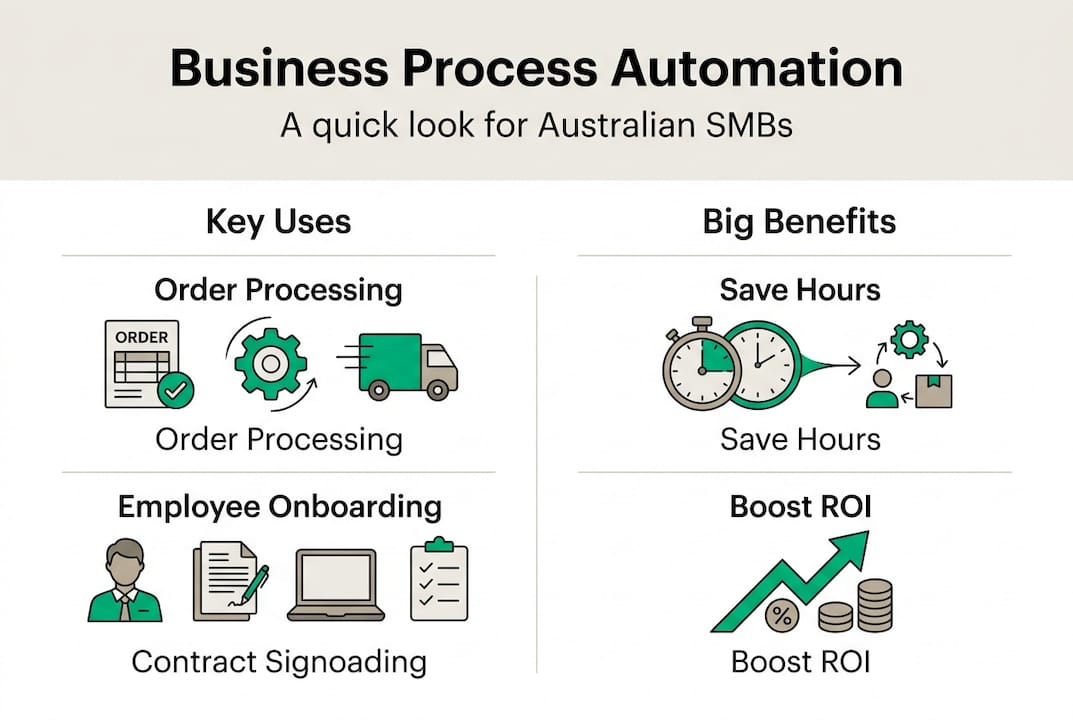
Practical examples relevant to Australian SMBs include automated order processing, employee onboarding, stock and inventory management, document generation, and compliance reporting. The AI advantages for SMBs from integrating these tools extend well beyond time savings, touching on accuracy, scalability, and staff satisfaction. For real-world context, exploring business automation examples shows how varied these wins can be across industries.
Key benefits of business process automation for Australian SMBs
The numbers are striking. Australian sector data shows that law firms save 28 hours weekly, construction firms save $92,000 per year, and accounting firms save 42 hours per week through targeted BPA. These are not outliers. They reflect what happens when well-chosen processes get automated properly.

Beyond hours saved, the financial case is compelling. SMBs that implement BPA well achieve 300 to 500% ROI and break even within one to six months. That is a faster payback than most equipment purchases or marketing campaigns.
Here is how the benefits break down across Australian sectors:
| Sector | Key benefit | Typical gain |
|---|---|---|
| Law and legal | Document drafting, matter management | 28 hours saved per week |
| Accounting | Reconciliation, reporting, client comms | 42 hours saved per week |
| Construction and trades | Quoting, scheduling, compliance docs | $92,000 saved per year |
| Allied health | Appointment booking, billing, recalls | Reduced admin by up to 60% |
| Retail and eCommerce | Inventory, order fulfilment, returns | Faster cycle times, fewer errors |
The top benefits, in order of impact for most Australian SMBs:
- Time savings: Staff focus on work that actually requires human judgement.
- Cost reduction: Fewer manual hours means lower labour costs and less overtime.
- Error reduction: Automated processes follow rules precisely, cutting costly mistakes.
- Scalability: Handle more volume without hiring proportionally more staff.
- Compliance: Consistent process execution reduces regulatory risk.
For professional services firms, the case is especially strong. Businesses in AI in professional services are adopting automation faster than almost any other sector in Australia right now. The accounting automation case study from FlowWorks illustrates just how transformative the right tools can be for a firm that moves decisively. Across industry AI applications, the pattern is consistent: early movers win.
Core steps to successfully automate your business processes
Understanding the benefits is one thing. Making automation happen is another. Here is exactly how to get started and avoid classic mistakes.
Best practice involves assessing needs, mapping processes, piloting, deploying, and monitoring KPIs as the proven sequence for successful BPA. Research into AI automation steps confirms that businesses skipping the early assessment and mapping stages consistently struggle with adoption and ROI.
Here is the five-step approach we recommend:
- Assess your business needs. Identify the processes consuming the most time or generating the most errors. Prioritise high-volume, repetitive, rule-based tasks where manual handling adds little value.
- Map the process and clarify goals. Document every step of the current process before touching any software. Set measurable targets: reduce invoice processing time by 50%, cut onboarding errors to zero, and so on.
- Select tools and run a pilot. Choose tools that fit your stack. AI platforms, RPA tools, and iPaaS (integration platforms) each suit different needs. Run a small pilot with real data before committing to a full rollout.
- Deploy at scale and manage change. Involve your team early. Staff who understand why a process is changing and have input into how it works will adopt it far faster. Change management is not optional.
- Monitor, review, and iterate. Set KPIs before you go live and review them at 30, 60, and 90 days. Automation is not a set-and-forget exercise.
For a structured approach to broader digital change, the AI implementation steps guide covers how to sequence technology decisions well. And AI integration best practices is worth reading before you lock in any vendor.
Pro Tip: Target your first automation at a process with a clear, measurable output. Quick wins build internal confidence and give leadership the evidence needed to fund larger projects.
Common pitfalls, risks, and how to avoid failed automation projects
Even with the best intentions, many automation efforts fail. Here is how to spot danger before it derails your project.
The single most important insight is uncomfortable but true: automation amplifies process flaws, and 80% of AI failures come from poor process design, not poor technology. If your invoicing process is messy when done manually, automating it will produce messy invoices faster. Speed is not the same as improvement.
Beyond process design, SMBs face distinct risks including governance gaps, over-automation, data quality issues, and scalability problems that emerge once volume increases. These are not hypothetical risks. They show up regularly when businesses rush implementation.
The most common pitfalls to watch for:
- Automating broken processes: Fix the workflow first, then automate it.
- Ignoring data quality: Garbage in, garbage out. Clean your data before automation touches it.
- Skipping proper testing: Pilot with realistic data volumes and edge cases, not just best-case scenarios.
- Over-automating customer interactions: Removing human contact from complaint handling or complex enquiries damages relationships and trust.
- Resistance to change: Teams not involved in the design phase often find ways to work around new systems.
Mitigation starts with process redesign, followed by a phased rollout and genuine staff training. An AI roadmap guide can help you sequence decisions and avoid the governance gaps that trip up so many SMBs. For additional framing, the BPA pitfalls resource from Camunda is a practical reference.
Pro Tip: Never automate a process you haven't fully documented and redesigned. Digitising chaos just makes chaos faster.
Why the smartest SMBs in Australia balance automation with the human touch
Here is an opinion that might surprise you: more automation is not always better. The most successful Australian businesses we work with are not the ones that automated the most. They are the ones that automated wisely, keeping humans in the loop where it matters.
Automation should amplify your team's strengths, not replace the judgment, empathy, and relationship-building that customers in Australia actually value. A tradie who sends automated job confirmations and invoices still earns repeat business because of trust built on-site, not software. A financial adviser whose client onboarding is seamlessly automated still wins referrals because of genuine conversations, not efficiency metrics.
The businesses that struggle are often those that chased cost reduction by removing human touchpoints from sensitive interactions. Customer service, dispute resolution, and complex sales all require human nuance. Compliance in Australian regulated industries carries real personal liability too, so human oversight is not just good practice, it is essential.
Look at AI adoption strategies that embed automation as a support layer rather than a replacement layer. The result is scalable, personalised service that actually strengthens your team's impact rather than diluting it.
Ready to streamline your business? Unlock the benefits of BPA with ORVX AI
BPA is genuinely accessible to Australian SMBs in 2026, and the ROI case has never been stronger. Getting started well makes all the difference between a project that delivers and one that stalls.
ORVX AI works hands-on with Australian businesses across professional services, construction and trades, and a broad range of industries to map processes, identify automation opportunities, and pilot solutions that deliver measurable results quickly. We are vendor-agnostic, locally based, and focused entirely on what works for your specific business. If you are ready to start your automation journey with expert support, visit ORVX AI to learn how we can help you move from audit to implementation with confidence.
Frequently asked questions
What types of business processes should Australian SMBs automate first?
Start with high-volume, repetitive, rule-based tasks like invoicing, onboarding, and reporting where rapid ROI is achievable. These processes have clear inputs and outputs, making automation straightforward and measurable.
How quickly can automation deliver ROI for small businesses?
Many SMBs see full payback in one to six months, with 300 to 500% ROI common for well-chosen automation projects. The key is selecting processes with high volume and clear success metrics from the outset.
What is the main risk with poorly implemented automation?
Automating broken processes often amplifies errors, and 80% of failures stem from poor process design rather than technology failure. Always redesign the process before you automate it.
How does BPA differ from RPA and BPM?
BPA covers end-to-end business flows, BPM manages the overall process lifecycle and improvement strategy, while RPA handles individual tasks within those processes using software robots. Each has its place, and they often work together.