TL;DR:
- Australian SMEs underestimate AI-powered business intelligence's accessibility and practical benefits for their operations.
- AI-driven BI automates data analysis, detects patterns, and provides real-time insights that save time and enhance decision-making.
- Successful adoption depends on deliberate implementation, quality data, and understanding which tasks require human judgment.
Most Australian small and medium business owners assume that AI-powered business intelligence (BI) belongs in the boardrooms of ASX-listed companies, not in a tradie's back office or a suburban retail shop. That assumption is costing them real money. The technology has shifted dramatically in the past three years, and today's AI-driven BI tools are built with scalability in mind, meaning a business turning over $2 million can now access the same quality of insight that once required a dedicated data science team. This article cuts through the confusion and gives you a practical, grounded view of what business intelligence AI actually is, what it can do for your operation, and where you still need to keep humans in the loop.
Table of Contents
- What is business intelligence AI?
- How business intelligence AI benefits SMEs
- Where AI-powered BI should (and shouldn't) replace human judgement
- How to get started with business intelligence AI
- Why 'plug-and-play' claims about AI business intelligence sometimes miss the mark
- Explore tailored business intelligence AI for your industry
- Frequently asked questions
Key Takeaways
| Point | Details |
|---|---|
| Not just for large firms | Business intelligence AI now delivers measurable value to Australian SMEs of all sizes. |
| Balance AI with human insight | AI automation can boost efficiency but important decisions still need human review. |
| Start small for big wins | Pilot projects in reporting or cash flow can return fast, reliable results. |
| Best practices multiply ROI | Adopting proven AI integration steps can double the return on investment for SMEs. |
What is business intelligence AI?
Business intelligence AI is the application of artificial intelligence to the process of collecting, organising, analysing, and presenting business data. Traditional BI tools, think spreadsheets and static dashboards, require a human to set up the reports, decide what to measure, and interpret the results. AI-driven BI does much of that heavy lifting automatically. It can spot patterns you would have missed, surface anomalies before they become problems, and even predict what is likely to happen next week based on historical trends.
The practical difference matters enormously for SME owners. Traditional BI tells you what happened. AI-driven BI tells you what is happening right now, flags what looks unusual, and suggests what might happen next.
Traditional BI vs. AI-driven BI at a glance:
| Feature | Traditional BI | AI-driven BI |
|---|---|---|
| Reporting speed | Manual, scheduled | Real-time or automated |
| Pattern detection | Human-led | Automated anomaly alerts |
| Forecasting | Basic trend lines | Predictive modelling |
| Data volume | Limited by analyst capacity | Scales with your data |
| Setup effort | High, ongoing | Lower after initial setup |
| Cost model | Fixed software licence | Often usage-based or SaaS |
Core features you will commonly see in AI-BI platforms suited to SMEs include:
- Automated dashboards that refresh in real time without manual data entry
- Predictive analytics that forecast sales, demand, or cash flow based on your historical data
- Anomaly detection that flags unusual spikes or drops in revenue, stock levels, or customer behaviour
- Natural language queries that let non-technical staff ask questions like "what was my best-selling product last month?"
- Recommendation engines that suggest actions, such as which customers to follow up with or which stock to reorder
AI is genuinely powerful in these structured, data-heavy tasks. However, as professionals working closely with AI for professional services firms and other industries have observed, vendor marketing often runs ahead of reality. The practical question, as noted in an important InfoWorld analysis, is which AI-BI tasks are accurate enough for decisions and which should remain human-reviewed, especially for numeric results and explanatory "why" claims. Not every AI output is ready to be acted on without a second glance.
How business intelligence AI benefits SMEs
Once you understand what the technology does, the next question is straightforward: what does it actually do for my business? The short answer is that it saves time, reduces costly errors, and helps you act on opportunities before your competitors even notice them.
Faster reporting cycles. A business owner who used to spend three hours on a Monday morning pulling together last week's sales figures can automate that entirely. AI-BI platforms can consolidate data from your point-of-sale system, your accounting software, and your inventory management tool into a single dashboard, updated overnight or even in real time. That is three hours returned to revenue-generating activity every single week.
Early risk and trend detection. Imagine your AI-BI tool notices that a particular product line's return rate has quietly doubled over the past fortnight. Without automation, that pattern might not surface until it appears in a quarterly review. With AI, you get an alert within days, giving you time to investigate the cause and act before the problem compounds.
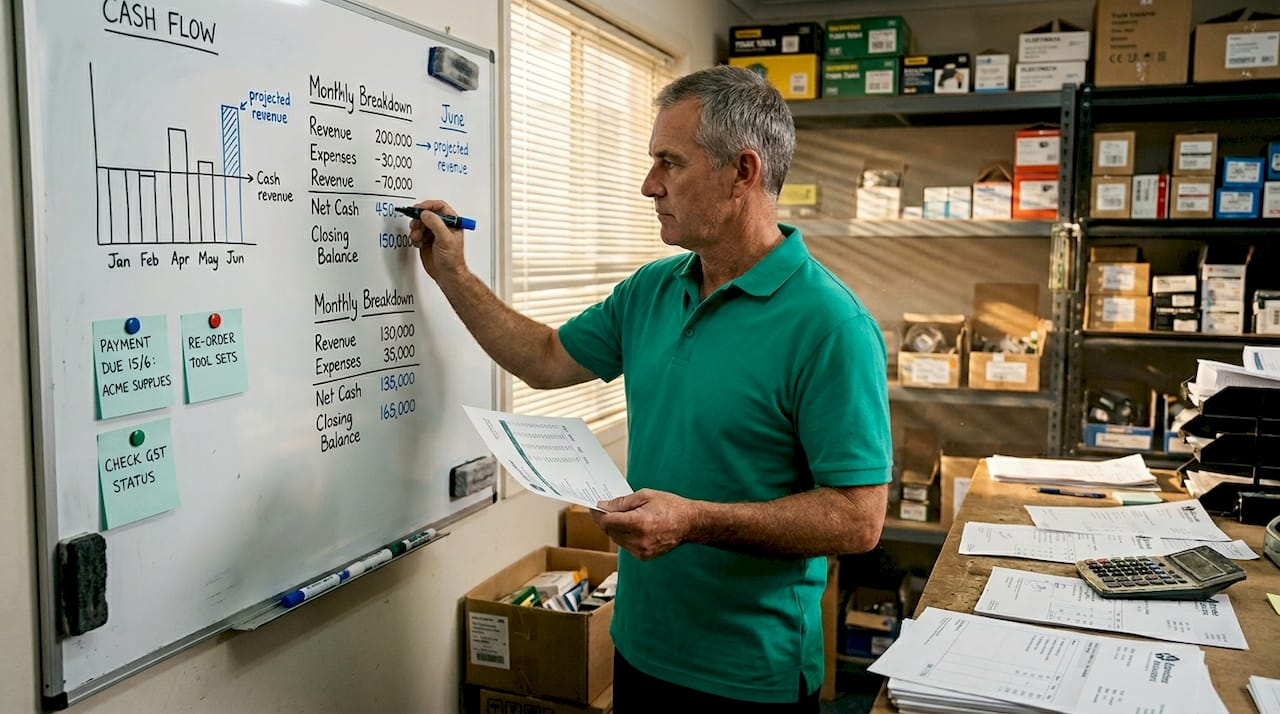
Improved cash flow management. Cash flow is the number one stressor for most Australian SMEs. AI-powered forecasting tools can model your likely cash position 30, 60, or 90 days out based on your receivables, your upcoming payables, and your historical seasonal patterns. That kind of forward visibility used to require a financial controller. Now it is available in a subscription tool.
Better customer targeting. AI-BI can segment your customer base automatically, identifying your highest-value clients, your at-risk churners, and the customers most likely to respond to a specific promotion. For a retail business or a professional services firm, that precision can meaningfully lift conversion rates without increasing marketing spend.
Reduced manual work and reporting errors. Manual data entry introduces mistakes. AI-BI platforms pull data directly from source systems, eliminating transcription errors and reducing the administrative burden on your team.
These outcomes are not hypothetical. AI applications for efficiency across industries show that AI-powered BI adoption lets SMEs improve efficiency, cut costs, and make faster decisions. Pair that with SME AI success tips and you have a clear pathway to genuine, measurable results.
Statistic: Businesses that successfully integrate AI into their operations report efficiency improvements of up to 111%, underscoring why Australian SMEs are increasingly exploring these tools.
Pro Tip: Do not try to fix every data problem at once. Pick one measurable outcome, such as cost per job in a trades business or lead conversion rate in a professional services firm, and let the AI-BI tool prove its value there before expanding its scope.
Where AI-powered BI should (and shouldn't) replace human judgement
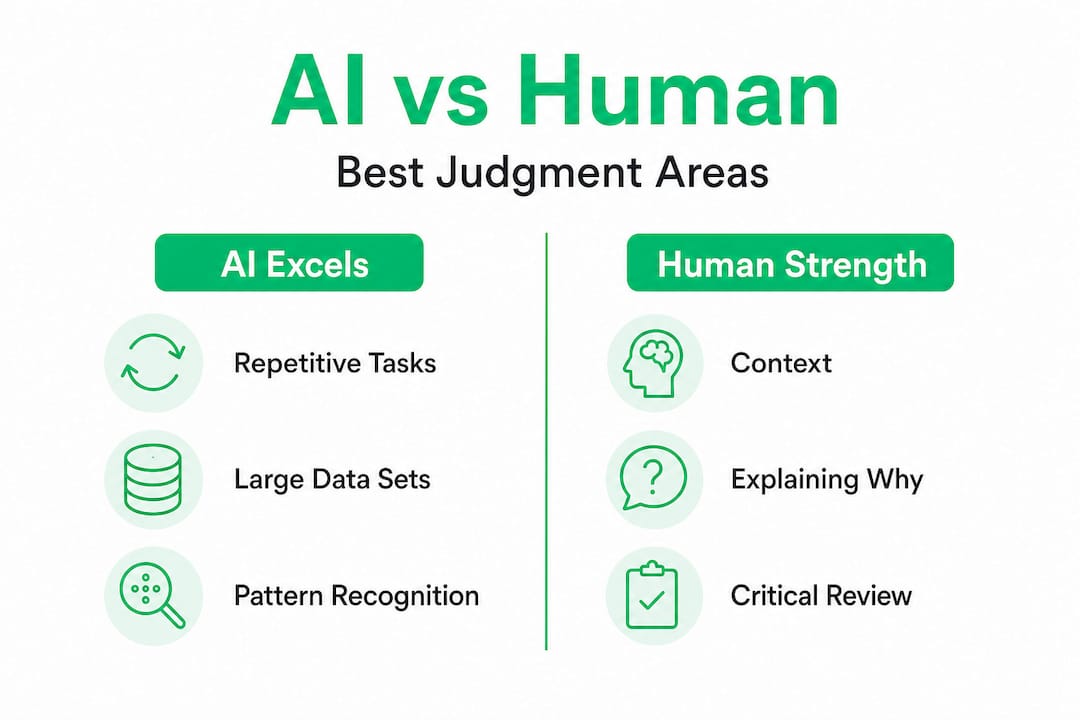
This is where many AI rollouts go wrong. Business owners either automate too little, leaving obvious efficiency gains on the table, or automate too much, trusting AI outputs for decisions that genuinely need human context and experience.
AI excels at tasks that are repetitive, structured, and data-rich. It struggles with tasks that require contextual knowledge, ethical judgement, or an understanding of factors that do not appear in your data set. A new local competitor opening down the road, a regulatory change, or a sudden shift in customer sentiment following a public event will not always show up in your historical data quickly enough for the AI to factor it in.
AI-suited vs. human-retain tasks for Australian SMEs:
| Business task | AI-suited | Human-retain |
|---|---|---|
| Weekly sales reporting | Yes | No |
| Cash flow forecasting | Mostly | Review critical outputs |
| Anomaly detection in stock | Yes | Alert then human verifies |
| Strategic pricing decisions | Inform only | Human decides |
| Customer segmentation | Yes | Human validates segment logic |
| Responding to market disruption | No | Yes |
| Identifying underperforming staff | AI flags patterns | HR and manager review |
| Setting annual business strategy | No | Yes |
The key lesson from practical AI automation pitfalls work is that automation works best when it handles the volume so humans can focus on the judgement calls.
"The practical question is which AI-BI tasks are accurate enough for decisions and which should remain human-reviewed, especially for numeric results and explanatory 'why' claims." — InfoWorld
Pro Tip: Until you have at least three to six months of live data running through your AI-BI tool, treat all its numeric outputs and trend explanations as a starting point for investigation, not a final answer. Build trust gradually.
The "why" is particularly important here. AI can tell you that your Tuesday afternoon sales dropped 22% last month. It cannot reliably tell you why without additional context, structured data inputs, or human investigation. Treating an AI-generated explanation as fact before verifying it is one of the most common mistakes SME owners make during early adoption.
How to get started with business intelligence AI
Knowing the theory is one thing. Taking the first practical step is another. Here is a workable sequence that has helped Australian SMEs get started without overcommitting resources or creating disruption.
-
Audit your current data landscape. Before you can build anything, you need to know what data you already have and where it lives. Sales data, customer records, inventory logs, and financial reports are the most common starting points. Map them out and assess their quality. Poor-quality data in means poor-quality insight out.
-
Identify your highest-value problem to solve. The easiest wins are usually in reporting and anomaly detection. Ask yourself: what decision do I currently make slowly because I lack timely data? That is your starting point.
-
Consult with an AI provider familiar with the Australian SME context. Generic offshore solutions often miss the nuances of local compliance requirements, industry-specific workflows, and the scale constraints that Australian SMEs operate under. A local, vendor-agnostic adviser will recommend tools that fit your actual situation rather than the most popular global platform.
-
Set clear goals and key performance indicators (KPIs) for your pilot. A KPI is a specific, measurable target, for example, "reduce weekly reporting time by four hours" or "increase lead-to-sale conversion rate by 10% within 90 days." Without a defined target, it is impossible to evaluate whether the AI-BI investment is working.
-
Run a focused pilot project. Pilot means small and controlled. Start with one data stream, one report type, or one department. An AI-powered sales report for your top 20 customers is a manageable pilot. A full business-wide intelligence overhaul in month one is not.
-
Manage the change with your team. The biggest underestimated risk in AI-BI rollouts is not the technology. It is the people. Staff who feel threatened by automation or confused by new dashboards will not use them. Invest in brief, practical training and involve team members in the pilot so they feel ownership rather than displacement.
Following AI integration best practices consistently delivers up to 50% higher ROI for Australian SMEs compared to unstructured rollouts. Pairing that disciplined approach with clear custom AI implementation steps designed for local business conditions makes the difference between a project that stalls and one that delivers.
Statistic: SMEs that follow structured AI integration frameworks consistently achieve better return on investment than those that adopt tools without a clear implementation plan.
Why 'plug-and-play' claims about AI business intelligence sometimes miss the mark
Here is an uncomfortable truth that the AI industry does not advertise loudly: most "plug-and-play" AI-BI solutions are plug-and-play only if your business already has clean, consistent, well-structured data. For most Australian SMEs, that is not the reality.
We have worked alongside businesses across retail, hospitality, trades, and professional services. The single most common stumbling block is not the AI itself. It is the years of inconsistent data sitting in spreadsheets, legacy accounting systems, and paper-based records that need to be cleaned, standardised, and connected before any AI tool can make sense of it. A platform that promises instant dashboards still needs coherent data to draw from.
The other overpromise that surfaces regularly is around explanatory intelligence, specifically the AI's ability to tell you why something happened. As highlighted by InfoWorld's analysis, vendor marketing can overpromise here. The AI may surface a plausible-sounding explanation that is statistically correlated but contextually wrong for your specific business.
The SMEs that get the best results from AI-BI are not the ones who moved fastest. They are the ones who moved deliberately. They started with one clear problem, ran a genuine pilot, validated the outputs against human knowledge, and then expanded scope incrementally. That iterative approach is less exciting than a full transformation story, but it is far more reliable.
A practical AI strategy for SMEs built on honest assessment of your data maturity, realistic timelines, and genuine team involvement will consistently outperform a top-down technology-led change programme. The technology is genuinely capable. The question is always whether your business is ready to use it well.
Explore tailored business intelligence AI for your industry
Every industry has different data, different pain points, and different opportunities. A one-size-fits-all approach to AI-BI rarely delivers the specific outcomes that Australian SMEs need.
At ORVX AI, we work directly with business owners to understand their workflows before recommending any tool or platform. Whether you are in retail managing inventory across multiple locations, in manufacturing tracking production yield and waste, or in trades and construction trying to get a cleaner picture of cost-per-job and project margins, we build AI-BI solutions that fit your actual operation. Our Australian-based team embeds with your business, maps your current processes, and designs a roadmap that starts with quick wins and grows with your confidence in the technology. If you are ready to move beyond spreadsheets and guesswork, we are the right partner to get you there.
Frequently asked questions
How is business intelligence AI different from basic reporting tools?
Business intelligence AI goes beyond static reports by automating pattern recognition and predictive analysis, surfacing insights that basic reporting tools require a human analyst to identify manually.
Can small businesses afford business intelligence AI?
Yes. Modern AI-BI solutions are designed to scale, so you can start with a focused, low-cost pilot. As shown in SME efficiency research, the efficiency and cost savings achieved often outweigh the investment within months.
What data do I need to use business intelligence AI?
You need your core business data, such as sales records, inventory figures, or customer interaction logs, in digital format. Cloud-based connectors can link most modern accounting and point-of-sale systems without requiring a technical team.
Are there risks when automating business decisions with AI?
Absolutely. Always review critical outputs manually because AI can make mistakes with numeric results or produce explanations that sound plausible but miss important business context.
How quickly can I see results with business intelligence AI?
Many SMEs notice measurable efficiency and insight gains within a few weeks of launching a focused pilot project. According to SME adoption data, structured pilots with clear KPIs deliver the fastest, most reliable early results.