
TL;DR:
- Many small businesses mistakenly view AI as a luxury for larger firms, but it can significantly cut admin hours and improve efficiency. Practical AI tools automate workflows, generate content, analyze customer data, and handle routine inquiries, especially when integrated into core operations with human oversight. Starting small with targeted use cases, measuring results, and seeking expert support enables SMEs to leverage AI effectively for tangible business benefits.
Most small business owners assume AI is a luxury reserved for tech giants with dedicated innovation teams and million-dollar budgets. That assumption is costing them real time and real money. Across Australia, small and medium businesses are quietly using AI to cut admin hours, handle customer enquiries overnight, and generate content that used to take days. A Brisbane allied health practice showed measurable admin-time savings when AI outputs were structured and reviewed by humans. This guide breaks down exactly what AI means for your business, what stops most owners from getting started, and how to move forward with confidence.
Table of Contents
- What AI really means for small businesses
- Common barriers and how to overcome them
- A step-by-step approach to AI success
- Real-world impact: case studies and lessons for Aussies
- Why the real AI advantage is all about tailored integration
- How to get expert support for your AI journey
- Frequently asked questions
Key Takeaways
| Point | Details |
|---|---|
| Integration trumps tools | The real value of AI for small businesses comes from integrating it into workflows, not just using new software. |
| Overcome common barriers | Address skills, data, and compliance challenges with training and measured pilots, not by rushing adoption. |
| Start with a pilot | Select one high-impact, measurable use case to pilot AI, then track results before expanding. |
| Human oversight boosts trust | AI delivers best results when outputs are reviewed by staff for quality and compliance. |
What AI really means for small businesses
Let's clear something up straight away. When people say "AI for small business," they're not talking about robots or science fiction. They're talking about software that learns from patterns and automates decisions that used to require human effort every single time.
For a small business owner, AI shows up in several practical forms:
- Workflow automation: Automatically routing enquiries, scheduling appointments, or triggering follow-up emails without manual input
- Content generation: Drafting product descriptions, social posts, or client proposals in seconds
- Customer insights: Analysing purchase history or website behaviour to suggest what a customer might need next
- Document processing: Extracting key data from invoices, contracts, or medical forms without someone reading every page
- Chatbots and virtual assistants: Handling common customer questions around the clock, freeing your staff for complex tasks
The critical point here is that AI value for SMBs depends far more on how deeply you integrate it into your operations than on simply signing up for the latest tool. Downloading an AI app and occasionally asking it to write an email is not transformation. Embedding AI into your quoting process, client onboarding, or inventory management so it runs automatically every single day — that's where the real gains are.
The OECD identifies four key enablers that determine whether SMEs actually benefit from AI: connectivity (reliable digital infrastructure), data (having clean, organised business data), skills (staff who know how to work with AI tools), and finance (access to funds for implementation and training). Most small businesses already have more of these than they realise. The gap is usually strategy, not resources.
For businesses in professional services, AI is already reshaping how proposals are written, how client files are managed, and how billing is tracked. The same logic applies whether you're running a legal practice, a financial planning firm, or a trade business quoting jobs.
Common barriers and how to overcome them
Understanding AI is one thing. But what's really stopping most small businesses from moving forward? Let's tackle the common roadblocks head-on.
Skills shortages, finance constraints, integration complexity, data privacy, and legal compliance issues are the most frequently cited barriers for SMEs considering AI adoption. These aren't small concerns, and pretending otherwise does no one any favours.
Research from the JPMorgan Chase Institute highlights that non-adopters are particularly worried about reliability, data privacy, and legal or compliance risks. In other words, it's not apathy holding businesses back. It's reasonable caution.
"Simply using AI tools is not enough to generate business transformation. Lasting improvement requires skills development, implementation support, and a foundation of trust — particularly around compliance and data handling."
Here's a practical breakdown of the most common barriers and what you can realistically do about them:
| Barrier | Why it matters | Practical solution |
|---|---|---|
| Skills shortage | Staff don't know how to use or manage AI tools | Start with short targeted training for one or two team members |
| Integration complexity | AI tools don't connect cleanly to existing software | Choose tools with native integrations or use a middleware platform |
| Data privacy concerns | Worry about customer data leaving secure environments | Use locally hosted or Australian-data-residency solutions |
| Legal and compliance risk | Unclear liability when AI makes errors | Establish human review checkpoints for all AI outputs |
| Upfront cost | Budget constraints delay investment decisions | Start with low-cost or free-tier tools on a single use case |
| Lack of trust in AI accuracy | Fear of wrong outputs causing business problems | Pilot on low-stakes tasks and validate results before scaling |
The strategies for overcoming AI barriers that tend to work best are not complicated. They involve picking one problem, testing a solution, and reviewing results honestly before expanding.
The same insight applies to AI adoption strategies for Australian SMEs: incremental progress beats an all-or-nothing approach every time. Businesses that try to automate everything at once almost always encounter problems with data quality, staff resistance, or mismatched tools.
Pro Tip: Don't try to solve five problems with five AI tools in your first three months. Pick the one workflow that wastes the most time and address that first. Once you've got a working result and your team is comfortable, layer in the next use case.
A step-by-step approach to AI success
Armed with knowledge about what gets in the way, here's a proven roadmap to start and scale your AI journey successfully.
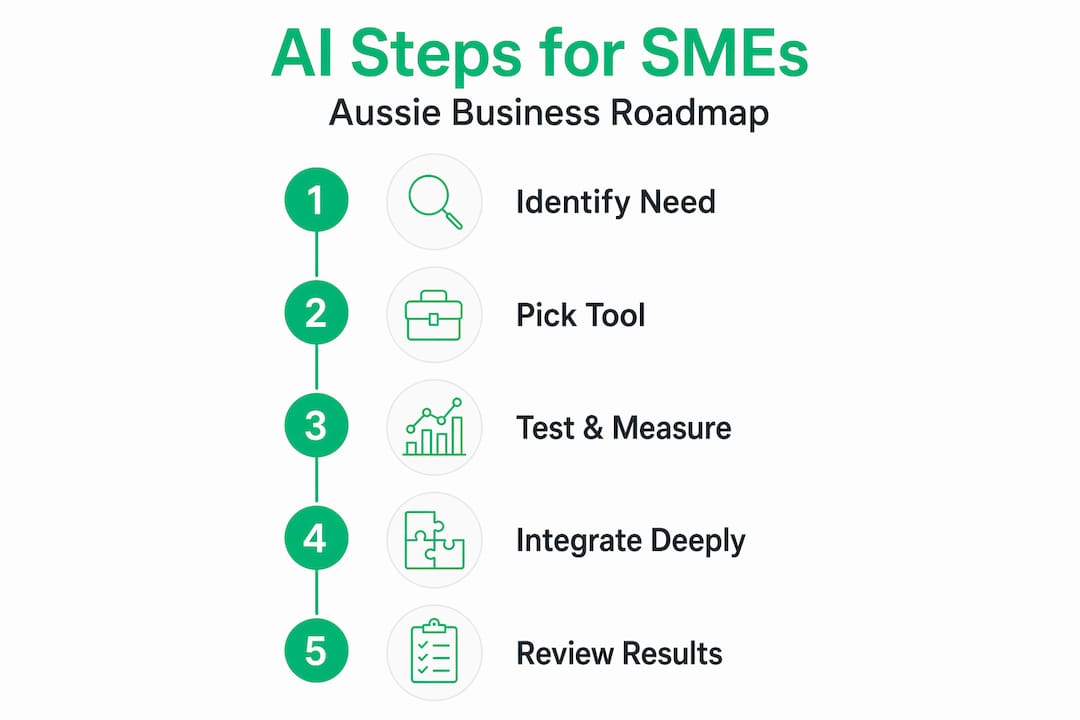
Treating AI as workflow automation is the most practical frame for small business owners. You're not building a technology business. You're automating a specific task that currently takes human effort, and you're measuring whether it actually works.
Here's a clean, sequential process that removes guesswork:
-
Define the outcome you want. Don't start with "I want to use AI." Start with "I want to reduce the time my team spends on appointment reminders by 80%." Specific outcomes are measurable. Vague goals are not.
-
Choose one use case and only one. Identify the single workflow that wastes the most time, generates the most errors, or creates the most friction for your customers. Common starting points include: responding to routine customer enquiries, generating first drafts of proposals or reports, or sorting and tagging incoming documents.
-
Set up the pilot in under two weeks. Most AI tools designed for small business can be configured and tested quickly. You don't need a developer. You need a willing team member, a clear use case, and a 14-day testing window.
-
Measure results against your defined outcome. Track time saved, error rate before and after, or customer response time. Don't just ask "did it seem to work?" Ask "what changed in the numbers?"
-
Review, refine, then expand. If results are positive, expand the same tool to a related workflow or introduce a second use case. If results are mixed, diagnose why before moving forward. Poor data, unclear instructions, or the wrong tool are the usual culprits.
Following AI integration best practices also means building human review into your process from day one, especially for anything customer-facing or compliance-sensitive.
Here's how this looks across different business types:
| Business type | AI use case | Measurable outcome |
|---|---|---|
| Trades (plumbing, electrical) | Automated job quoting and follow-up | 30% reduction in time to send quotes |
| Retail | AI-powered product recommendations | 15% increase in average order value |
| Healthcare or allied health | Automated appointment reminders and intake forms | 40% reduction in no-shows |
| Professional services | AI-assisted document drafting | 50% faster first-draft preparation |
| Hospitality | Chatbot handling booking enquiries | 60% of routine enquiries resolved without staff |

Each of these outcomes is measurable within 30 to 60 days, which is exactly the window recommended for an honest assessment. The AI operations guide for Australian SMBs digs deeper into how to structure these workflows so they stick.
Pro Tip: Always track AI ROI in terms of time saved, errors reduced, and revenue impact — not just the cost of the tool subscription. A $100-per-month AI tool that saves your team 10 hours a week pays for itself in the first day.
Real-world impact: case studies and lessons for Aussies
These aren't just theories. Australian businesses are already seeing strong results from targeted AI adoption. Let's look at what actually works.
The Brisbane allied health case is one of the clearest examples available. This practice implemented AI-assisted admin tools for appointment scheduling, patient intake documentation, and compliance reporting. The result was a significant reduction in admin hours per week. Crucially, admin-time savings were real and measurable because the practice kept human review in the loop for every AI-generated output, particularly for compliance-sensitive documents. That human oversight layer was not a bottleneck. It was what made the system trustworthy.
Other practical examples Australian small businesses are using right now include:
- CRM automation: Automatically logging customer interactions, triggering follow-up tasks, and segmenting customers by behaviour without manual data entry
- Customer service chatbots: Handling frequently asked questions on websites and social media channels outside business hours, reducing inbound call volume
- Document generation: Creating contracts, reports, and proposals from templates using AI that fills in client-specific details automatically
- Lead qualification: Scoring and routing incoming leads based on their behaviour and enquiry content before a human sales conversation even starts
- Invoice and receipt processing: Extracting line items and amounts from uploaded documents for automatic entry into accounting systems
"The businesses getting the best results are not the ones with the most AI tools. They're the ones who paired AI outputs with clear human quality checks, especially in regulated or client-facing contexts."
The AI transformation outcomes for SMEs are most consistent when implementation is deliberate and outcomes are defined before deployment, not after. And CRM AI case studies from Australian SMBs show that even modest automation of customer relationship tasks can free up several hours per week per team member, which compounds significantly over a full year.
The lesson from every successful case is the same: start small, measure honestly, keep humans accountable for outputs, and expand only what works.
Why the real AI advantage is all about tailored integration
Here's a view you won't hear often enough: the biggest AI mistakes small businesses make have nothing to do with choosing the wrong tool. They come from adopting AI without first understanding how it needs to fit into their specific workflows, team structure, and regulatory context.
There's enormous pressure right now to "get on board with AI" before competitors do. That pressure leads businesses to subscribe to tools they never fully configure, run pilots with no defined success criteria, and declare AI "didn't work" after a few weeks of muddled results. The tools weren't the problem. The integration was.
OECD research confirms that many businesses either fail to integrate AI into their core operations at all, or they encounter serious friction around trust, compliance, and skills development. Simply "using AI" does not translate into measurable operational transformation without genuine implementation support.
The advice to "just try every new tool" is seductive because it feels low-risk. It isn't. Every tool you introduce without a clear integration plan adds complexity, drains staff attention, and creates data governance questions you may not be equipped to answer.
What actually works is a different approach entirely. Understand your workflow first. Identify where time is wasted, where errors occur, or where customer experience breaks down. Then find the AI solution that fits that specific gap, rather than looking for gaps to justify a tool you've already decided to use.
Australian businesses also operate in a specific regulatory context. Privacy law, industry-specific compliance requirements, and data sovereignty concerns mean that the same AI solution that works for a US-based business may need significant adjustment before it's appropriate here. That context matters and it's one reason why locally grounded implementation advice is worth seeking out. Business intelligence AI is a good example of a category where Australian data handling requirements genuinely shape which tools and configurations are suitable.
The businesses that win with AI are not the fastest adopters. They're the most deliberate ones.
How to get expert support for your AI journey
If you're ready to move from confusion to clarity, the right support can mean the difference between a tool that sits unused and a system that saves your business hours every week.
Navigating AI adoption on your own is genuinely difficult, especially when skills, integration complexity, and compliance concerns are all in play at once. ORVX AI is an Australian consultancy that embeds directly with your team to understand your specific workflows, identify the highest-value AI opportunities, and manage implementation from pilot to full deployment. There are no templated packages. Every strategy is built around your business.
If you're in the trades, industry-specific AI solutions for trades businesses can help you automate quoting, job scheduling, and follow-up communication in ways that fit how your business already operates. For professional services firms, AI solutions for professional services cover everything from document automation to client onboarding and CRM intelligence. Book a consultation with the ORVX AI team to get a clear, actionable plan built for your business.
Frequently asked questions
What are the biggest risks of using AI in small business?
The main risks include data privacy breaches, compliance failures, skill gaps that lead to misuse, and poorly integrated tools that create more work than they save. OECD research consistently identifies these as the core blockers for SME adoption.
How do I measure if AI is working for my business?
Track concrete outcomes for your first use case over 30 to 60 days, specifically time saved per week, reduction in error rates, or revenue changes directly linked to the automated process. A practical SMB approach is to define your success metric before you launch the pilot, not after.
What's the first step toward using AI in my small business?
Identify one specific workflow that is time-consuming, repetitive, and measurable, then test a single AI tool against that task. Starting with one use case and validating results before expanding is the most reliable path forward.
Are there grants or resources for Australian small businesses adopting AI?
Australian SMEs can access guidance through bodies like the Australian Small Business Advisory Services and state-based digital business programmes, though direct AI-specific grants vary by industry and funding period. Checking with your industry association is a practical first step.
Does AI replace my staff or help them work better?
AI delivers the best results when it handles repetitive tasks and frees your staff to focus on higher-value work, particularly when humans review AI-generated outputs. The Brisbane allied health case is a clear example of AI augmenting staff capability rather than replacing it.