
TL;DR:
- AI helps Australian SMBs save significant time on repetitive tasks like inquiries, admin, and bookings.
- Successful AI adoption requires problem-focused planning, quality data, stakeholder buy-in, and pilot testing.
- Ongoing measurement and iterative strategies are vital for maintaining ROI and expanding AI's impact.
If you're spending hours each week on manual admin, chasing invoices, or answering the same customer enquiries over and over, you're not alone. Most Australian small and medium businesses are haemorrhaging time on tasks that AI can handle in seconds. The good news is that the technology is no longer reserved for large enterprises with deep pockets. In 2026, practical AI tools are accessible, affordable, and delivering measurable results for businesses across every industry. This guide walks you through what AI can actually do for your operations, how to prepare properly, and how to verify the results once you're up and running.
Table of Contents
- Understanding AI's operational impact in Australian SMEs
- Key prerequisites: Preparing your business for AI
- Step-by-step: Implementing AI to optimise core operations
- Measuring results: How to verify ROI, productivity, and efficiency gains
- Our take: What most guides miss about AI optimisation
- Explore tailored AI solutions for your business
- Frequently asked questions
Key Takeaways
| Point | Details |
|---|---|
| AI drives rapid ROI | Australian SMBs can realise operational improvements in under a year with the right AI strategies. |
| Focus on pain points | Successful businesses target AI at their biggest operational hassles first, then expand. |
| Measure what matters | Productivity, cost, and time metrics show the clearest results from AI optimisation. |
| Incremental wins are key | Small, well-deployed AI pilots outperform large, generic implementations. |
| Support is available | Industry-specific AI services help businesses overcome common adoption barriers. |
Understanding AI's operational impact in Australian SMEs
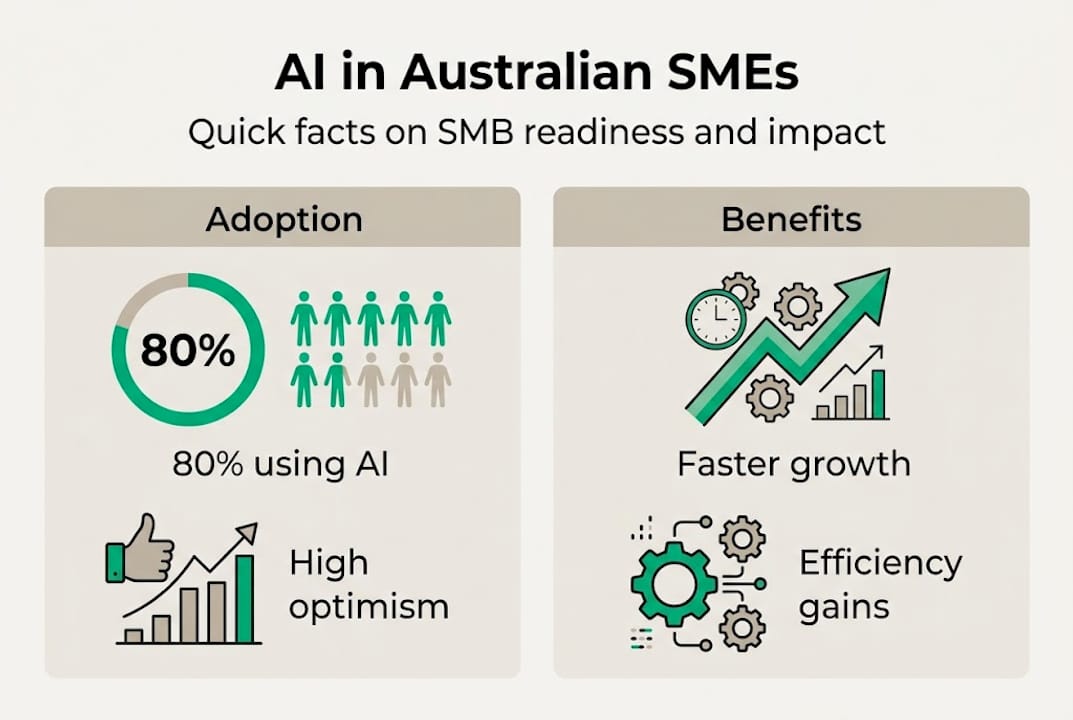
The numbers tell a compelling story. AI adoption rates show 80% of Australian SMBs are now using AI in some capacity, and 41% of those businesses report saving more than 25% of their labour time. Western Australia leads the country, with 22% of SMB owners saving more than half their working hours through AI tools. These aren't marginal gains. They represent real hours returned to business owners who can reinvest that time into growth, client relationships, or simply leaving the office at a reasonable hour.
The AI readiness optimism among SMB owners is high, with many recognising AI's potential even before they've fully adopted it. The gap between optimism and action is where most businesses get stuck, and it's usually because they don't know where to start.
Here's a snapshot of what AI is delivering for Australian SMBs right now:
| Use case | Typical outcome | Estimated monthly cost |
|---|---|---|
| AI chatbot for enquiries | 80% enquiry handling automated | ~AU$50 |
| Admin automation | 25%+ labour time saved | AU$38 to AU$80/user |
| After-hours bookings | 15% new bookings captured | Included in chatbot cost |
| Document processing | Hours per week reclaimed | Varies by tool |
A Cairns dive operator implemented an AI chatbot and achieved 80% of enquiries handled automatically, with setup taking just two days and running at roughly AU$50 per month. They also captured 15% more bookings from after-hours enquiries that would previously have gone unanswered. That's a direct revenue gain from a modest investment.
Key operational areas where AI is making an impact for Australian SMBs:
- Customer enquiries and bookings via AI chatbots
- Invoice processing and accounts admin through automation
- Scheduling and rostering with intelligent tools
- Data analysis and reporting replacing manual spreadsheet work
- Email triage and response drafting using large language models
The AI advantages for SMBs are broad, but the businesses seeing the best results are those targeting specific, high-friction tasks rather than trying to automate everything at once. Understanding AI investment benefits before you begin helps you set realistic expectations and build a solid business case internally.
Key prerequisites: Preparing your business for AI
Before you install a single tool, preparation matters more than most guides admit. A study of 583 Australian SMEs found that 64.7% had adopted AI, with an average ROI achieved in just 8.8 months. The defining success factors weren't budget or tech sophistication. They were a problem-first approach and the right partnerships.
That finding is worth sitting with. Businesses that started by identifying a specific operational problem, rather than chasing the latest tool, consistently outperformed those that adopted AI for its own sake.
Here's how to assess your readiness before moving forward:
- Data quality: Do you have clean, accessible data for the processes you want to automate?
- Skills baseline: Can your team learn new tools, or will you need external support?
- Compliance awareness: Are you across Australian Privacy Act obligations for customer data?
- Process clarity: Can you describe the workflow you want to improve in plain language?
- Budget realism: Have you factored in setup, training, and ongoing subscription costs?
One of the most important decisions you'll make is whether to build internal capability or work with an external partner. Both paths have merit, but they suit different situations.
| Approach | Best for | Risk level | Speed to results |
|---|---|---|---|
| Internal capability | Larger teams with tech skills | Lower long-term | Slower |
| External AI partner | SMBs needing fast, tailored results | Lower short-term | Faster |
| Hybrid model | Businesses wanting knowledge transfer | Balanced | Moderate |
Generic, off-the-shelf AI solutions often disappoint because they're built for the average business, not yours. Bespoke implementation, guided by someone who understands your specific workflows, consistently delivers better outcomes. The AI implementation steps for Australian SMEs differ meaningfully from global templates, particularly around compliance, local integrations, and industry-specific workflows. Reviewing AI adoption strategies tailored to the Australian context helps you avoid the common pitfalls.
Pro Tip: Don't try to automate your entire business in one go. Pick the single highest-friction task in your week, the one that costs you the most time or money, and start there. A focused win builds confidence and proves the model before you scale.
Step-by-step: Implementing AI to optimise core operations
With your preparation done, here's how to move from planning to live implementation without derailing your team or your budget.
- Define the problem precisely. Write down the specific task, how long it takes, who does it, and what a successful outcome looks like. Vague goals produce vague results.
- Select the right tool for that task. Match the tool to the problem, not the other way around. Don't adopt a platform because it's popular; adopt it because it solves your defined problem.
- Map the existing workflow. Document every step of the current process before you change anything. This gives you a baseline to measure against and helps identify integration points.
- Build stakeholder buy-in. Talk to the staff who will use the tool before you implement it. Resistance to change is the most common reason AI projects stall. Involve people early.
- Run a pilot with real data. Test the tool on a limited scope, one team, one location, or one process, before rolling it out broadly.
- Measure against your baseline. Track time saved, errors reduced, and cost per task. Compare directly to your pre-implementation numbers.
- Iterate and expand. Once the pilot proves value, document what worked and replicate it across other areas.
A Brisbane allied health practice offers a clear example of this approach in action. They used ChatGPT to automate NDIS clinical notes and cut admin by one third, saving 4 to 5 hours per week at approximately AU$38 per user per month. The key was that they started with one specific, painful task rather than trying to overhaul their entire practice management system.
Pro Tip: Before committing to a full rollout, run a two-week pilot and track results daily. Small issues are easy to fix in a pilot. They become expensive after a full deployment.
The AI implementation benefits compound over time as your team builds confidence and your processes become more refined. Exploring AI industry applications relevant to your sector also helps you identify use cases you may not have considered.

Measuring results: How to verify ROI, productivity, and efficiency gains
Implementing AI without measuring the outcome is like renovating a shop and never checking if sales improved. Measurement is what separates businesses that get lasting value from those that abandon tools after a few months.
According to AJG Australia's 2026 benchmarking, 63% of businesses have operationalised AI, with an average of 28 months to full ROI and 86% reporting a positive productivity impact. That ROI timeline is longer than many expect, which is why measuring early indicators matters.
"57% of revenue-growing Australian SMBs use AI weekly, yet 54% say their operations would be unaffected if AI disappeared tomorrow." This gap, identified in a Xero survey of 500 AU SMBs, reveals that many businesses are using AI superficially rather than integrating it into core workflows.
Here are the metrics you should be tracking from day one:
| Metric | How to measure | Target benchmark |
|---|---|---|
| Time saved per task | Before/after time logs | 25%+ reduction |
| Labour cost per process | Hours x hourly rate | Meaningful reduction in 90 days |
| Error rate | Manual audit of outputs | Reduction vs. baseline |
| Customer response time | CRM or booking system data | Sub-5-minute response |
| Revenue from new channels | After-hours bookings, leads | Trackable uplift |
The same Xero survey found that privacy concerns affect 42% of SMBs and time availability blocks 23%. These barriers are real, but they're also manageable with the right support structure in place.
Following AI integration best practices helps you build measurement into your process from the start rather than retrofitting it later. For service-based businesses, understanding AI in professional services provides sector-specific benchmarks that are more relevant than general statistics.
Review your metrics monthly for the first six months. Look for trends, not just snapshots. A tool that saves 20 minutes per day in month one might save 45 minutes by month three as your team gets faster and the workflow matures.
Our take: What most guides miss about AI optimisation
Most AI guides focus on the technology. We focus on the business problem. That distinction matters more than any tool selection.
The businesses we see struggle most with AI adoption are the ones that started with a platform and worked backwards to find a use for it. The ones that succeed start with a painful, specific operational problem and then find the simplest tool that solves it. That sounds obvious, but the pressure to adopt the latest AI product means many SMB owners skip this step entirely.
There's also a persistent myth that AI implementation is a one-time project. It isn't. The businesses extracting genuine value treat AI as an ongoing practice, reviewing what's working, retiring what isn't, and expanding into new areas as confidence builds. Building an AI strategy with this iterative mindset from the start changes everything.
Finally, change management is consistently underestimated. Your team's willingness to use a tool determines its ROI more than the tool's features. Invest time in people, not just platforms.
Explore tailored AI solutions for your business
If you've read this far, you're serious about making AI work for your business rather than just experimenting with it. That's exactly the mindset that produces results.
At ORVX AI, we work directly with Australian SMBs across trades, manufacturing, warehousing, and beyond to identify where AI will deliver the fastest, most meaningful impact. Whether you're in AI for trades, exploring AI for manufacturing, or looking at AI for warehousing, we build bespoke solutions around your actual workflows, not generic templates. Get in touch with our team to start with a no-obligation operational audit and find out exactly where AI can save you time and money.
Frequently asked questions
How quickly can Australian SMBs see ROI from AI solutions?
ROI timelines vary significantly by sector and use case. A study of 583 SMEs found an average of 8.8 months, while AJG's 2026 benchmarking puts the average closer to 28 months for fully operationalised AI, making early measurement critical.
What types of operational tasks are best optimised with AI?
AI delivers the strongest results in repetitive, rule-based tasks. 80% of enquiries can be handled automatically via chatbots, and data analysis leads adoption at 60% of SMBs, making admin, bookings, and reporting the highest-value starting points.
What are the main barriers to AI adoption for small businesses?
The most common barriers are time, privacy, and skills. Privacy concerns affect 42% of Australian SMBs, while 40% report no measurable results yet due to skills and data gaps. Addressing these early with the right support makes adoption far smoother.
Where can I find tailored AI solutions for my industry?
ORVX AI provides specialist AI tools and strategies for trades, health, retail, warehousing, manufacturing, and more, all built around your specific operational needs rather than off-the-shelf packages.